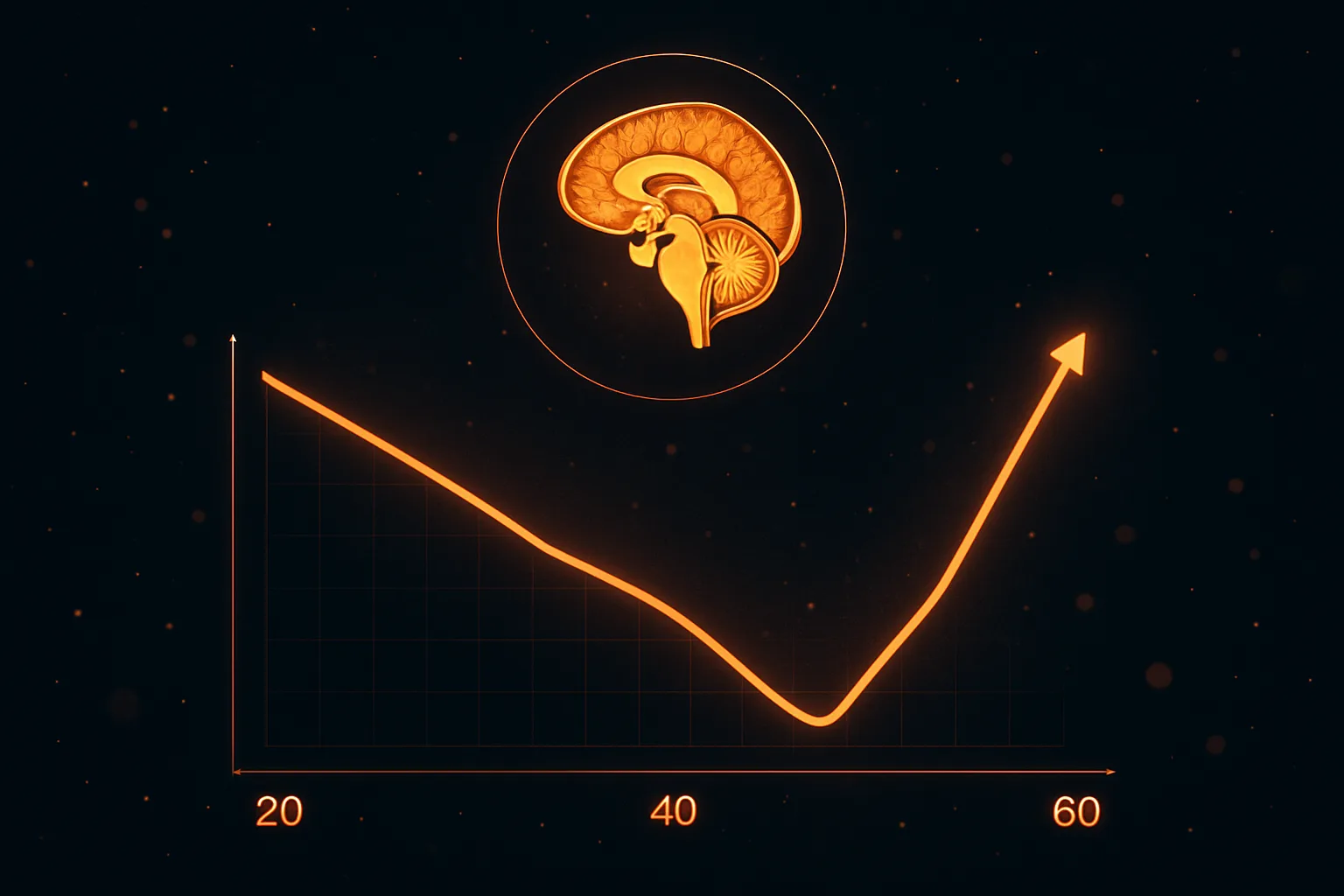
For readers searching "best peptides for muscle over 40," the short answer published research and community sources commonly describe is this: growth hormone output peaks in late adolescence and falls roughly 14% per decade after age 30. By 50, the body produces about half the GH it made at 20, and IGF-1 follows the same trajectory. This is the physiological driver trial data and community sources describe as underlying the over-40 muscle story — sarcopenia, visceral fat accumulation, slower recovery, and reduced training response.
Research-context information only. Peptides discussed below are research compounds. Protocols, doses, and reactions reported come from published research and self-reported community sources. This article reports what has been documented, not what should be done. Consult a licensed physician for personal medical decisions.
Evidence at a glance
Peptides covered below, sorted by clinical evidence strength. Each peptide also carries a parallel community-evidence grade reflecting real-world adoption. How we grade evidence.
Doubles GH AUC when stacked with a GHRP in healthy adults.
The direct intervention community sources commonly describe is restoring pulsatile GH release through GHRH+GHRP peptide stacks. Published research describes a GHRH analog (sermorelin, CJC-1295, tesamorelin) priming the pituitary while a GHRP (ipamorelin, GHRP-2) triggers release. The combined pulse is described in published clinical research as 2-3x larger than either peptide alone.
This guide ranks the six peptides community sources most commonly describe for over-40 users, in the order experienced users typically reach for them. Each entry explains what trial data and community usage describe for that compound, who typically chooses it, and what self-reported community outcomes look like. Dosing detail, injection timing, and bloodwork live in the linked deep-dive guides.
The Rankings
Bac Water Made for Peptides
Don't risk a $300 peptide on generic bac water.
Most cloudy reconstitutions trace back to one thing — and it isn't the peptide. Sterile, non-pyrogenic, 0.9% benzyl alcohol — formulated for peptide reconstitution, not repackaged from generic stock.
✓ 0.9% benzyl alcohol✓ Made for peptides✓ 30 mL multi-dose
1. CJC-1295 + Ipamorelin (Blend) — the over-40 canonical stack
Best for: over-40 lifters looking for the most commonly chosen entry point and best cost-per-effect.
Community sources most commonly describe CJC-1295 + ipamorelin (the no-DAC blend) as the over-40 default. CJC-1295 without the DAC modification is a modified GRF(1-29) with a roughly 30-minute effective half-life — long enough in published pharmacokinetic data to produce a meaningful GH pulse when paired with a GHRP, short enough to preserve the pulsatile rhythm of natural GH release. A single trial-protocol injection in healthy adults raised GH 2-10x and IGF-1 1.5-3x in published research.
Paired with ipamorelin, the stack produces a clean synergistic pulse. Trial data describe ipamorelin as the most selective GHRP — releasing growth hormone without meaningful cortisol, ACTH, or prolactin elevation. That selectivity is what published research describes as making pre-bed dosing compatible with normal sleep architecture, which community sources commonly describe as particularly important for over-40 users whose sleep quality is already declining.
Community reports on CJC + ipa for over-40 users cluster around three themes: better sleep within 1-2 weeks, fuller-looking muscles around week 4-6, and gradual fat loss alongside slow recomposition by week 8-12. Self-reported community timelines describe slower onset than younger users typically describe, but a similar end-state trajectory. The most common community caveat is that effects are described as subtle relative to tesa + ipa — community sources describe tesa as producing larger body-composition shifts at higher costs.
2. Sermorelin + Ipamorelin — the conservative starting stack
Best for: users over 50 or anyone wanting the gentlest, most-established GHRH on this list.
Community sources commonly describe sermorelin + ipamorelin as the conservative on-ramp for over-40 users new to GH peptides. Sermorelin is the original synthetic GHRH(1-29) — the gentlest GHRH on this list and the one with the longest clinical track record. Published research describes sermorelin as having been FDA-approved for pediatric GH deficiency before that approval was withdrawn for commercial reasons (not safety findings). Its roughly 10-minute half-life means each pulse is smaller per dose than CJC-1295 or tesamorelin in published pharmacokinetic data — which community sources describe as a feature for cautious starters.
Paired with ipamorelin, the stack still produces a synergistic pulse — just a smaller one than CJC + ipa. Community sources commonly describe over-50 users settling on sermorelin + ipamorelin as the long-term default, while younger over-40 users typically graduate from sermorelin to CJC + ipa after a first successful cycle.
Community reports for sermorelin + ipa cluster around subtle sleep improvements, gradual recovery improvements, and modest body-composition shift over longer time horizons. Users in community sources who switch from sermorelin to CJC + ipa typically describe a noticeable difference in the magnitude of effect, while others self-report running sermorelin long-term without issue.
3. Tesamorelin + Ipamorelin — the premium recomp stack
Best for: over-40 users with central obesity prioritizing body recomposition over budget.
Tesamorelin + ipamorelin is the stack many over-40 community users describe graduating to once they've experienced lower-tier GH peptides. Tesamorelin is the most clinically-tested compound on this list — the only GHRH analog with phase III randomized trial data behind it. A 26-week phase III trial in patients with abdominal fat accumulation reported daily tesamorelin reducing visceral fat by roughly 15-18% and raising IGF-1 about 80% versus placebo. A follow-up published analysis of the same trials reported tesamorelin also increased truncal lean muscle area while decreasing intramuscular fat.
For over-40 users with the most common aging body-composition pattern (central obesity, reduced lean mass), community sources commonly describe this as the highest-leverage stack. Cost is the trade-off: community sources describe tesa + ipa as roughly 1.5-2x the per-cycle cost of CJC + ipa.
Community reports on tesa + ipa for over-40 users cluster around three themes: visible waist-tightening within 4-6 weeks, deeper sleep within the first week, and improved between-session recovery. The most common complaints in community sources are cost and occasional injection-site sensitivity attributed to tesamorelin specifically.
4. MK-677 (Ibutamoren) — the oral option for older adults
Best for: over-50 users without glucose issues who want a no-injection protocol with the strongest age-specific evidence.
MK-677 is the only oral compound on this list with strong published evidence in older adults specifically. The Nass 2008 RCT in Annals of Internal Medicine studied adults aged 60-81 and reported 1.6 kg fat-free mass gain over 12 months versus placebo — the most direct trial evidence on this list for the over-60 population. Published research describes MK-677 as activating the same ghrelin receptor as the GHRPs but in pill form, taken once daily in trial protocols.
The side-effect profile is what published research and community sources commonly describe as keeping MK-677 from ranking higher for over-40 users specifically. Trial data document fluid retention in weeks 1-6 (described as more pronounced than community sources describe in younger users) and a measurable rise in fasting blood glucose. Community-recommended protocols for older users describe HbA1c monitoring at weeks 8 and 12 as non-negotiable, particularly for users with prediabetes or diabetes family history.
Community reports cluster around faster sleep onset, fuller-looking muscles, and improved recovery — alongside the consistent water-retention and appetite caveats. Trial data and community sources describe the oral convenience as the primary draw, with the side-effect profile as the documented trade-off.
Best for: over-40 users already on a GHRH from a clinic who need a compatible GHRP.
Solo ipamorelin for over-40 muscle is uncommon in community usage — published research describes the ghrelin-receptor pulse on its own as smaller than the combined GHRH+GHRP pulse. The use case community sources commonly describe is over-40 users already prescribed sermorelin or tesamorelin from a telehealth clinic who need to add the GHRP half to complete the stack.
Ipamorelin's documented advantage is the absence of off-target effects: trial data describe no cortisol spike, no prolactin bump, no aggressive appetite increase, and no impact on sleep architecture. Community sources commonly describe this clean profile as particularly relevant for over-40 users where sleep quality is already a concern.
Community feedback in self-reported sources is consistent: over-40 users on a GHRH-only protocol who add ipamorelin commonly describe a real step up in sleep quality and recovery within the first week.
Best for: experienced over-40 users who've already optimized GH output and want a downstream tool.
IGF-1 LR3 doesn't go through the GH pathway at all — published research describes it as IGF-1 itself, modified to last longer in the body, injected directly. That makes it conceptually simple (skip the brain, act on the muscle directly) and practically more complex. Documented risks include hypoglycemia, because trial data describe IGF-1 as cross-activating the insulin receptor at high doses. Community sources commonly describe meal-timing inconsistency as making this risk more relevant for over-40 users specifically. Trial protocols and community guidance describe keeping fast-acting carbs accessible and warn against combining IGF-1 with exogenous insulin without medical supervision.
For most over-40 users researching peptides for muscle, community sources describe IGF-1 LR3 as well past the point of diminishing returns. Its niche in community usage is the experienced user who has already maxed out a GHRH+GHRP stack, has clean labs, and wants additional tools — at which point self-reported community protocols describe a low-dose IGF-1 LR3 phase as occasionally added.
Community reports cluster around three themes: vivid hand and forearm pumps within hours, durable strength gains over 4-6 weeks, and the consistent caution that hypoglycemia onsets faster than first-time users describe expecting.
Community usage and trial-evidence patterns map cleanly onto reader profiles. Here's how the picks above tend to break down across over-40 audiences:
First-time GH-peptide users over 40 with a cautious approach commonly choose sermorelin + ipamorelin. Published research describes sermorelin as the gentlest GHRH on this list and the one with the longest safety record.
Typical over-40 lifter with moderate budget commonly chooses CJC-1295 + ipamorelin. Community sources describe this as the canonical stack — strongest cost-per-effect ratio and the most widely available blend.
Over-40 users with central obesity prioritizing recomposition commonly choose tesamorelin + ipamorelin. Phase III trial data describe the strongest evidence for combined visceral-fat reduction and lean-mass preservation.
Users who can't or won't inject commonly choose MK-677. Trial data describe the strongest age-specific evidence for older adults, with the documented water-retention, appetite, and glucose-drift profile as the trade-off.
Over-40 users already running a GHRH from a telehealth clinic commonly add solo ipamorelin to complete the synergistic stack.
Experienced over-40 users who've already maxed a base GHRH+GHRP cycle sometimes layer IGF-1 LR3 on top as an advanced tool. Community usage describes this as a 4-6 week add-on, not a base protocol.
Women over 40 commonly use the same compounds at 70-80% of the male dose. Tesamorelin's phase III trials included both sexes, and community sources describe the same general decision tree as applying.
What Trial and Community Data Describe as Signals of Effect
Three signals appear consistently in published research and community sources for over-40 users, in this order:
Weeks 1-2: Sleep changes first. Trial subjects and community sources commonly describe falling asleep faster, sleeping deeper, and reporting more vivid dreams within the first 1-2 weeks of GH peptide use. Community guidance treats absence of any sleep shift by day 14 as a flag for under-dosing, product degradation, or injection-timing issues. For over-40 users specifically, community sources commonly describe this sleep shift as the first reliable signal the protocol is working.
Weeks 4-8: Bloodwork. IGF-1 is the most-tracked biomarker in trial protocols and community guidance for over-40 users. Published research describes a working GHRH+GHRP stack raising IGF-1 30-60% from baseline; lower than that suggests under-dosing or product issues. Trial data describe IGF-1 increases above 60% as the dose-reduction threshold most clinical protocols use. Trials also commonly tracked fasting glucose and HbA1c at 8-12 weeks because GH opposes insulin, and a subset of trial subjects developed measurable glucose elevation. Community sources describe over-40 users as needing closer glucose monitoring than younger users because age-related drift makes baseline shifts easier to miss.
Weeks 6-12: Visible body composition. Trial subjects and community sources commonly describe waist tightening, fuller-looking muscles, and improved between-session recovery in this window. Trial-reported lean-tissue gains in trained subjects on a full secretagogue cycle have typically clustered around 2-4 lb. For over-40 users, self-reported community timelines describe the trajectory as the same as younger users but slightly slower in onset. Trial data does not support claims of steroid-scale transformations from secretagogue stacks alone.
Running GH peptides without bloodwork over 40 is what community sources commonly describe as missing the diagnostic signal. The trial-and-community standard is baseline IGF-1 plus fasting glucose, HbA1c, lipid panel, fasting insulin, total and free testosterone (men), TSH, free T4, PSA (men over 45), and hs-CRP — that's how trial protocols measured efficacy and what community sources commonly treat as the minimum monitoring set for older users specifically.