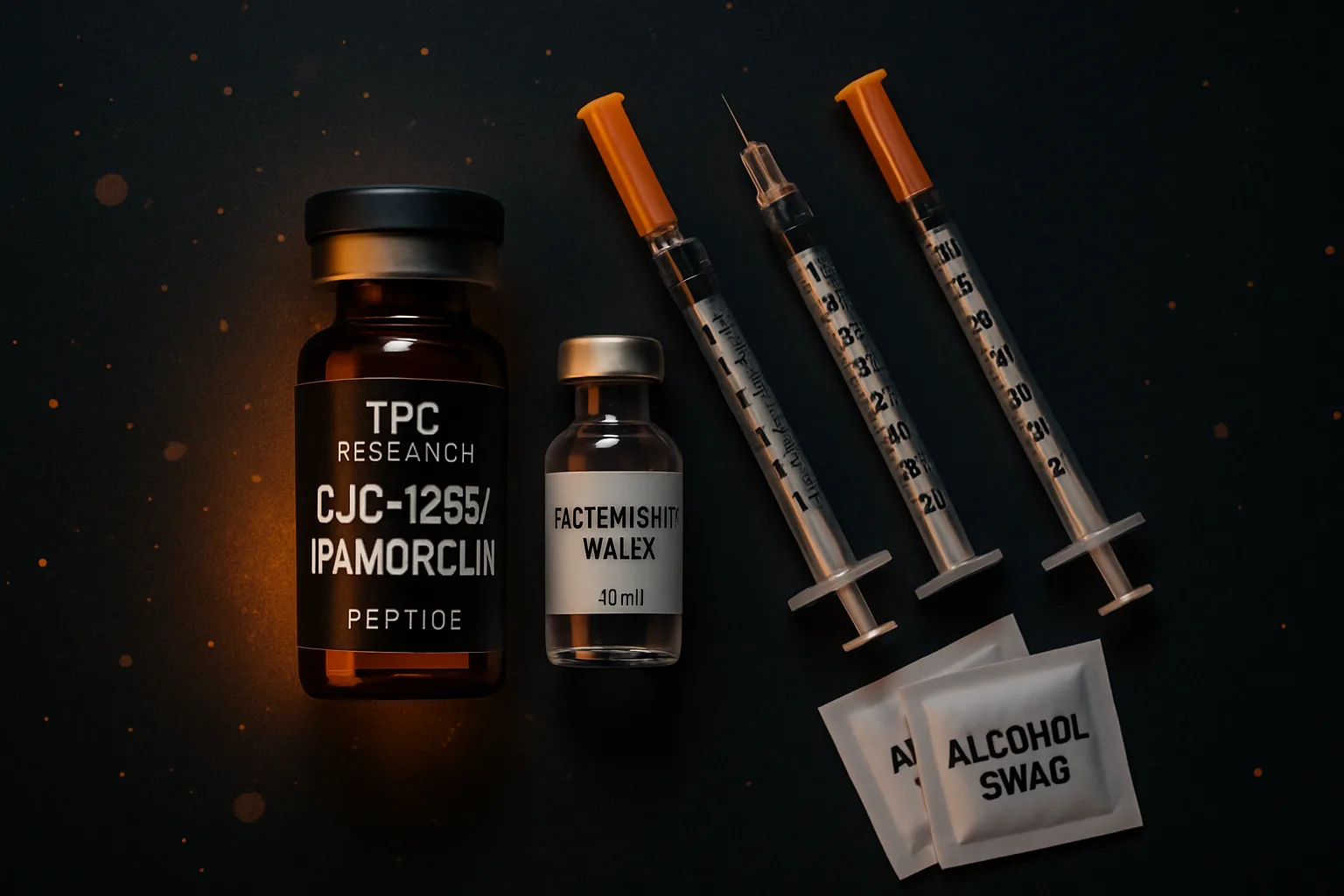
The injection pattern most often described in community sources:
- Wash hands and gather supplies.
- Wipe the vial stopper with an alcohol swab.
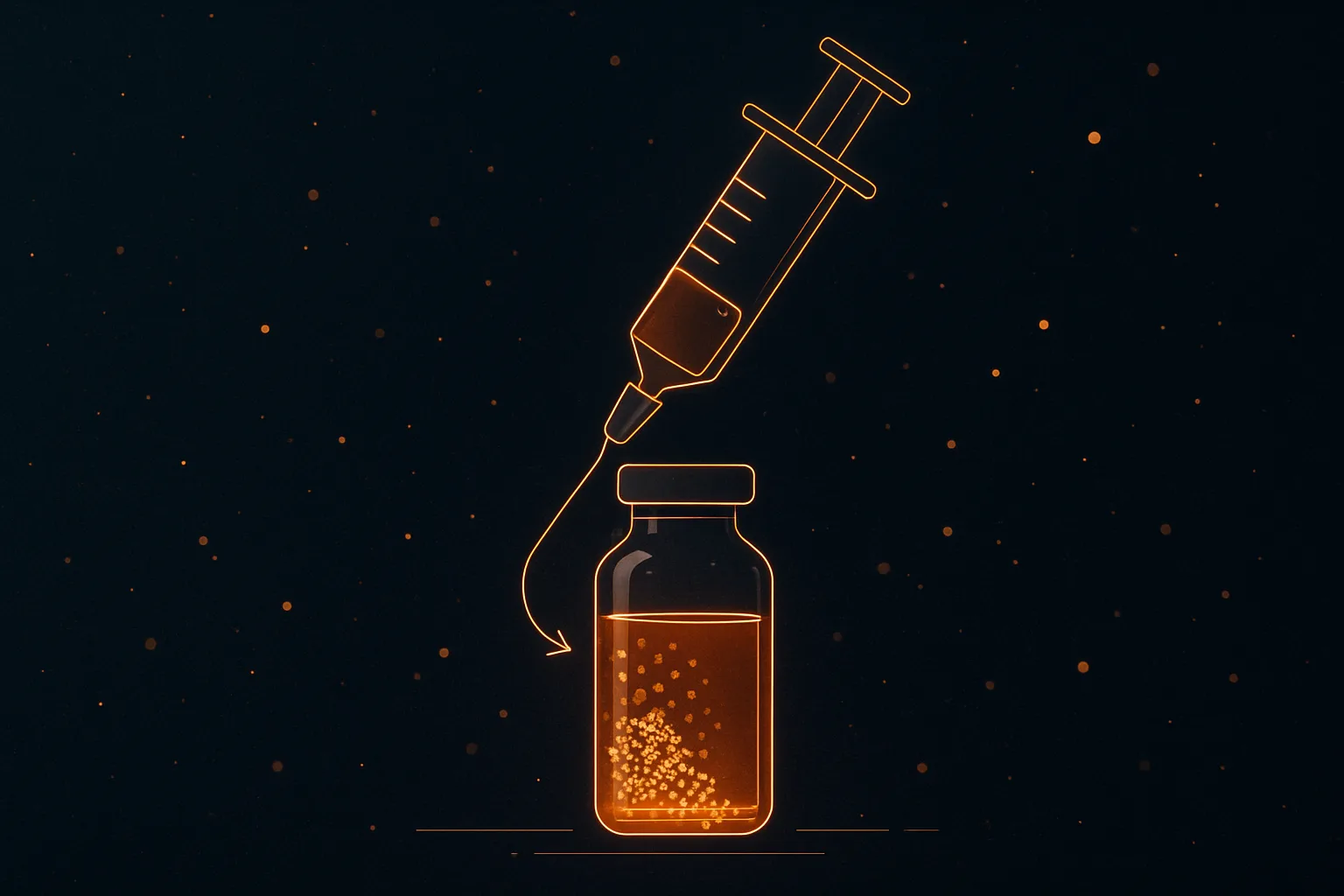
- Draw the dose. With the insulin syringe, pull the plunger to the volume mark equal to the target dose, insert the needle into the inverted vial, and slowly draw to the target volume. Community sources commonly describe pulling air in first to prevent negative pressure.
- Check for bubbles. Community guidance commonly describes flicking the syringe to move bubbles to the needle end, then pushing them back into the vial and re-drawing.
- Withdraw the needle from the vial.
- Pick the site. Lower abdomen 2" from the navel, or upper thigh, are the sites community sources commonly describe. Rotation between sites is the standard pattern.
- Wipe the injection site with an alcohol swab.
- Pinch the skin to tent it. Community guidance commonly describes 45° insertion for the thigh, 45-90° for the abdomen.
- Push the plunger slowly (3-5 seconds is the timing community sources commonly describe).
- Withdraw the needle. Community guidance commonly describes pressing (not rubbing) the site with the alcohol swab.
- Dispose of the syringe in a sharps container.
Community sources commonly describe the insulin needle as thin enough that most users self-report feeling almost nothing. Community reports cluster around occasional minor bruising at injection sites — common in self-reported community timelines without further consequence.
Timeline Trial Subjects and Community Sources Describe
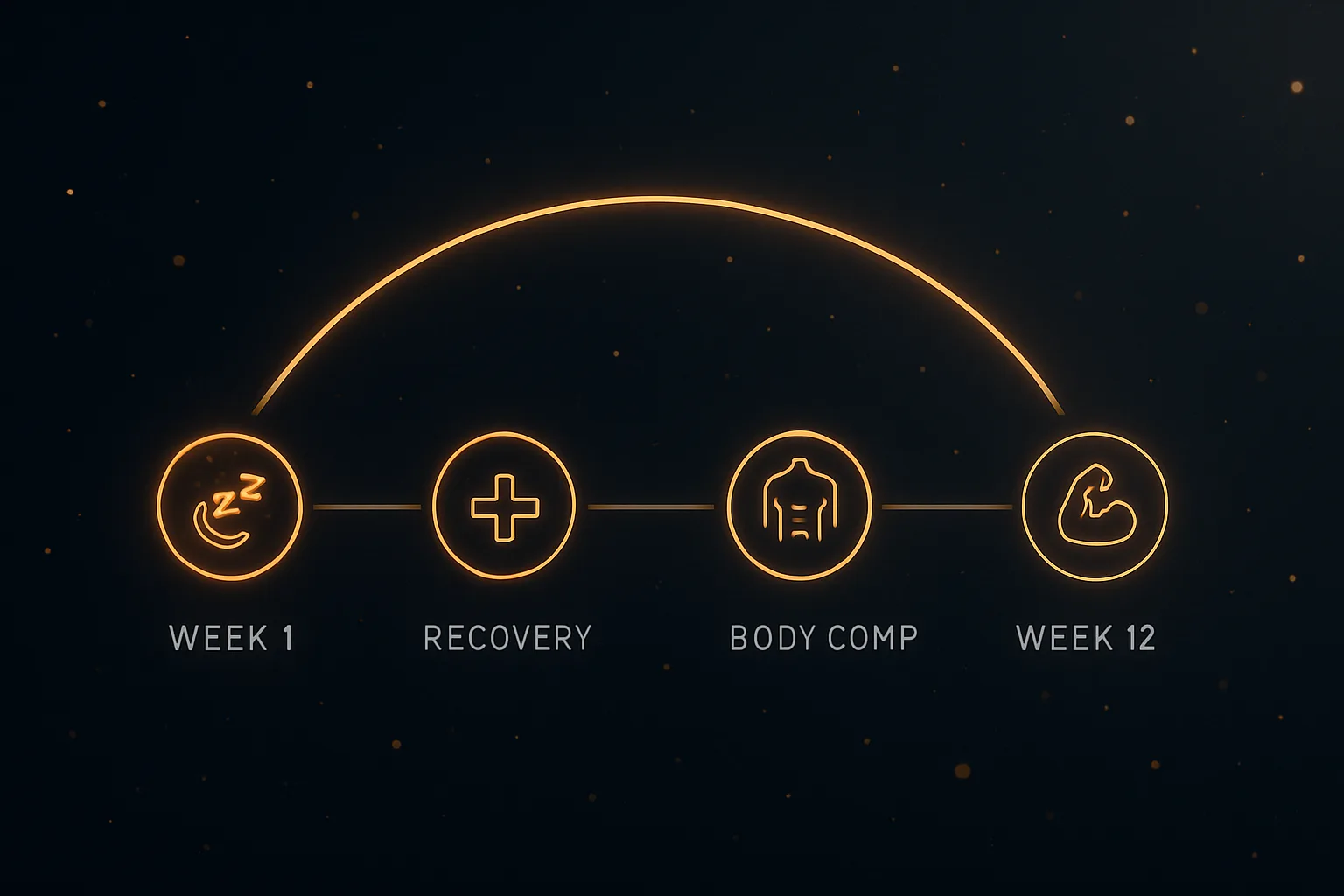
Week 1: Community sources commonly describe deeper sleep within 2-3 days, mild water retention (1-2 lb on the scale in self-reported timelines), and possible mild hand tingling or vivid dreams.
Weeks 2-4: Community reports cluster around faster between-session recovery, slightly improved gym performance, and continued sleep depth. Community sources commonly describe a small appetite increase in this window.
Weeks 4-8: Body-composition shifts become visible in community-reported timelines. Community sources commonly describe slightly better muscle definition and modest strength increases on compound lifts (2-5% increases on 5-rep maxes are typical in self-reported community reports).
Weeks 8-12: Trial-reported lean-tissue gains in trained subjects on a full secretagogue cycle have typically clustered around 2-4 lb. Community reports across full 12-week cycles commonly describe similar magnitude when training and protein intake are maintained.
Weeks 12-16: Consolidation. Community sources commonly describe extending to 16 weeks for some users, with others running a 12-week cycle and taking 4 weeks off.
What Trial Data Does Not Describe
Community sources commonly flag several patterns as outside what trial data and self-reported community timelines support:
- Steroid-scale first-cycle mass gains. Trial data does not support claims of steroid-scale transformations from secretagogue stacks alone. Published research describes the GH/IGF-1 axis as carrying a documented ceiling on the muscle-building effect.
- HPTA suppression. Published research describes peptides like CJC-1295 and ipamorelin as acting on the pituitary GH axis, not the HPTA. Community sources commonly describe PCT as not applicable.
- Dramatic strength increases. Community reports cluster around 2-10% improvements on major lifts across a full cycle. Larger jumps are not commonly described in community sources.
- Fat loss in a calorie surplus. Community sources commonly describe the stack as supporting body recomposition without overriding nutrition.
- Visible changes in week 1. Community sources commonly describe impatience at week 1 as the most consistent first-cycle issue. Trial subjects and community timelines describe visible physique changes at weeks 6-8, not week 1.
The most consistently described first-cycle issues in community sources:
Reconstitution math errors. Community sources commonly describe this as the single most consistent issue. The pattern community guidance describes is verifying concentration arithmetic against the specific vial before every injection.
Post-meal injection. Published research describes elevated insulin as substantially blunting GH release. Community sources commonly describe empty-stomach timing as standard.
Skipping bloodwork. Community sources commonly describe baseline and 4-week labs as the minimum monitoring set. Running peptides without labs is what community sources commonly describe as functionally flying blind.
Dosing above 200 mcg per injection. Published pharmacokinetic data describe the GH response plateauing at receptor saturation; community sources commonly describe higher doses as wasted product.
Stopping the cycle early. Community sources commonly describe the muscle-building signal as taking 8+ weeks to show in self-reported timelines. Pulling out at week 4 is what community sources commonly describe as the most common reason first cycles produce no signal.
Not tracking lifts or body composition. Community sources commonly describe weekly lift logging plus biweekly measurements and photos as the standard pattern for evaluating cycle response.
Training and Nutrition Patterns Community Sources Describe
Community sources commonly describe the peptide as the signal and training plus nutrition as what the signal acts on.
Training pattern community sources commonly describe:
- 3-4 resistance training sessions per week
- Compound focus: squat, deadlift, bench, overhead press, row, pull-up
- 3-5 sets of 5-8 reps at 70-85% 1RM
- Progressive overload week over week
Nutrition pattern community sources commonly describe:
- Protein: 1.6-2.2 g/kg of target body weight (roughly 130-180 g/day for an average lifter)
- Calories: maintenance or small surplus for lean-mass focus, small deficit for body recomposition focus
- Creatine monohydrate 5 g/day (community sources commonly describe creatine as the only supplement with consistently strong evidence)
- Sleep 7-9 hours with consistent bedtime
How Different Audiences Choose
Community usage and trial-evidence patterns map cleanly onto reader profiles. Here's how typical patterns break down:
Users new to GH peptides typically choose CJC-1295 + ipamorelin as the first stack — community sources describe it as the most commonly chosen entry point.
Users who have completed a first cycle and want stronger body-composition shift commonly graduate to tesamorelin + ipamorelin — community sources describe it as carrying the deeper trial-evidence base.
Users adding a recovery layer commonly add BPC-157 — community sources describe it as stacking cleanly with a GHRH+GHRP base without interaction with the GH axis.
Users layering an advanced anabolic tool after a base cycle sometimes add IGF-1 LR3 — community sources describe it as advanced-only, after a successful base cycle.