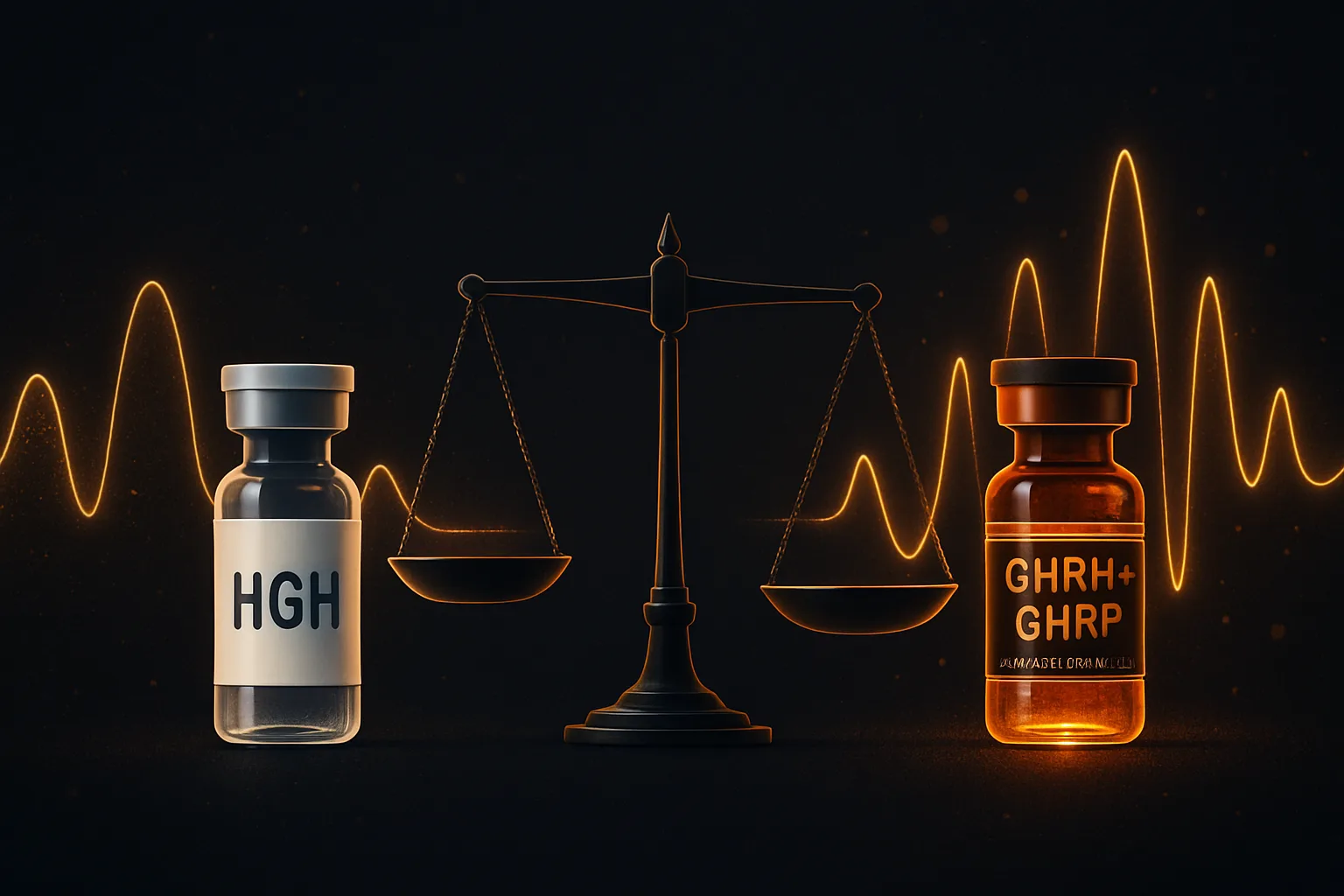
HGH is the aspirational gold standard for muscle-building pharmacology. Peptides are the practical alternative. If you've been around the lifting community long enough, you've heard people claim HGH is irreplaceable — and you've heard others claim GHRH+GHRP stacks produce identical results at a tenth of the cost. The truth is in between.
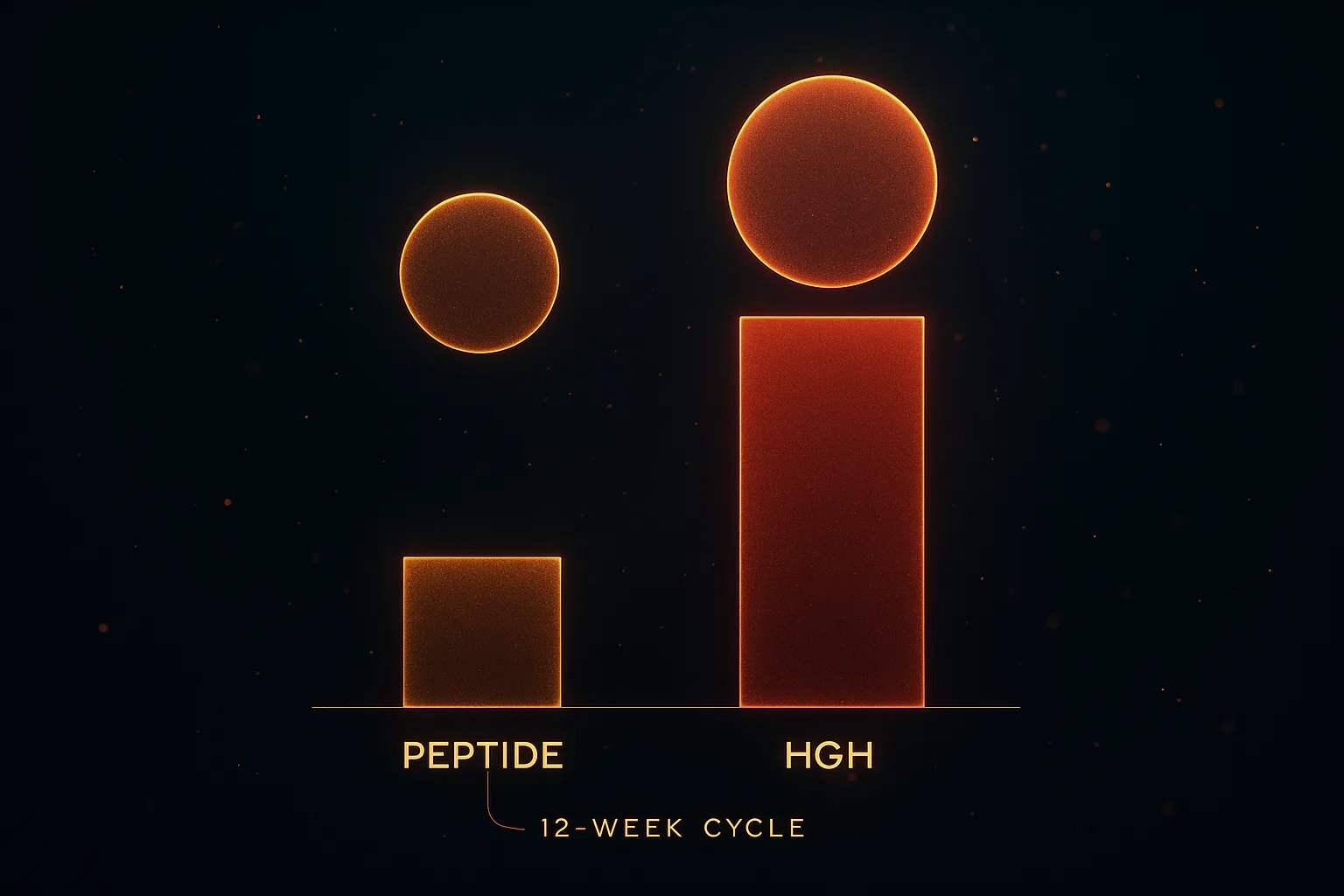
Short answer: well-designed GHRH+GHRP stacks deliver roughly 60-80% of HGH's anabolic effect at 20-30% of the cost, with fewer side effects and better long-term sustainability. If maximum muscle building is the only priority and you're okay with the side effects and cost, HGH wins. For most users, peptides hit the better point on the cost/effect/safety curve.
The Mechanism Difference
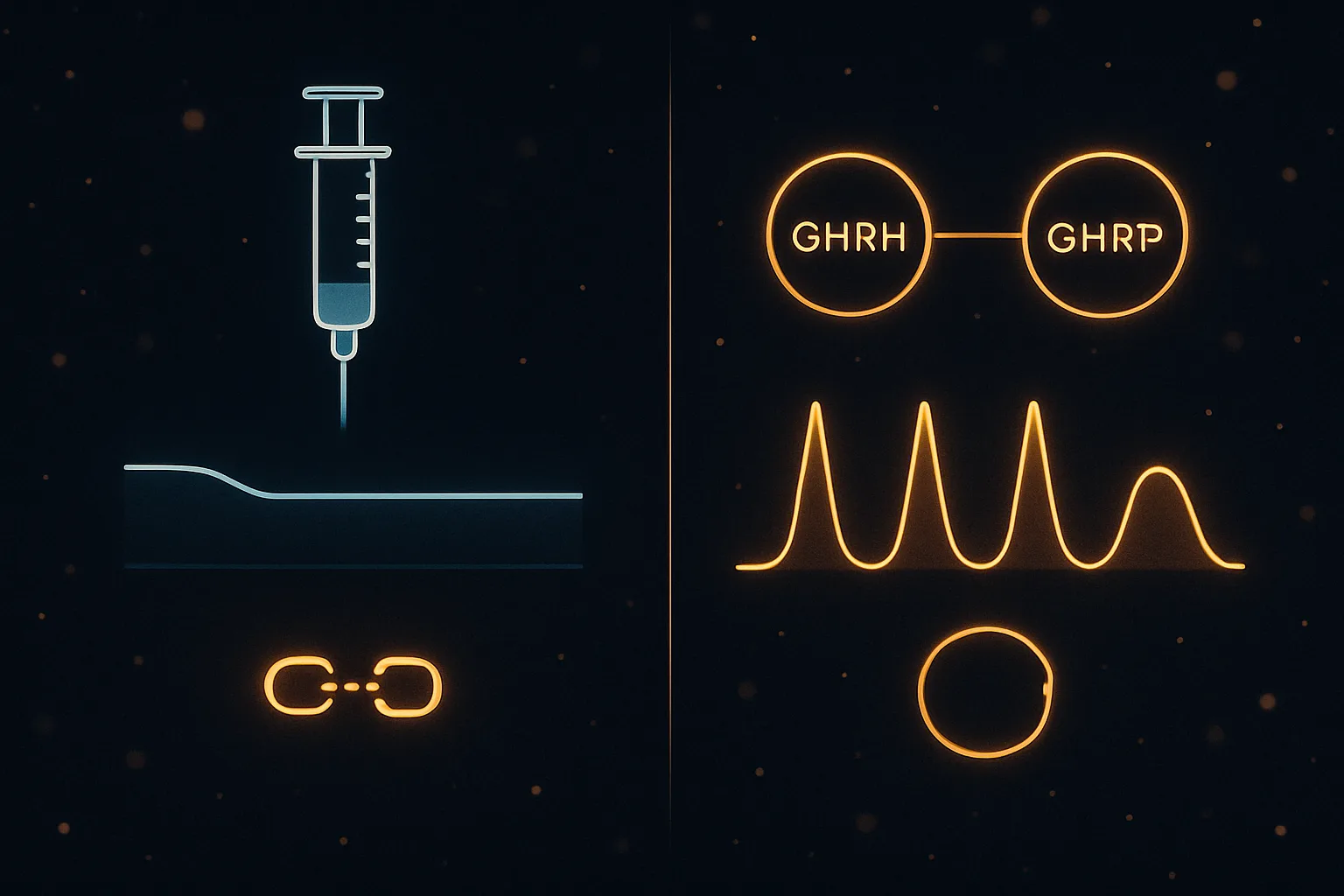
HGH (somatropin) is recombinant human growth hormone — the same 191-amino-acid protein your pituitary produces, injected directly. It bypasses the pituitary entirely. Serum GH levels rise to a sustained peak lasting several hours, then decline. Repeated daily injections create a near-continuous elevated GH state that's much higher than physiological pulses.
GHRH+GHRP stacks work upstream of HGH. The GHRH analog (tesamorelin, CJC-1295, sermorelin) primes the pituitary somatotrophs; the GHRP (ipamorelin, GHRP-2, GHRP-6) triggers release through the ghrelin receptor. Result: a large acute GH pulse that matches the body's natural pattern, then rapid clearance back to baseline (Bowers et al., 1990).
The practical difference: HGH gives you sustained elevated GH for hours; peptides give you a natural-pattern pulse. Both raise IGF-1 — the downstream anabolic marker — but the side effect profiles diverge because HGH overrides the feedback loops your body uses to self-regulate GH exposure.
Quick Comparison Table
| Axis | HGH | Tesa + Ipa | CJC + Ipa | Sermorelin + Ipa |
|---|---|---|---|---|
| IGF-1 elevation (% over baseline) | 50-100% | 50-80% | 30-60% | 20-40% |
| Lean mass gain (12-16 wk cycle) | 4-8 lb | 3-5 lb | 2-3 lb | 1.5-2.5 lb |
| Fat loss (12-16 wk cycle) | 5-12 lb | 5-8 lb | 3-5 lb | 2-4 lb |
| Pulsatile pattern preserved | No | Yes | Yes | Yes |
| Insulin resistance risk | High | Moderate | Moderate | Low |
| Cycle cost (12-16 wk, research chem pricing) | $1200-2400 | $600-900 | $400-600 | $350-500 |
| Injection frequency | Daily | Daily | Daily | Daily |
| Legal status (US) | Rx only, off-label illegal | FDA-approved Rx | Research chem | Rx |
The Peptide Case
Three reasons peptides win for most users:
1. Pulsatility preserves feedback. Natural GH is pulsatile — bursts of release separated by low periods. This rhythm is what the body's somatostatin-GH feedback loop evolved around. Sustained HGH injection breaks that loop; GHRH+GHRP preserves it. The practical result: fewer side effects (less insulin resistance, less fluid retention, less carpal tunnel) at the same IGF-1 elevation.
2. Cost-per-effect. At therapeutic muscle-building doses (2-4 IU/day), HGH costs roughly $40-80/day at research-chemical pricing, or $1200-2400 for a 12-16 week cycle. Tesamorelin + ipamorelin at equivalent IGF-1 elevation costs $600-900 for the same period. CJC-1295 + ipamorelin costs $400-600. The peptide stack is 2-5x cheaper per cycle at similar IGF-1 response.
3. Quality control. HGH sold outside pharmaceutical channels is frequently counterfeit — fake HGH, underdosed HGH, HCG or bacteriostatic water relabeled as HGH. Research chemical peptide vendors with third-party COAs produce more reliable quality at this price point.
The HGH Case
Three reasons HGH wins for some users:
1. Maximum muscle building. At 6+ IU/day (bodybuilding doses), HGH produces muscle gains peptides cannot match. For competitive bodybuilders or athletes in the final stretch of contest prep, HGH's effect size is real.
2. Direct dosing control. HGH at 2 IU produces 2 IU of GH equivalent. Peptide response varies based on pituitary reserve, receptor sensitivity, and individual response — some users get strong IGF-1 elevation, others get less. HGH is more predictable.
3. Established protocol playbook. Decades of bodybuilding community experience with HGH dosing, cycle length, and stacking. Peptide protocols are well-understood but have less long-horizon track record in competitive use.