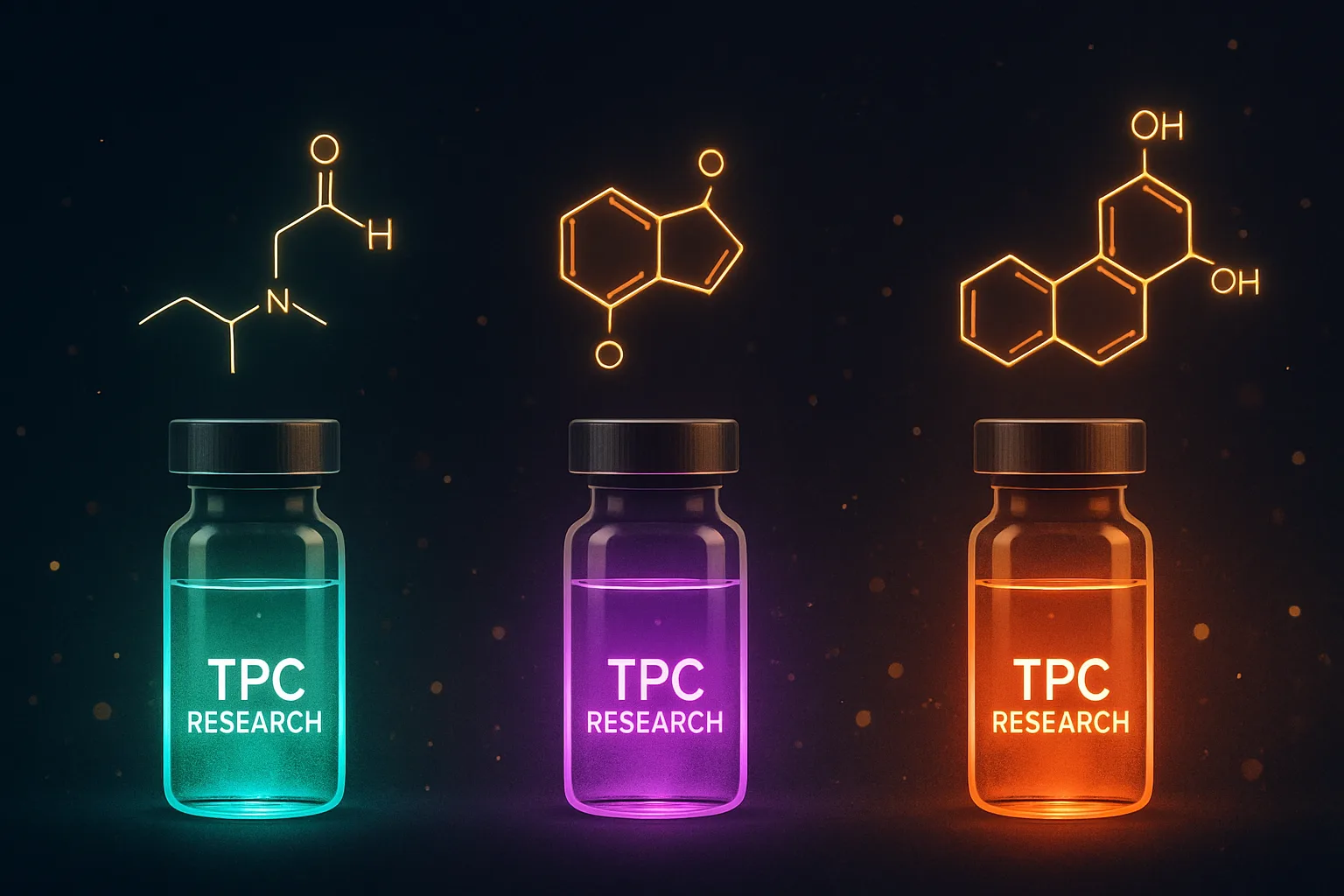
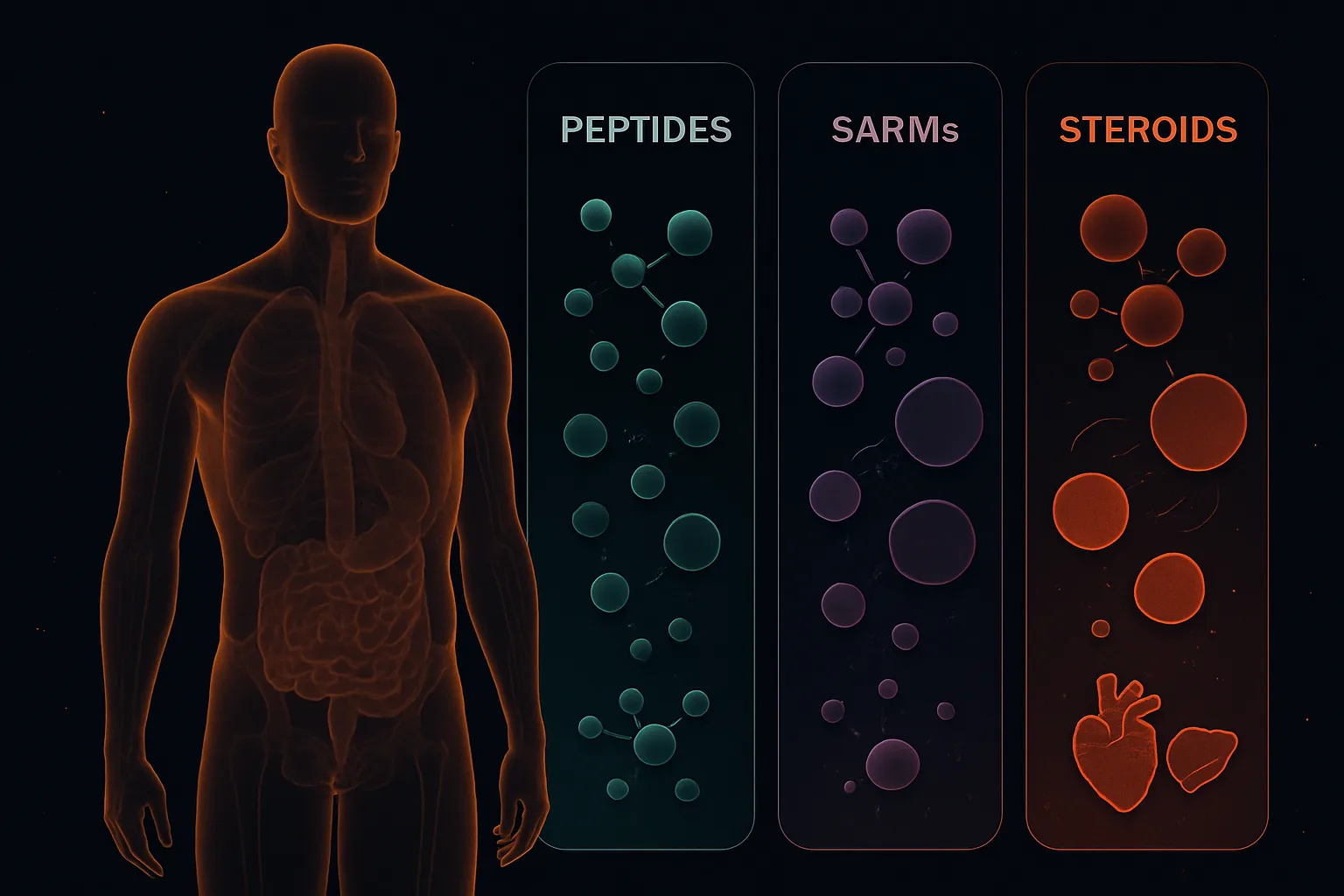
Three categories of muscle-building compound. Different mechanisms, different legal status, different safety trade-offs. Peptides win on some axes and lose on others — this article lays out where each category fits and where it falls short, so a serious decision about training pharmacology is made with real information, not marketing.
Short answer on raw muscle-building power: steroids > SARMs > peptides. Short answer on safety, legality, and long-term sustainability: peptides > SARMs > steroids. The right pick depends on your priorities — and on what you will actually stick with for the next decade.
The Three Categories in One Table
| Axis |
Peptides (GH stacks) |
SARMs |
Steroids |
| Typical first-cycle muscle gain |
2-4 lb |
5-8 lb |
10-20 lb |
| Strength increase |
Modest |
Moderate |
Large |
| Recovery improvement |
Large |
Moderate |
Large |
| HPTA suppression |
None |
Yes (moderate) |
Yes (severe) |
| Liver toxicity |
None |
Moderate (some) |
Moderate-severe (orals) |
| Lipid disruption |
Minimal |
Moderate |
Severe |
| Cardiac remodeling |
None documented |
Unclear |
Yes (long-term) |
| Legal status (US) |
Research chemical / Rx |
Unscheduled but unapproved |
Controlled substance |
| Requires PCT |
No |
Yes |
Yes |
| Typical cycle cost (12 wk) |
$400-700 |
$200-400 |
$150-300 |
| Bloodwork cadence |
Quarterly |
Monthly |
Biweekly (orals) |
Peptides: Mechanism and Reality
Growth hormone peptide stacks — tesamorelin + ipamorelin, CJC-1295 + ipamorelin, sermorelin + ipamorelin — work by amplifying the body's own pulsatile GH release through two receptors simultaneously. A GHRH analog primes the pituitary somatotrophs; a GHRP triggers release through the ghrelin receptor. Combined, they produce a GH pulse 2-3x larger than either alone (Bowers et al., 1990).
The downstream effect: elevated IGF-1, improved recovery, modest lean mass gains, reduced visceral fat. Tesamorelin's phase III trials showed 15-18% visceral fat reduction and preserved muscle cross-sectional area (Falutz et al., 2010; Adrian et al., 2019). Realistic first-cycle gain in a trained lifter: 2-4 lb of lean tissue over 12-16 weeks.
What peptides don't do: put 20 lb on you in a cycle. The GH/IGF-1 axis has a physiological ceiling that bounds the total muscle-building effect. If the goal is the physique transformation of a first steroid cycle, peptides will disappoint.
Non-GH peptides worth mentioning:
- Follistatin-344 — myostatin inhibitor, mechanism distinct from GH (Kota et al., 2009 in nonhuman primates). Experimental.
- IGF-1 LR3 — direct IGF-1 receptor agonist, advanced stack, hypoglycemia risk.
- BPC-157 and TB-500 — healing peptides, routinely stacked with heavier cycles for joint and tendon protection.
Deep dive: Best Tesamorelin + Ipamorelin Vendors | Best CJC-1295 + Ipamorelin Vendors — pre-mixed GHRH+GHRP blends ranked by price and COA.
SARMs: What They Actually Are
Selective androgen receptor modulators bind the androgen receptor like testosterone but with tissue-selective activation — designed to hit muscle strongly while sparing prostate and liver. The theory does not fully hold up in practice.
Common SARMs:
- Ostarine (MK-2866) — mildest, used in cutting cycles
- LGD-4033 (ligandrol) — strongest on mass, significant HPTA suppression
- RAD-140 (testolone) — strong, hepatotoxic signals in multiple reports
- YK-11 — technically a myostatin inhibitor with SARM-like activity, liver and cardiovascular concerns
- Cardarine (GW-501516) — PPAR-delta agonist, not technically a SARM, carcinogenicity signals in animal studies
Bloodwork reality on SARMs: HDL drops 30-50% within 4-6 weeks. Testosterone and LH suppress on most SARMs within 2 weeks. Liver enzymes elevate on RAD-140 and YK-11. The "safer than steroids" framing is marketing; the bloodwork patterns are closer to mild oral steroids than to supplements.
Quality issue: independent testing of SARM products sold as research chemicals repeatedly finds mislabeled compounds, incorrect dosing, or contamination. Unlike peptides sold by vendors with third-party COAs, the SARM market has minimal quality infrastructure.
Legal status (US): SARMs are not FDA-approved for human use and are technically illegal to sell for human consumption, though research chemical loopholes persist. WADA bans all SARMs for competitive athletes.
Cycle cost: $200-400 for 12 weeks plus $100-150 for PCT (SERMs like tamoxifen or enclomiphene to restart the HPTA).
Steroids: Mechanism and Real Trade-Offs
Anabolic-androgenic steroids — testosterone, nandrolone, trenbolone, oxandrolone, and dozens of derivatives — are the gold standard for maximum muscle-building, used by competitive bodybuilders, strength athletes, and TRT patients. No peptide or SARM matches them on raw mass or strength.
Typical first cycle (testosterone enanthate, 500 mg/week, 12 weeks): 10-20 lb of lean mass, 15-30% strength increase on compound lifts, dramatic improvement in recovery. Post-cycle, about 40-60% of gains are kept long-term with proper training.
Side-effect reality — what bloodwork actually shows:
- HDL drops 30-60% within 4-6 weeks
- Hematocrit and hemoglobin rise (cardiac workload)
- Blood pressure rises (variable, often 10-20 mmHg systolic)
- Estradiol rises proportional to dose and aromatase activity (requires aromatase inhibitor management)
- Full HPTA shutdown within 2-4 weeks
- Oral steroids (anadrol, oxandrolone, dianabol) add liver enzyme elevation
Long-term concerns: Multi-cycle users show cardiac remodeling on echocardiogram, accelerated atherosclerosis, and a small but real mortality signal in cohort studies of elite bodybuilders.
Legal status (US): Controlled substances under federal law. Possession without a prescription is a federal offense. TRT prescriptions are available for diagnosed hypogonadism but cycle-level doses are not.
Cycle cost: $150-300 for a 12-week test cycle + $100-200 for PCT + $50-150 for ancillaries (aromatase inhibitor, liver support for orals). Cheapest per cycle, most expensive in long-term bloodwork and cardiac cost.
The Trade-Off Matrix
If your only priority is maximum muscle in 12-16 weeks: steroids. Nothing else is close.
If you want meaningful gains with marginally better safety than steroids: SARMs are a step down in effect and a small step up in safety. Most serious users consider the gap too small to justify choosing SARMs over a well-monitored testosterone cycle.
If you want to build muscle sustainably over 10+ years without HPTA suppression, lipid crashes, or cardiac risk: peptides. The per-cycle gain is smaller, but you can cycle peptides indefinitely with manageable bloodwork.
If you are over 40 and prioritizing healthspan alongside muscle: peptides. GH decline is the primary physiological bottleneck at your age, and GHRH+GHRP directly addresses it. Steroids over 40 require aggressive cardiac monitoring most users do not want to do.
If you are training for a physique competition: most competitors use steroids. Peptides are part of that stack (for recovery, visceral fat, lean mass preservation) but not the primary driver.
If you are training for general fitness, longevity, and a good physique: peptides. The delta between "peptide-enhanced physique" and "steroid-enhanced physique" is smaller than the marketing suggests, and the safety delta is enormous.
Stacking Across Categories
Peptides and steroids stack cleanly because the mechanisms do not overlap.
Common steroid + peptide stacks:
- Test + tesa+ipa: The steroid drives the anabolic push; the GH peptide layer preserves lean mass on the post-cycle, accelerates recovery, and reduces visceral fat that accumulates at higher calorie intakes.
- Test + BPC-157 + TB-500: Healing stack on top of a heavy cycle. Protects tendons and joints against the disproportionate connective-tissue strain of steroid-driven strength gains.
- Test + IGF-1 LR3 (advanced): Adds downstream anabolism. Hypoglycemia risk on top of a steroid cycle that is already insulin-resistance-shifting. Not for beginners.
SARMs + peptides: Similar logic. Ostarine + CJC+ipa is a common "minimalist" stack in the research-chemical community. BPC-157 for tendon protection during aggressive SARM cycles.
Post-cycle: Peptides are often run after a steroid or SARM cycle as a recovery and lean-mass-preservation tool. GH peptides do not interfere with PCT (SERMs work on the HPTA; GH peptides work on the somatotrophs).
Legal and Practical Framing
Peptides: Tesamorelin, sermorelin, and cagrilintide are FDA-approved or prescription-available through licensed telehealth channels for specific indications. BPC-157 and TB-500 are research chemicals (post-April 2026 FDA reclassification, with an active public comment period). CJC-1295 and ipamorelin are research chemicals. Legality depends on sourcing and use framing.
SARMs: Not FDA-approved. Sold as research chemicals with explicit "not for human consumption" labeling. Banned by WADA and most athletic organizations.
Steroids: Schedule III controlled substances in the US. TRT is legal with a prescription for diagnosed hypogonadism. Cycle-level doses without a prescription are a federal offense.
How to Choose — Decision Tree
First cycle of anything, age under 30, prioritizing safety and reversibility → peptides. GH peptide stack (tesa+ipa or CJC+ipa). Run 12-16 weeks, off 4-8, repeat.
First cycle, ambitious about muscle, accepting real bloodwork risk → a testosterone-only cycle (500 mg/week enanthate, 12 weeks + PCT). Better studied and more predictable than SARMs.
Over 40, prioritizing healthspan → peptides, full stop. Add TRT if your testosterone is clinically low.
Competitive bodybuilder → multi-compound steroid cycles with peptide adjuncts. Outside the scope of this article.
Drug-tested athlete → peptides only (WADA prohibits GH secretagogues above certain thresholds in competition testing, but recreational use between competitions is detectable only briefly).
Frequently Asked Questions
Which actually builds the most muscle — peptides, SARMs, or steroids?
Steroids, by a large margin. Testosterone and derivatives produce 10-20 lb of lean mass in a first cycle; SARMs deliver roughly half that; GH peptide stacks typically produce 2-4 lb per cycle. The ordering on raw mass is steroids > SARMs > peptides. The ordering flips on safety, legality, and long-term sustainability.
Are SARMs really safer than steroids?
Marginally on some axes, not at all on others. SARMs are designed to be tissue-selective but in practice they still suppress the HPTA, disrupt lipids, and some (RAD-140, YK-11) carry hepatotoxicity signals. The "safer" marketing does not survive bloodwork scrutiny.
Can you stack peptides with SARMs or steroids?
Yes. Peptides stack cleanly with both because mechanisms do not overlap. GHRH+GHRP raises GH/IGF-1; steroids and SARMs act on the androgen receptor. BPC-157 and TB-500 are routinely added to steroid cycles for tendon protection.
If peptides are weaker, why would anyone use them?
Three reasons. First, side-effect profile — no HPTA suppression, no lipid crash, no liver load. Second, cycling simplicity — no PCT required after peptides. Third, medical and legal framing — several peptides can be obtained through licensed telehealth channels.
What's the cost difference across the three?
Steroid cycles run $150-300. SARM cycles run $200-400. Peptide cycles run $400-700. Peptides are the most expensive per cycle, but the absence of PCT and lower bloodwork cadence close the gap long-term.
Which is best for over-40 users?
Peptides, specifically GHRH+GHRP stacks. Age-related GH decline is the primary physiological bottleneck for muscle maintenance past 40. Steroids over 40 require aggressive cardiac and hematocrit monitoring; SARMs carry the same issues at lower magnitude.
References
| # |
Citation |
PMID |
| 1 |
Bowers CY, et al. GH-releasing peptide acts synergistically with GH-releasing hormone. J Clin Endocrinol Metab. 1990;70(4):975-982. |
2108187 |
| 2 |
Falutz J, et al. Effects of tesamorelin in HIV-infected patients with abdominal fat accumulation. J Clin Endocrinol Metab. 2010;95(9):4291-4304. |
20101189 |
| 3 |
Adrian S, et al. Tesamorelin decreases muscle fat and increases muscle area in adults with HIV. J Frailty Aging. 2019;8(3):154-159. |
31237318 |
| 4 |
Teichman SL, et al. Prolonged stimulation of GH and IGF-I secretion by CJC-1295. J Clin Endocrinol Metab. 2006;91(3):799-805. |
16352683 |
| 5 |
Raun K, et al. Ipamorelin, the first selective growth hormone secretagogue. Eur J Endocrinol. 1998;139(5):552-561. |
9849822 |
| 6 |
Nass R, et al. Effects of an oral ghrelin mimetic on body composition in healthy older adults. Ann Intern Med. 2008;149(9):601-611. |
18981485 |
| 7 |
Kota J, et al. Follistatin gene delivery enhances muscle growth and strength in nonhuman primates. Sci Transl Med. 2009;1(6):6ra15. |
20368179 |
| 8 |
Pandya N, et al. GHRP-6 requires endogenous hypothalamic GHRH for maximal GH stimulation. J Clin Endocrinol Metab. 1998;83(4):1186-1189. |
9543138 |