For readers searching "best peptides for workout recovery," the short answer most experienced users describe in community sources is this: recovery peptides cover two different pieces of the same problem. BPC-157 and TB-500 act on repair pathways (soft tissue, vascular, connective tissue). GHRH+GHRP stacks act through deeper sleep, which community sources commonly describe as the most underused recovery lever. Athletes in high-volume sports commonly run both layers.
Research-context information only. Peptides discussed below are research compounds. Protocols, doses, and reactions reported come from published research and self-reported community sources. This article reports what has been documented, not what should be done. Consult a licensed physician for personal medical decisions.
Evidence at a glance
Peptides covered below, sorted by clinical evidence strength. Each peptide also carries a parallel community-evidence grade reflecting real-world adoption. How we grade evidence.
Roughly 40% faster dermal wound closure and angiogenesis in rodent models.
This guide ranks the 7 peptides community sources most commonly describe for post-workout recovery in the order experienced users typically reach for them. Each entry explains what trial data and community usage describe for that peptide in a recovery context, who tends to choose it, and what self-reported community outcomes look like. Cycle structure, injection mechanics, and bloodwork detail live in the linked deep-dive guides.
For injury-specific recovery (acute tendon tears, post-surgical protocols), see Best Peptides for Healing. This guide covers training athletes, not injury patients.
Why Recovery Matters for Long-Run Muscle Growth
Published research describes muscle protein synthesis as peaking 24-72 hours after a training stimulus. Training the same muscle group while MPS is still elevated blunts the second session's effect; training too infrequently lets MPS drop back to baseline before the next stimulus. The sweet spot — usually 2-3 sessions per muscle group per week in published training literature — depends on individual recovery capacity.
Community reports cluster around recovery peptides shifting that sweet spot toward higher frequency. Better soft-tissue integrity, reduced systemic inflammation, deeper sleep — community sources commonly describe these as letting users train the same tissue sooner without regression.
The Rankings
Bac Water Made for Peptides
Don't risk a $300 peptide on generic bac water.
Most cloudy reconstitutions trace back to one thing — and it isn't the peptide. Sterile, non-pyrogenic, 0.9% benzyl alcohol — formulated for peptide reconstitution, not repackaged from generic stock.
✓ 0.9% benzyl alcohol✓ Made for peptides✓ 30 mL multi-dose
Best for: athletes accumulating multi-site wear from high-volume training.
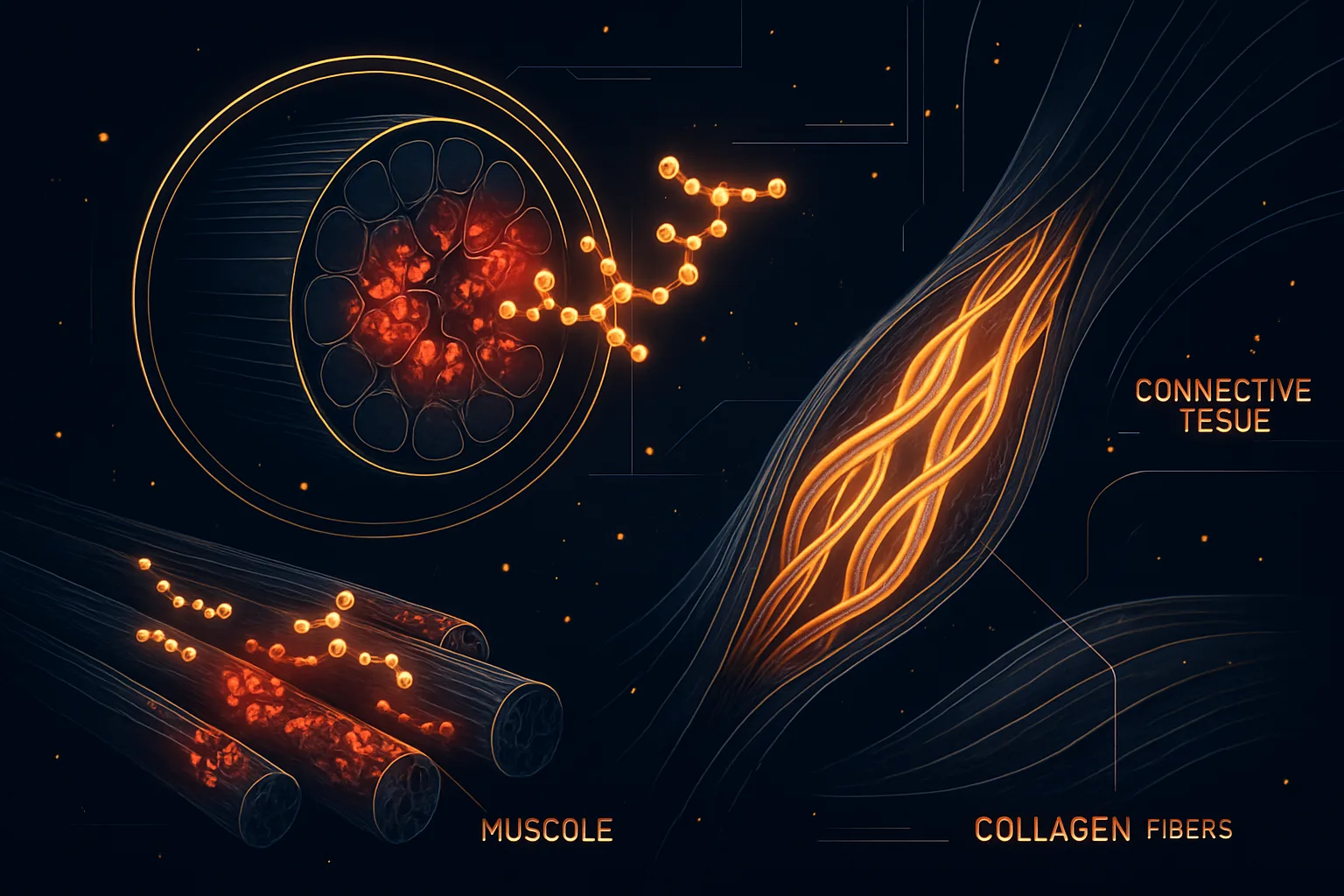
This is the stack community sources most commonly describe for athletes whose recovery problem isn't one tendon but the whole body. BPC-157 is a pentadecapeptide fragment of a gastric juice protein, studied extensively in animal models for soft tissue and gut healing. TB-500 (synthetic thymosin beta-4) acts more systemically — published research describes it as promoting actin polymerization, supporting cell migration to injury sites, and influencing muscle, vascular, and connective tissue repair.
Combined, community sources commonly describe the pairing as covering both soft-tissue focal injuries and broader training-volume accumulation. CrossFit athletes, powerlifters, grapplers, and combat sport athletes — all populations community usage commonly describes accumulating shoulder, elbow, hip, knee, and lower-back wear simultaneously — tend to choose the Wolverine pairing.
Community reports cluster around three themes: noticeable reduction in localized joint discomfort within 5-10 days, faster between-session recovery by week 2-3, and a more durable training tolerance over a full 4-8 week cycle. The most common community caveat is that the protocol involves two separate compounds and slightly more reconstitution work.
Best for: users dealing with a specific tendon, ligament, or joint complaint.
BPC-157 is the recovery peptide community sources most commonly describe on its own. Published animal research describes BPC-157 as supporting soft tissue and gut-lining healing through angiogenic and growth-factor pathways. For training athletes, community usage typically describes it for localized pain and tendon/ligament support.
Community sources commonly describe solo BPC-157 as adequate when wear is localized to a single tendon or joint — most training-site discomfort, in self-reported community timelines, fits this pattern. Users in community sources commonly describe injecting subcutaneously near the problem site if the source is known.
Community reports cluster around two themes: pain and inflammation improving within 5-10 days at most localized training sites, and full effect by week 3-4. The most common community caveat is that whole-body multi-site wear responds better to the Wolverine pairing than to BPC-157 alone.
Best for: athletes with whole-body wear and no specific focal problem.
TB-500 acts more systemically than BPC-157 in published research. Community sources commonly describe it for athletes with whole-body wear but no single focal point — high-volume CrossFit, triathlon training, post-competition recovery — where the problem isn't a single tendon but distributed across muscle, vascular, and connective tissue.
Community usage as a standalone is less common than the paired Wolverine protocol; users in community sources commonly describe choosing solo TB-500 when budget is tight or when prior cycles have already responded well to BPC-157.
Community reports cluster around recovery acceleration at weeks 2-3, with users commonly describing improved training tolerance across cumulative volume rather than dramatic single-site relief.
4. CJC-1295 + Ipamorelin — the sleep-driven recovery layer
Best for: athletes who want to add the sleep-quality recovery lever to a soft-tissue base.
The recovery benefit of GH peptide stacks is mostly sleep-mediated in both published research and community reports. Users in community sources commonly describe deeper sleep within 2-3 days of starting CJC + ipa, and sleep is the recovery lever community sources most consistently describe as underused.
Published pharmacokinetic data describe CJC-1295 (no DAC) as a synthetic GHRH analog with a roughly 30-minute effective half-life. Combined with ipamorelin's selective GH-release profile, the pre-bed pulse aligns with the body's largest natural GH pulse during early slow-wave sleep — community sources describe deeper SWS as supporting glymphatic clearance, muscle protein synthesis during sleep, and subjective "rested" feeling on waking.
Community reports cluster around three themes: deeper sleep within 2-3 days, faster between-session recovery by week 2, and a 10-20% increase in training frequency tolerance attributed to the sleep component in self-reported community timelines.
5. Tesamorelin + Ipamorelin — the recomp-plus-recovery option
Best for: athletes cutting for a weight class or aesthetic target while maintaining training volume.
Same sleep and recovery benefits as CJC + ipa community sources describe, with a stronger GH pulse and added body-composition signal. Tesamorelin is the only GHRH analog with phase III randomized trial data behind it — the Falutz et al. 26-week trial reported reduced visceral fat alongside an 80% IGF-1 increase versus placebo.
For athletes whose recovery problem overlaps with a body-composition goal, community sources commonly describe tesa + ipa as covering both. The trade-off described most often is cost — tesa + ipa is the most expensive stack on this list.
Community reports cluster around the same sleep and recovery improvements community sources describe for CJC + ipa, with the additional waist-tightening signal trial data documented for tesamorelin.
Best for: users layering a collagen-synthesis adjunct onto an existing recovery base.
GHK-Cu is a copper-binding peptide. Published research describes documented effects on collagen synthesis and wound healing, particularly in older adults. Community sources commonly describe GHK-Cu as more relevant to skin and wound healing than to training-induced soft tissue repair — for general post-workout recovery, community usage commonly favors the BPC/TB combination instead.
Community usage commonly describes GHK-Cu as a layered adjunct on top of BPC-157 or TB-500 during longer recovery phases or post-injury protocols where the collagen synthesis angle is relevant.
Community reports vary widely in workout-recovery contexts, which is itself a signal that responses are individual outside the documented skin and wound-healing applications.
7. Ipamorelin (Solo) — the budget sleep-quality option
Best for: users who want the sleep benefit without the cost of a paired GHRH+GHRP stack.
Ipamorelin's claim to fame in published research is selectivity — it lifts GH without meaningfully raising cortisol, prolactin, or ACTH. Solo ipamorelin produces a smaller GH pulse than paired GHRH+GHRP protocols in pharmacokinetic data, but community sources commonly describe a real sleep-quality and recovery improvement even at solo doses.
Community usage as a primary recovery peptide is uncommon; community reports cluster around solo ipamorelin as a budget-conscious sleep-quality lever or as a complement for users already on a GHRH from a clinic source.
Community reports describe sleep-quality and recovery improvements within the first week, with users commonly noting smaller magnitude than paired GHRH+GHRP stacks.
Community usage and trial-evidence patterns map cleanly onto reader profiles. Here's how the picks above tend to break down across common athletic audiences:
Powerlifters running heavy compound work 3x per week commonly choose the Wolverine stack cycled 6 weeks on / 2 off, with CJC-1295 + ipamorelin layered for sleep during heavy strength blocks.
CrossFit athletes training 5-6x per week with multi-site wear commonly run the Wolverine stack continuous-low-dose, layered with tesamorelin + ipamorelin during competition prep for the body-composition signal alongside the sleep benefit.
Bodybuilders running 4-5x per week volume training commonly run tesamorelin + ipamorelin as the base for sleep and recomp, with BPC-157 layered during heavy accumulation blocks. TB-500 sometimes added if accumulated wear is multi-site.
Endurance athletes (marathon, triathlon) with vascular and connective-tissue wear commonly choose TB-500 as the base — community sources describe it as handling vascular wear better than BPC alone — with BPC-157 added for any specific tendon or joint issue.
Combat sports athletes (BJJ, wrestling, MMA) with constant multi-site soft-tissue wear commonly run the Wolverine stack 8 weeks on / 2 off as the default, with GH stacks layered during off-camp periods for recomp and sleep.
Older athletes prioritizing recovery from accumulating wear commonly choose CJC-1295 + ipamorelin for the sleep-driven recovery lever, layered with BPC-157 for any localized issues.
What Trial and Community Data Describe as Signals of Effect
Three signals appear consistently in published research and community sources, in this order:
Days 2-7: Sleep depth on GHRH+GHRP layers. Community sources commonly describe sleep depth as the first signal on any GH peptide layer, typically within 48-72 hours. Trial subjects on GHRH+GHRP protocols describe the same pattern.
Weeks 1-3: Soft-tissue and inflammation signals. Community reports on BPC-157 cluster around localized pain and inflammation improvement at days 5-10, with full effect commonly described by week 3-4. TB-500 timelines in community sources describe recovery acceleration at weeks 2-3.
Weeks 2-6: Training-volume tolerance. Community sources commonly describe a measurable increase in training frequency tolerance — same lifts, less between-session disruption — by the end of week 2 on a Wolverine + GH stack. Users running solo BPC-157 commonly describe the same shift slightly later.
GH peptide stacks layered onto recovery protocols carry the same monitoring requirements as standalone GH stacks. The trial-and-community standard is baseline IGF-1 plus a 4-week recheck and 8-12 week metabolic panel — see Best Peptides for Muscle Growth for the full protocol.