Methylene blue is unusual among compounds people take for cognition because the relationship between dose and effect is not a straight line — it is a U-shape. Low doses and high doses do opposite things at the cellular level, and the entire research interest in methylene blue for mitochondrial and cognitive endpoints sits at the low end of that curve. This makes "how much" a more consequential question for methylene blue than for most compounds, because overshooting doesn't just waste material — it reverses the mechanism.
This guide separates the dose figures by where they come from: the FDA-approved clinical dose for methemoglobinemia, the low oral dose used in the human cognition research, and the much smaller fixed doses described in nootropic community sources. It also flags the two safety issues that dominate any discussion of methylene blue dosing — the MAO-A serotonin-syndrome interaction and G6PD contraindication — because those override dose considerations entirely.
Research-context information only. Methylene blue is the active ingredient in FDA-approved products for methemoglobinemia; research-chemical and compounded forms are not FDA-approved and are sold for research purposes only. Protocols, doses, and reactions reported below come from published clinical trials and self-reported community sources. This article reports what has been documented, not what should be done. Consult a licensed physician for personal medical decisions.
Quick Reference: Protocol
The dose figures that appear in methylene blue discussion fall into three clearly separated tiers, and conflating them is the most common error in community write-ups:
- Clinical / pharmacologic (methemoglobinemia): the FDA-approved dose is 1 to 2 mg/kg given intravenously. This is a hospital intervention for a specific emergency, not a self-administered protocol, and at the high end it approaches the dose where methylene blue's effects begin to reverse.
- Cognition research (low oral): the human fMRI study by Rodriguez and colleagues (PMID 27351678) administered a single low oral dose — on the order of a few hundred milligrams in that specific protocol — and reported increased fMRI response during memory tasks and a measured improvement in memory retrieval. This is a single-study data point, not a repeated protocol.
- Community-reported (low fixed dose): nootropic community sources commonly describe much smaller fixed oral doses, in the rough range of 5 to 15 mg, or sometimes framed as roughly 0.5 to 1 mg/kg — deliberately kept at the low end of the curve. These are self-reported figures, not trial-validated protocols.
The unifying theme across all three tiers is that the meaningful research is at the low end. Bruchey and Gonzalez-Lima (PMID 20463863) documented the hormetic, U-shaped dose-response directly: responses rise with increasing dose, peak, then fall back to baseline and below as the dose climbs further. That curve is why community sources describe erring low rather than high.
Routes of Administration
Methylene blue's routes track its uses. The FDA-approved methemoglobinemia treatment is intravenous (1 to 2 mg/kg). The cognition research and essentially all community use describe the oral route — the Rodriguez study used oral dosing, and community sources describe oral drops of a low-concentration solution, often diluted further in water. Because methylene blue is an intense dye, oral solutions are typically diluted before use; community sources frequently mention this both to manage the taste and to make small volumes measurable.
A handling note that recurs in every community source: methylene blue stains everything it touches a vivid blue, and it tints urine blue or blue-green and can tint stool. Those color changes are benign and expected, not a sign of a problem. The pharmaceutical/USP grade point from the buying guide applies at the dosing stage too — the low doses discussed here assume purified material, because aquarium and industrial grades can carry heavy-metal contaminants.
Reconstitution Quick Reference
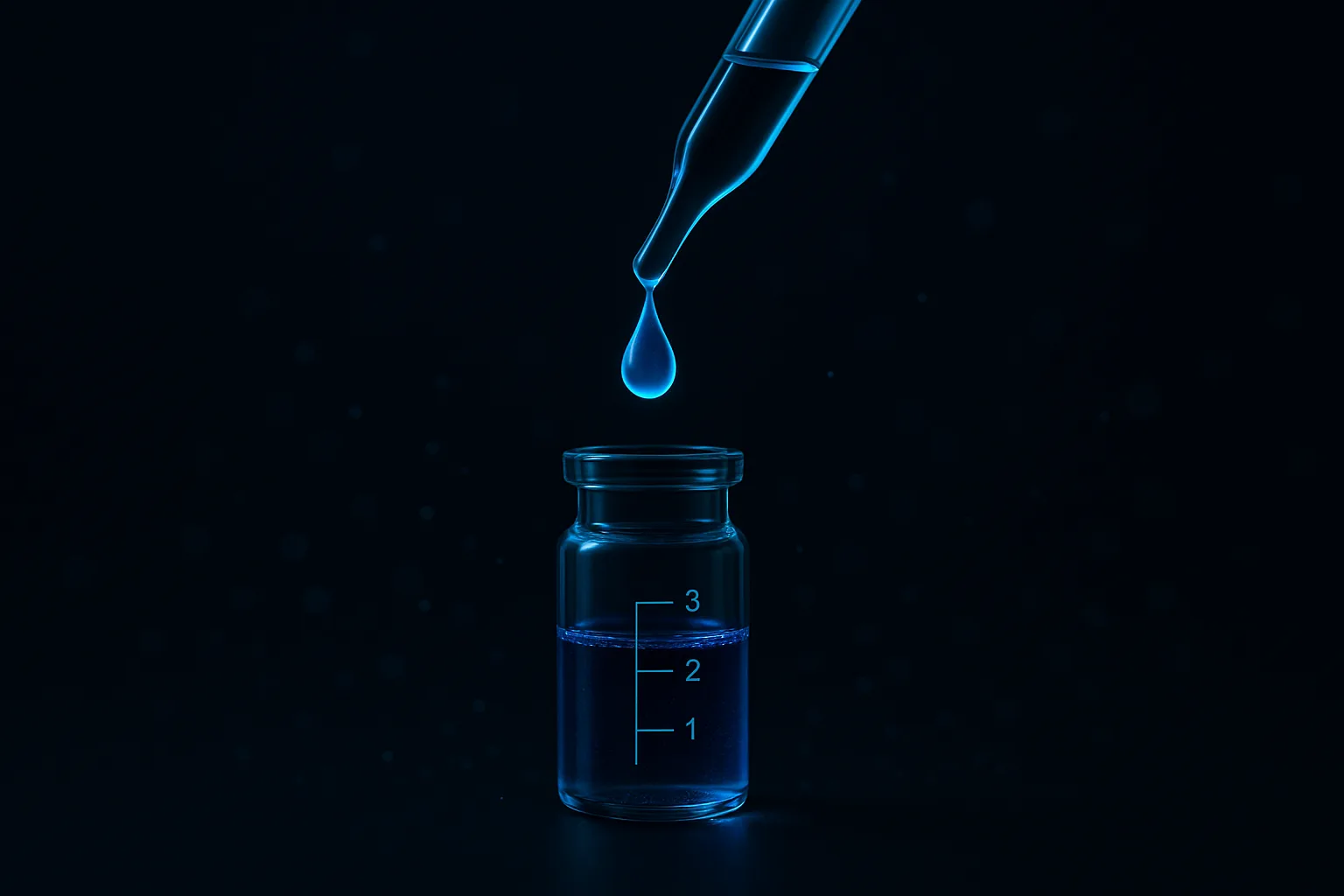
Methylene blue is generally sold as a ready-made solution rather than a lyophilized powder needing bacteriostatic water, so the reconstitution math common to injectable peptides does not apply in the same way. The relevant arithmetic is concentration-to-dose conversion for an oral solution:
| Listed product | Concentration | Math to a small oral dose |
|---|---|---|
| 1% solution (e.g., 60 mL) | ~10 mg per mL | 0.5 mL ≈ 5 mg; 1 mL ≈ 10 mg |
| 10 mg/mL solution (e.g., 30 mL) | 10 mg per mL | 0.5 mL ≈ 5 mg; 1 mL ≈ 10 mg |
These conversions reflect the concentration arithmetic community sources describe when working with low-dose oral protocols — not manufacturer dosing instructions.
Both common listings land near 10 mg/mL, so a fraction of a milliliter corresponds to the low fixed doses community sources describe. Community sources commonly describe diluting that fraction into a larger volume of water before drinking, both to make the small dose easier to measure and to reduce staining of the mouth. These are reported practices, not instructions.
Our methylene blue vendor comparison lists verified suppliers with active coupons.