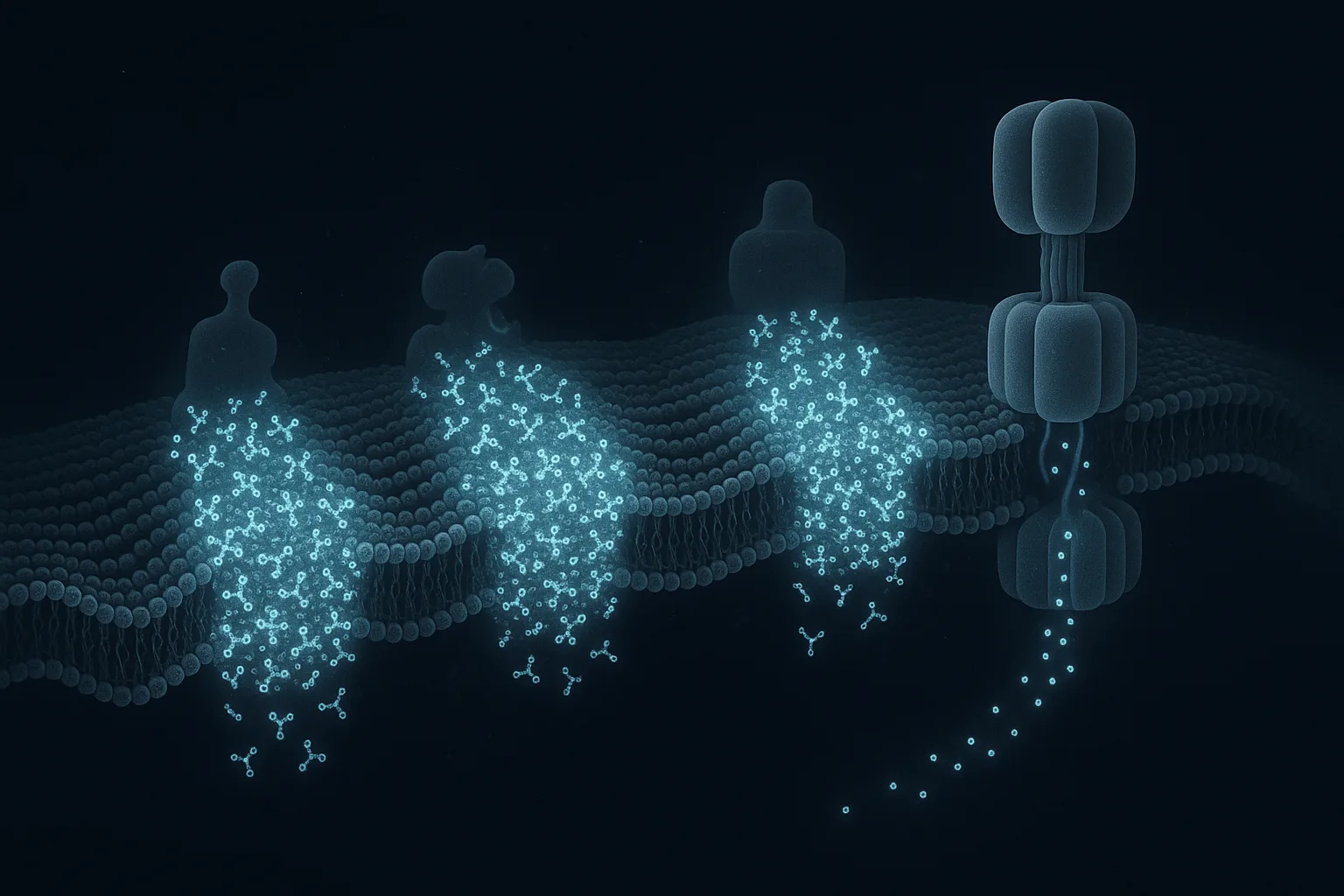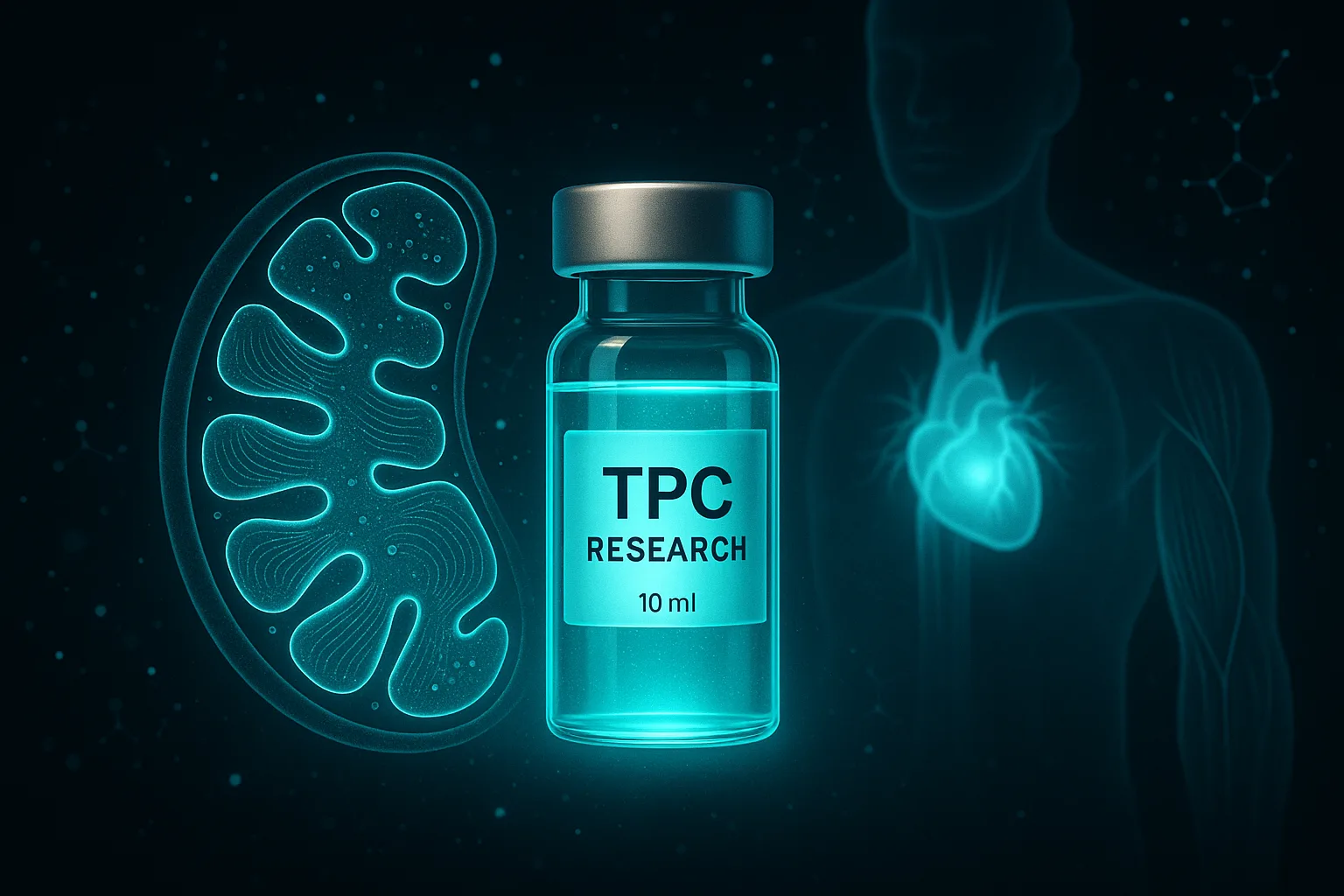
SS-31, also called elamipretide, is a synthetic tetrapeptide (D-Arg-dimethylTyr-Lys-Phe-NH2) that binds cardiolipin on the inner mitochondrial membrane. Unlike most peptides, it doesn't work through a receptor — it stabilizes the structural scaffold that powers every cell.
That mechanism matters because mitochondrial dysfunction sits underneath almost every chronic disease of aging: heart failure, sarcopenia, cognitive decline, macular degeneration, and metabolic disease. SS-31 is the most thoroughly studied peptide targeting that layer.
Below are the 7 benefits with the strongest evidence — ranked by quality of data, not by hype. Several have human clinical trial support. Some failed their primary endpoints but showed mechanistic benefit. We'll be clear about which is which.
How SS-31 Works (30-Second Version)
Cardiolipin is a phospholipid found only on the inner mitochondrial membrane. It anchors cytochrome c, organizes the electron transport chain into supercomplexes, and shapes the cristae folds where ATP is produced. When cardiolipin is peroxidized or disorganized — by age, ischemia, or genetic mutation — mitochondria leak electrons, produce less ATP, and pump out more reactive oxygen species.
SS-31 binds cardiolipin via electrostatic and hydrophobic interactions (Szeto 2014). This stabilizes cristae structure, restores electron flow, and increases ATP output — usually within an hour of dosing. For the mechanism deep-dive see the SS-31 research guide; for protocol specifics see the SS-31 dosing guide.
Benefit 1: Rapid Restoration of Mitochondrial ATP Output
Evidence quality: Strong (human RCT)
This is the signature finding. In a randomized, double-blind, placebo-controlled trial of 39 older adults (60-85) pre-screened for mitochondrial dysfunction, a single IV dose of elamipretide significantly raised in vivo mitochondrial ATPmax in skeletal muscle — measured non-invasively via magnetic resonance spectroscopy (Roshanravan et al., 2021).
The effect rose on the day of dosing and faded by day 7, consistent with the 16-hour plasma half-life. For comparison, achieving similar ATPmax improvements through exercise training takes weeks to months.
Why it matters: ATP is the universal energy currency. If you can measurably raise it in vivo — in human muscle — after a single dose, every downstream benefit (recovery, endurance, cellular resilience) has a plausible mechanistic basis.
Benefit 2: Cardiac Function in Cardiolipin Deficiency (Barth Syndrome)
Evidence quality: Strong (Phase 2/3 RCT + 168-week extension, FDA approved 2025)
Barth syndrome is a rare X-linked genetic disorder causing defective cardiolipin remodeling, leading to cardiomyopathy, skeletal myopathy, and neutropenia. The TAZPOWER trial randomized 12 subjects to 40 mg/day SC elamipretide vs placebo for 12 weeks, followed by crossover and open-label extension (Thompson et al., 2021).
The 12-week primary endpoints (6-minute walk test and symptom assessment) were not met. But the 168-week open-label extension showed sustained improvement in cardiac function, exercise capacity, and quality of life — strong enough that the FDA approved elamipretide for Barth syndrome in September 2025. Eight of the original 10 open-label subjects reached the 168-week visit.
This is the single cleanest proof that cardiolipin binding translates to clinical benefit in humans — because Barth patients have the underlying cardiolipin defect SS-31 is designed to address.
Evidence quality: Strong (preclinical, consistent across multiple labs)
In aged mice, a single hour of SS-31 treatment restored in vivo P/O ratio and ATPmax to young-adult levels (Siegel et al., 2013). Eight days of treatment increased whole-animal treadmill endurance.
A follow-up study confirmed SS-31 reverses redox proteome damage across aged skeletal muscle — hundreds of cysteine residues lose pathological S-glutathionylation, gastrocnemius mass and fatigue resistance improve, and exercise tolerance increases without any change in mitochondrial content (Campbell et al., 2019).
Most recently, SS-31 was shown to bind directly to the adenine nucleotide translocator (ANT) and improve ADP sensitivity in aged human muscle mitochondria within an hour (Siegel et al., 2023) — giving a molecular explanation for the rapid functional rescue.
Caveat: the mouse data are strong, and the human muscle ex vivo + single-dose ATP data support the mechanism, but long-term RCTs of SS-31 for age-related sarcopenia have not been run.
Benefit 4: Slower Retinal Degradation in Dry AMD
Evidence quality: Moderate (Phase 2 RCT, primary endpoint missed)
The ReCLAIM-2 Phase 2 trial tested 40 mg/day SC elamipretide for 48 weeks in geographic atrophy secondary to AMD (Allingham et al., 2024). Primary endpoints (best-corrected visual acuity, low-luminance BCVA change) were not met.
Exploratory secondary analyses showed slower ellipsoid zone degradation — the retinal layer most tied to photoreceptor survival. Stealth is using ellipsoid zone preservation as the primary endpoint for the Phase 3 AMD program.
The earlier Phase 1 ReCLAIM study (n=15 completers, 24 weeks) showed mean +4.6 letter BCVA improvement and +5.4 letters on low-luminance BCVA (Cousins et al., 2022).
Translation: the mechanism looks real at the tissue level, but functional vision benefit hasn't cleared a regulatory endpoint yet.
Ready to buy? Compare verified vendors on our best SS-31 sources page, or browse all coupon codes for up to 50% off.
Benefit 5: Reduced Oxidative Stress Without Antioxidant Supplementation
Evidence quality: Moderate-Strong (mechanistic + preclinical)
Most mitochondrial antioxidants (CoQ10, MitoQ, lipoic acid) scavenge reactive oxygen species (ROS) after they form. SS-31 works upstream: by stabilizing the cardiolipin-cytochrome c complex, it prevents cytochrome c from converting into a peroxidase in the first place (Birk et al., 2013).
Less peroxidase activity means less peroxidized cardiolipin, which means intact cristae, better electron flow, and lower downstream ROS output. In aged muscle, SS-31 treatment shifted the glutathione redox status to a more reduced state and reversed S-glutathionylation on hundreds of proteins (Campbell et al., 2019).
Practical takeaway: this is a different category of antioxidant action — structural rather than chemical. It's why community users often pair SS-31 with NAD+ rather than with traditional antioxidants. See the NAD+ dosing guide for the complementary pathway.
Benefit 6: Primary Mitochondrial Myopathy — Dose-Dependent Walk Improvement (Earlier Trials) but Null Phase 3
Evidence quality: Mixed (MMPOWER-1 positive, MMPOWER-3 negative)
The first MMPOWER trial showed that escalating IV elamipretide doses improved 6-minute walk distance in adults with genetically confirmed primary mitochondrial myopathy (PMM) (Karaa et al., 2018).
The Phase 3 MMPOWER-3 trial (40 mg/day SC for 24 weeks) did not improve the 6MWT or fatigue at 24 weeks compared with placebo in a genotypically diverse PMM population (Karaa et al., 2023).
A prespecified subgroup of patients with nuclear DNA pathogenic variants did improve on the 6MWT; those with mitochondrial DNA variants did not. This matches the Barth story: SS-31 seems to work best when the defect is specifically cardiolipin-related or cristae-related.
For generally healthy users, the PMM data set a realistic ceiling: SS-31 is not a pharmacological exercise mimetic for everyone.
Benefit 7: Protection Against Ischemia-Reperfusion Injury
Evidence quality: Strong preclinical, mechanism only in humans
Ischemia (loss of blood flow) destroys mitochondrial cristae. Reperfusion (blood flow returning) floods the tissue with oxygen, generating a burst of ROS and tissue damage. SS-31 pretreatment in rat renal ischemia preserved cristae structure, prevented mitochondrial swelling, and led to rapid ATP recovery on reperfusion — with downstream protection of tubular function (Birk et al., 2013).
Similar protection has been shown in heart and hind-limb ischemia models. Human clinical data in this area is limited, but it's one of the reasons SS-31 is being explored for post-MI cardioprotection.
Evidence Summary
| Benefit |
Evidence Quality |
Data Type |
| Mitochondrial ATP restoration |
Strong |
Human RCT (single dose) |
| Barth syndrome cardiac function |
Strong |
Phase 2/3 + 168wk OLE (FDA approved) |
| Age-related muscle dysfunction |
Strong |
Preclinical + human muscle ex vivo |
| AMD retinal preservation |
Moderate |
Phase 2 (primary missed, secondary positive) |
| Oxidative stress reduction |
Moderate-Strong |
Mechanistic + preclinical |
| Primary mitochondrial myopathy |
Mixed |
Phase 3 negative, subgroup positive |
| Ischemia-reperfusion protection |
Preclinical |
Animal models |
What SS-31 Will NOT Do
Setting realistic expectations:
- It won't build muscle. SS-31 restores function in dysfunctional mitochondria. It doesn't drive hypertrophy or replace training.
- It won't burn fat. No clinical data supports a weight-loss or body-recomposition benefit.
- It won't reliably help HFrEF. The PROGRESS-HF Phase 2 trial did not improve left ventricular end-systolic volume at 4 weeks in stable HFrEF patients (Butler et al., 2020).
- It won't work equally for everyone. The MMPOWER-3 subgroup data and the Barth specificity suggest SS-31 benefits scale with how cardiolipin-centered the underlying dysfunction is.

Who Should Consider SS-31
Based on the evidence pattern, SS-31 is most plausibly useful for:
- Adults 55+ with subjective energy/recovery decline tied to mitochondrial aging
- Athletes recovering from high training loads or returning from overtraining
- Long COVID cases where mitochondrial dysfunction has been documented (off-label, limited data)
- People stacking longevity compounds targeting different aging pathways — SS-31 covers the mitochondrial structure layer that NAD+ and rapamycin do not
It's less obviously useful for someone young, healthy, and training consistently. The baseline mitochondrial function ceiling matters — you can only rescue what's dysfunctional.
If you want to track whether SS-31 is actually working for you, the SS-31 bloodwork guide covers fasting lactate, CoQ10, and oxidative stress markers that respond to cardiolipin support.
Frequently Asked Questions
What is the strongest proven benefit of SS-31?
Direct restoration of mitochondrial ATP production. A single IV dose raised muscle ATPmax in older adults with dysfunctional mitochondria in a randomized trial — the most replicable finding across species.
Does SS-31 actually help heart failure?
Only where the failure is cardiolipin-driven. Barth syndrome (now FDA-approved): yes. Stable HFrEF (PROGRESS-HF): no functional benefit at 4 weeks. Established HFpEF: preclinical evidence suggests mitochondrial benefit without functional translation so far.
Does SS-31 slow dry AMD?
Phase 2 missed its primary visual acuity endpoint, but slowed ellipsoid zone degradation — the layer responsible for photoreceptor survival. Stealth is using that as the Phase 3 primary endpoint.
Is SS-31 a cardiolipin antioxidant?
Indirectly. It prevents cytochrome c from turning into a peroxidase by stabilizing the cytochrome c/cardiolipin complex. That cuts ROS at the source rather than scavenging ROS after formation.
In aged mice and older adults with baseline mitochondrial dysfunction, yes — ATPmax and endurance rise. In young, healthy, well-trained individuals, there's no controlled data. Community reports are mixed.
Is SS-31 FDA-approved?
Yes for Barth syndrome (September 2025). Still investigational for heart failure, primary mitochondrial myopathy, AMD, and general anti-aging use.
References
| Citation |
Topic |
PMID |
| Szeto, Br J Pharmacol (2014) |
First-in-class cardiolipin-protective compound |
24117165 |
| Birk et al., J Am Soc Nephrol (2013) |
SS-31 re-energizes ischemic mitochondria via cardiolipin |
23813215 |
| Siegel et al., Aging Cell (2013) |
Rapid mitochondrial + muscle rescue in aged mice |
23692570 |
| Campbell et al., Free Radic Biol Med (2019) |
Redox stress reversal + exercise tolerance |
30597195 |
| Siegel et al., GeroScience (2023) |
ANT binding and ADP sensitivity in aged muscle |
37462785 |
| Roshanravan et al., PLoS One (2021) |
Single-dose elamipretide raises ATPmax in older adults |
34264994 |
| Thompson et al., Genet Med (2021) |
TAZPOWER trial in Barth syndrome |
33077895 |
| Karaa et al., Neurology (2023) |
MMPOWER-3 Phase 3 in primary mitochondrial myopathy |
37268435 |
For educational and research purposes only. This is not medical advice. SS-31 (elamipretide) is FDA-approved for Barth syndrome as of 2025; all other uses remain investigational.