Survodutide is a dual glucagon/GLP-1 receptor agonist — and it's the glucagon component that makes the benefit profile distinct from semaglutide or tirzepatide. Here are six research-backed effects, ranked by the strength of clinical evidence.
Research-context information only. Survodutide is an investigational drug not approved by the FDA. Protocols, doses, and reactions reported below come from published clinical trials and self-reported community sources. This article reports what has been documented, not what should be done. Possession or use of investigational drugs outside an authorized clinical trial may be illegal in your jurisdiction. Consult a licensed physician for personal medical decisions.
Key Benefits at a Glance
- Weight loss: Up to 18.7% body weight reduction in Phase 2 (46 weeks)
- Liver fat clearance: 62% MASH improvement rate at the 4.8mg dose (Phase 2)
- Glycemic control: Dose-dependent HbA1c reductions in T2D patients
- Body composition: Dual mechanism targets fat loss from both intake and expenditure
- Cardiovascular markers: Improvements in lipids, blood pressure, and inflammatory markers
- Energy expenditure: Glucagon receptor activation increases metabolic rate
1. Weight Loss (Strongest Evidence)
Evidence level: Phase 2 randomized controlled trial in 387 participants
The Phase 2 obesity trial demonstrated dose-dependent weight loss over 46 weeks:
- 0.6 mg/week: -6.2% body weight
- 2.4 mg/week: -12.5%
- 3.6 mg/week: -13.2%
- 4.8 mg/week: -14.9% (intention-to-treat) / -18.7% (actual doses received)
- Placebo: -2.8%
Over half of participants receiving 4.8mg achieved ≥15% body weight loss. The dual mechanism — appetite suppression via GLP-1 plus increased energy expenditure via glucagon — creates weight loss from both sides of the energy equation.
Practical significance: The 18.7% weight loss in completers approaches retatrutide's Phase 2 results and substantially exceeds semaglutide monotherapy.
2. Liver Fat Reduction / MASH (Strong Evidence)
Evidence level: Phase 2 randomized, biopsy-confirmed MASH trial
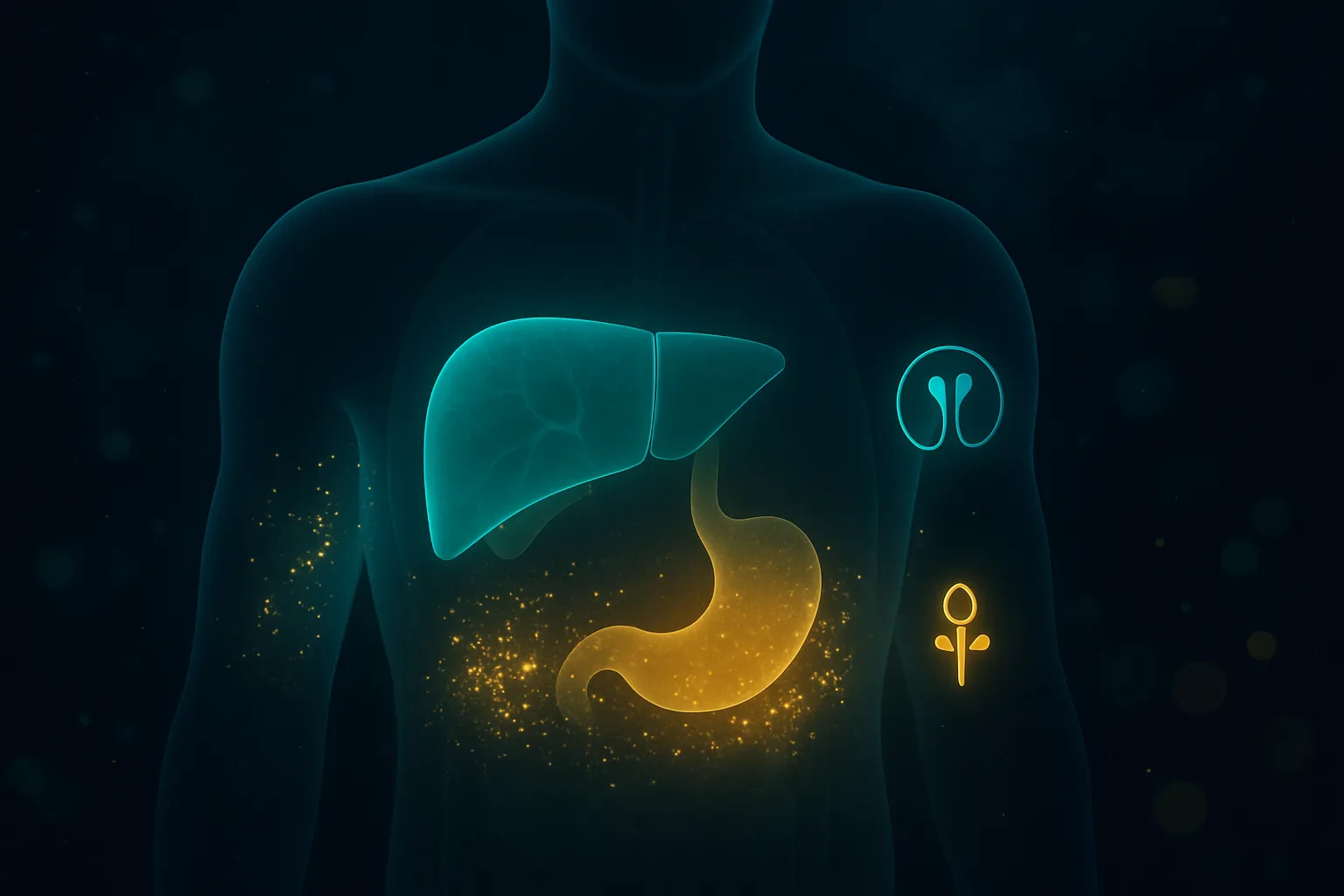
This may be survodutide's most clinically significant benefit. In a dedicated Phase 2 trial for metabolic dysfunction-associated steatohepatitis (MASH, formerly NASH):
- 62% of participants on the 4.8mg dose achieved histologic improvement in MASH with no worsening of fibrosis (47% / 62% / 43% across the 2.4 / 4.8 / 6.0mg doses vs 14% placebo)
- 36% achieved improvement in fibrosis by at least one stage at 4.8mg (34% / 36% / 34% across doses vs 22% placebo)
- Liver fat content decreased by ≥30% in the majority of treated participants
The glucagon receptor component is the key driver — glucagon directly stimulates hepatic lipid oxidation and reduces hepatic lipogenesis. Based on that 62% histologic-improvement rate reported in the Phase 2 MASH trial, survodutide ranks — alongside retatrutide — among the most effective pharmacological interventions studied for MASH to date.
3. Glycemic Control (Strong Evidence)
Evidence level: Phase 2 randomized trial in people with type 2 diabetes
In the T2D trial, survodutide produced dose-dependent HbA1c reductions:
- Survodutide at the highest doses reduced HbA1c significantly more than placebo
- Body weight decreased dose-dependently up to -8.7% (highest dose group)
- Survodutide at doses ≥1.8mg weekly produced greater body weight reductions than open-label semaglutide 1mg
The dual mechanism provides glycemic control through complementary pathways: GLP-1 enhances glucose-dependent insulin secretion while glucagon paradoxically improves hepatic glucose metabolism by reducing liver fat.
Ready to buy? Compare verified vendors on our best survodutide sources page, or browse all coupon codes for up to 50% off.