articlesApril 25, 2026·8 min read

GLP-1 for Alzheimer's: 2026 Trial Results (Mixed)

Semaglutide EVOKE trial missed its primary endpoint. Liraglutide ELAD showed 50% less brain volume loss. What the 2026 data means for GLP-1 peptide buyers.

GLP-1 peptide molecular structure suspended over an abstract glowing brain with neural pathways

Between late 2025 and April 2026, two major trials of GLP-1 peptides in Alzheimer's disease published contrasting results. Semaglutide missed its Phase 3 primary endpoint. Liraglutide hit Phase 2b secondary endpoints with a striking MRI signal. If you've been following the "GLP-1s might cure dementia" headlines from 2024, this is the reality check — and it changes how buyers should think about GLP-1 peptides for brain health.

Research-context information only. Peptides discussed below are research compounds. Protocols, doses, and reactions reported come from published research and self-reported community sources. This article reports what has been documented, not what should be done. Consult a licensed physician for personal medical decisions.

The Two Trials That Changed the Story

Two datasets matter more than the rest. Everything else published in this window either supports one of these or reflects observational data with known limitations.

EVOKE and EVOKE+ (semaglutide, Phase 3) — negative. Novo Nordisk ran two parallel Phase 3 trials enrolling 3,808 participants aged 55 to 85 with mild cognitive impairment or mild Alzheimer's dementia confirmed by amyloid PET or CSF. Patients received oral semaglutide 14 mg or placebo for 104 weeks. The primary endpoint was change in CDR-SB (Clinical Dementia Rating — Sum of Boxes). Results published in The Lancet March 2026: mean CDR-SB change was 2.3 on semaglutide vs 2.3 on placebo in EVOKE, and 2.2 vs 2.1 in EVOKE+. Secondary cognitive and functional outcomes also showed no meaningful difference. The 52-week blinded extension was discontinued.

The one positive signal: amyloid and tau biomarkers dropped modestly in the semaglutide arm (roughly 10% reductions in some markers), and inflammation markers moved in the right direction. Biological activity was real. It just didn't translate into cognitive or functional benefit over two years.

ELAD (liraglutide, Phase 2b) — mixed but interesting. Published in Nature Medicine in late 2025, this Imperial College-led UK trial randomized 204 patients with mild to moderate Alzheimer's (without diabetes) to daily injected liraglutide or placebo for 52 weeks. The primary endpoint — change in cerebral glucose metabolism on FDG-PET — was not met (p = 0.14). But secondary endpoints told a different story:

  • 18% slower cognitive decline on the ADAS-Exec (executive function) measure
  • Nearly 50% less gray matter volume loss on MRI, specifically in frontal, temporal, parietal, and total gray matter regions
  • Safety and tolerability: well tolerated in a non-diabetic AD population

The effect sizes are large enough that they shouldn't be dismissed. They're also Phase 2b, underpowered for clinical endpoints, and hinge on surrogate measures that don't always predict Phase 3 success.
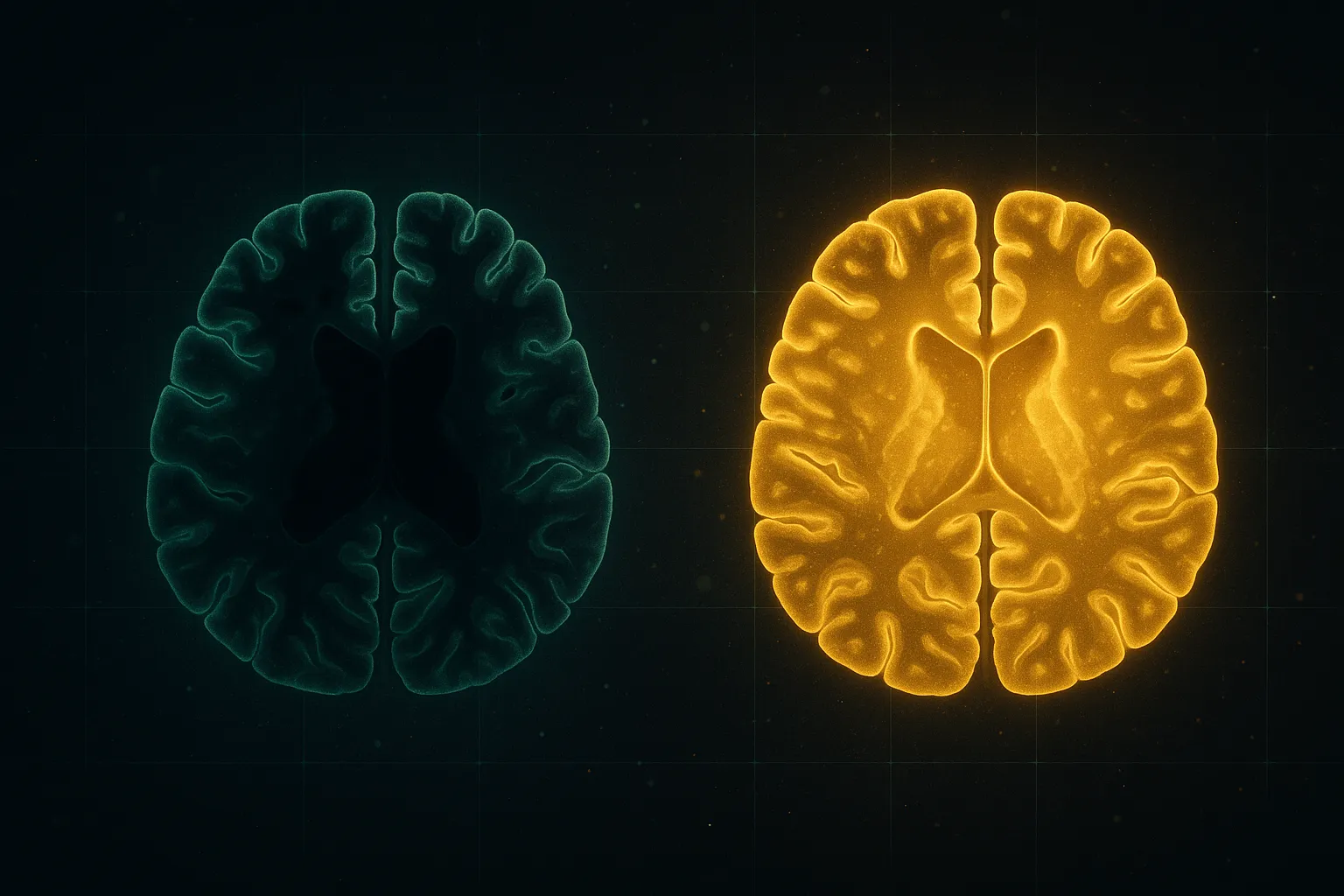
Scientific imaging aesthetic showing contrasting brain scans with one arm showing preserved gray matter volume

Why the Results Diverged

Nobody knows for certain, but four hypotheses are on the table:

1. Blood-brain barrier penetration. Liraglutide is a smaller peptide with properties that appear to cross the blood-brain barrier more readily than semaglutide, which was engineered for albumin binding and long half-life at the cost of CNS penetration. If the target is neuronal GLP-1 receptors, liraglutide may simply reach more of them.

2. Oral vs injectable formulation. EVOKE used oral semaglutide (oral tablet formulation, roughly 1% bioavailability). ELAD used daily subcutaneous injections. Peak CNS exposure differs substantially.

3. Disease stage. ELAD enrolled mild to moderate dementia. EVOKE specifically targeted early-stage symptomatic AD (MCI or mild dementia). Counter-intuitively, the less-advanced population in EVOKE showed no benefit. This may reflect floor effects in early patients — less to "save" in 104 weeks — or something about amyloid-confirmed populations that differs from the broader ELAD cohort.

4. Trial duration and power. ELAD ran 52 weeks in 204 patients. EVOKE ran 104 weeks in nearly 20x the sample. A real but small effect could have been missed in ELAD power-wise; in EVOKE, a real small effect should have been detected. The most parsimonious read: semaglutide's CNS effect is too weak to matter at scale.

What the Observational Data Still Shows

The negative EVOKE readout does not erase the observational evidence, which is large and consistent:

  • A 295,000-patient propensity-matched cohort found 70% reduced dementia risk in GLP-1 users vs non-users
  • A separate retrospective cohort showed HR 0.58 for dementia in GLP-1 users vs DPP-4 inhibitor users (95% CI 0.55–0.61, p < 0.0001)
  • Multiple 2025 reviews of diabetic medical records reported 40–70% lower dementia incidence in GLP-1 users across different drug classes

Observational data can't establish causality. Healthier patients get put on GLP-1 drugs. Better glycemic control independently reduces dementia risk. Socioeconomic confounders are hard to fully adjust for. But the signal has been reproduced across independent datasets, drug classes, and countries. It's real; it's just not necessarily the drug doing the work.

For vendor comparisons and current pricing on the GLP-1 peptides referenced in these trials:

What This Means for Buyers

If you were considering a GLP-1 peptide specifically for brain-health reasons, the 2026 data changes the calculus. Here's the read:

Semaglutide for cognition: not supported. The largest, best-controlled trial in Alzheimer's is now negative. If your reason for taking semaglutide is weight loss, metabolic health, or knee cartilage (where the 2026 osteoarthritis data is positive), those indications are intact. The dementia-slowing case is not.

Liraglutide for cognition: still a question mark. The ELAD data is interesting but preliminary. A Phase 3 liraglutide AD trial has not launched. Buying liraglutide specifically for brain protection is getting ahead of the evidence. If you're already using liraglutide for weight loss, the possible brain-side benefit is a reasonable bonus hypothesis.

Retatrutide and tirzepatide for cognition: unknown. Neither has a dedicated Alzheimer's trial underway. Observational data doesn't separate them from older GLP-1 drugs. If the class effect is real, they should work; if it's blood-brain barrier penetration specifically, they may not.

The observational "lower dementia risk" signal: take it as bonus, not indication. If your reason for taking a GLP-1 is metabolic or weight-related, the dementia signal is a plausible add-on. If dementia prevention is your primary goal and you're not overweight or diabetic, there is no validated protocol and no trial data supporting that use.

Dark navy scientific composition showing peptide receptor binding to neurons with contrasting signaling intensity

How to Think About the Biomarker Data

One subtlety worth flagging: EVOKE showed biomarker improvement without clinical benefit. Amyloid and tau markers moved modestly. Inflammation decreased. But the CDR-SB, which patients and caregivers actually care about, didn't budge.

This is a recurring pattern in Alzheimer's trials. Anti-amyloid antibodies (lecanemab, donanemab) produce massive biomarker changes and small clinical effects. GLP-1 produces small biomarker changes and no clinical effect. Either the disease progresses through mechanisms these drugs don't reach, or the trial durations are too short, or the patients are too far along for the mechanism to help. The field hasn't figured out which.

For buyers, the practical implication: biomarker changes are not proof of benefit. A vendor or clinician pointing to "semaglutide reduces neuroinflammation markers" is citing real data that didn't translate to clinical outcomes in the largest trial ever run for this indication.

Practical Framework If You Want CNS-Adjacent Peptides

If brain health is your goal and you're building a peptide stack, the GLP-1 class is not the strongest-evidence option for that specific indication. The peptides with direct cognitive trial data are Semax, Selank, and emerging work on Dihexa. See our best peptides for brain health breakdown for the full ranking.

That said, if you're on a GLP-1 for weight loss or diabetes and you're older than 55, the possible CNS side-benefit from the observational data is a real, if unvalidated, bonus. It's not a reason to start; it's a reason to not worry about continuing.

Full dosing protocols:

The Bottom Line

The 2026 trial data didn't end the GLP-1-for-brain hypothesis, but it narrowed it substantially. Semaglutide — the most-prescribed, best-studied GLP-1 — does not slow Alzheimer's progression at 14 mg oral dosing over 104 weeks. Liraglutide shows a surprising MRI signal at 52 weeks that demands Phase 3 confirmation. The 40–70% dementia risk reduction in observational data persists but is almost certainly partly confounded.

For buyers: if you're using a GLP-1 peptide for weight loss, metabolic health, or (on the newer data) joint health, continue. If you were buying it primarily for dementia prevention, the evidence doesn't support that use case today. Revisit when Phase 3 liraglutide data lands.

Frequently Asked Questions

Does semaglutide slow Alzheimer's disease progression?
No. The Phase 3 EVOKE and EVOKE+ trials, published in The Lancet in March 2026, tested oral semaglutide 14 mg in 3,808 patients with early Alzheimer's and missed the primary cognitive endpoint (CDR-SB). Mean 104-week change was 2.3 on semaglutide vs 2.3 on placebo. Biomarkers improved, but this did not translate into clinical benefit.
Did liraglutide work for Alzheimer's?
Partially. The Phase 2b ELAD trial in 204 patients missed its primary brain glucose metabolism endpoint but showed 18% slower cognitive decline (ADAS-Exec) and nearly 50% less gray matter volume loss on MRI in the liraglutide arm over 52 weeks. Results are promising but require a larger Phase 3 trial to confirm.
Why did liraglutide look better than semaglutide?
Possible reasons include blood-brain barrier penetration (liraglutide is thought to cross more readily than semaglutide), daily injection versus oral dosing, or patient population differences (ELAD enrolled mild to moderate AD without diabetes; EVOKE enrolled early AD with amyloid confirmation). No head-to-head trial exists yet, so this is inference.
Do observational studies still support GLP-1 peptides for brain health?
Yes. Large propensity-matched cohort studies consistently show 40–70% lower dementia risk in GLP-1 users versus non-users. These are observational and prone to confounding (healthier patients, better diabetes control), but the signal has been reproduced across multiple datasets and drug classes within the GLP-1 family.
What does research describe about GLP-1 peptides for dementia prevention?
The evidence doesn't support using GLP-1 peptides purely for dementia prevention today. The strongest human trial data (EVOKE) is negative for semaglutide in established Alzheimer's. The observational signal is real but unproven as causal. For people already on a GLP-1 for weight loss or diabetes, a brain-related side-benefit is plausible but not guaranteed. For asymptomatic, non-overweight people, there is no validated indication.
30ml bacteriostatic water vial — 0.9% benzyl alcohol multi-dose
Bac Water Made for Peptides
Don't risk a $300 peptide on generic bac water.
Most cloudy reconstitutions trace back to one thing — and it isn't the peptide. Sterile, non-pyrogenic, 0.9% benzyl alcohol — formulated for peptide reconstitution, not repackaged from generic stock.
0.9% benzyl alcohol Made for peptides 30 mL multi-dose
See why our bac water doesn't ruin peptides
30ml from $18.75 · Ships fast · Code thepeptidecatalog

References

  1. Cummings J, et al. Efficacy and safety of oral semaglutide 14 mg (flexible dose) in early-stage symptomatic Alzheimer's disease (evoke and evoke+): two phase 3, randomised, placebo-controlled trials. The Lancet. 2026. DOI: 10.1016/S0140-6736(26)00459-9.
  2. Femminella GD, Edison P, et al. Liraglutide in mild to moderate Alzheimer's disease: a phase 2b clinical trial. Nature Medicine. 2025. PMID 41326666.
  3. Cummings J, et al. evoke and evoke+: design of two large-scale, double-blind, placebo-controlled, phase 3 studies evaluating efficacy, safety, and tolerability of semaglutide in early-stage symptomatic Alzheimer's disease. Alzheimer's Research & Therapy. 2025. PMID 39780249.
  4. Zhang Y, et al. Real-world observations of GLP-1 receptor agonists and SGLT-2 inhibitors as potential treatments for Alzheimer's disease. Alzheimer's & Dementia. 2025. DOI: 10.1002/alz.70639.
  5. Novo Nordisk. Evoke phase 3 trials did not demonstrate a statistically significant reduction in Alzheimer's disease progression. Press release, November 24, 2025.
  6. Alzheimer's Drug Discovery Foundation. Readout of Phase 3 Semaglutide Trials Marks Critical Moment in Alzheimer's Research. 2025.
  7. Imperial College London. Weight-loss drug liraglutide slowed Alzheimer's decline. News release, December 2025.