Side-by-side evidence
Outcomes where both peptides have published data. Each cell carries two grades: clinical evidence (human-RCT depth for this specific outcome) and community evidence (real-world adoption). How we grade evidence.
| Outcome | Semaglutide | Tirzepatide |
|---|
| Body weight reduction | Clinical:Strong Community:Strong ~14.9% weight loss in STEP 1 at 2.4 mg weekly over 68 weeks. | Clinical:Strong Community:Moderate ~22.5% weight loss in SURMOUNT-1 at 15 mg weekly over 72 weeks; beat semaglutide head-to-head in SURMOUNT-5. |
| Glycemic control (HbA1c) | Clinical:Strong Community:Strong HbA1c reductions of ~1.4-1.8 points across SUSTAIN trials. | Clinical:Strong Community:Moderate Larger HbA1c reductions (~2.0-2.4 points) in SURPASS trials. |
| Cardiovascular outcomes | Clinical:Strong Community:Strong SUSTAIN-6 and SELECT trials confirmed reduced MACE in T2D and obesity respectively. | Clinical:Moderate Community:Moderate SURPASS-CVOT ongoing; existing data show clear cardiometabolic improvement signals. |
| Side effect burden | Clinical:Strong Community:Strong GI symptoms in 30-50% of subjects during titration; usually transient. | Clinical:Strong Community:Moderate Similar GI profile; some studies suggest slightly higher nausea early in titration. |
The Two Most Effective Weight Loss Peptides
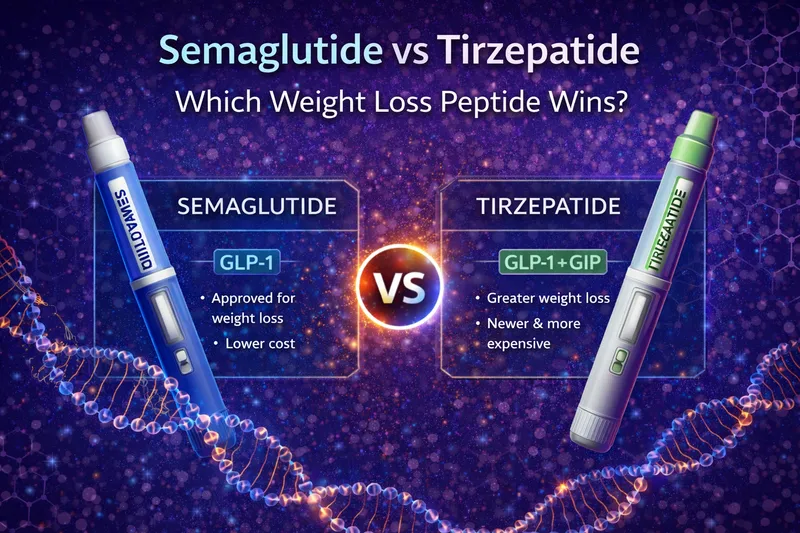
Semaglutide and Tirzepatide have transformed the weight loss landscape. Both are GLP-1 receptor agonists, but Tirzepatide adds a second mechanism — GIP receptor agonism — that may give it an edge in clinical trials.
This comparison covers the real differences backed by published trial data.
Mechanism of Action
Semaglutide (GLP-1 Agonist)
Semaglutide mimics the GLP-1 hormone, which is naturally released after eating. Effects include:
- Appetite suppression — acts on hypothalamic hunger centers
- Delayed gastric emptying — food stays in the stomach longer, increasing satiety
- Improved insulin sensitivity — reduces blood sugar spikes
- Reduced food reward signaling — decreases cravings and reward-driven eating
Semaglutide is a single agonist — it targets only the GLP-1 receptor.
Tirzepatide (Dual GIP/GLP-1 Agonist)
Tirzepatide activates both GLP-1 and GIP (glucose-dependent insulinotropic polypeptide) receptors:
- GLP-1 effects — same appetite suppression and insulin sensitivity as semaglutide
- GIP receptor activation — enhances fat metabolism and insulin secretion through a complementary pathway
- Synergistic signaling — the dual mechanism produces greater metabolic effects than either pathway alone
This dual agonism is why Tirzepatide has shown superior weight loss in head-to-head trials.
Quick Comparison Table
| Feature |
Semaglutide |
Tirzepatide |
| Mechanism |
GLP-1 agonist |
Dual GIP/GLP-1 agonist |
| FDA status |
Approved (diabetes + weight loss + oral) |
Approved (diabetes + weight loss) |
| FDA approved |
Yes — weight loss & T2D |
Yes — weight loss & T2D |
| Administration |
Weekly injection (or daily oral) |
Weekly injection |
| Oral option |
Yes |
No |
| Max clinical dose |
2.4 mg/week |
15 mg/week |
| Avg weight loss (trials) |
~15–17% body weight |
~20–22.5% body weight |
| Time to market |
2017 (T2D), 2021 (weight) |
2022 (T2D), 2023 (weight) |
Ready to buy? Compare verified vendors on our best semaglutide sources page, or browse all coupon codes for up to 50% off.
Clinical Trial Results
STEP Trials (Semaglutide)
The STEP program studied semaglutide 2.4 mg weekly in overweight/obese adults:
- STEP 1: 16.9% average weight loss over 68 weeks vs 2.4% placebo
- STEP 2 (T2D patients): 9.6% weight loss
- STEP 3 (with behavioral therapy): 16.0% weight loss
- STEP 5 (2-year data): 15.2% sustained weight loss
SURMOUNT Trials (Tirzepatide)
The SURMOUNT program studied tirzepatide at 5mg, 10mg, and 15mg weekly:
- SURMOUNT-1: 20.9% average weight loss at 15mg over 72 weeks vs 3.1% placebo
- SURMOUNT-2 (T2D patients): 14.7% at 15mg
- SURMOUNT-3 (with lifestyle intervention): 26.6% at highest dose
- SURMOUNT-4 (maintenance): continued weight loss vs weight regain on placebo
Head-to-Head
No large head-to-head trial has directly compared them at optimal doses for weight loss. However, cross-trial comparison consistently shows Tirzepatide producing 3–6% greater body weight reduction at maximum doses.
Side Effects Compared
Both share similar GI side effect profiles since they both activate GLP-1 receptors:
| Side Effect |
Semaglutide |
Tirzepatide |
| Nausea |
~44% (most common) |
~31% |
| Diarrhea |
~30% |
~23% |
| Vomiting |
~24% |
~12% |
| Constipation |
~24% |
~23% |
| Pancreatitis risk |
Rare but monitored |
Rare but monitored |
| Gallbladder events |
Slightly elevated |
Slightly elevated |
| Muscle loss |
Concern at higher weight loss |
Concern at higher weight loss |
Tirzepatide generally shows lower GI side effect rates in trials, possibly because GIP receptor activation provides a "smoother" signaling profile than pure GLP-1 agonism.
Muscle Loss Concern
Both peptides cause significant weight loss, and a portion of that weight is lean mass. This is a concern at higher doses and longer durations. Research suggests combining either peptide with resistance training and adequate protein intake to preserve muscle.
Dosing Comparison
Semaglutide
| Phase |
Dose |
Frequency |
| Week 1–4 |
0.25 mg |
Weekly |
| Week 5–8 |
0.5 mg |
Weekly |
| Week 9–12 |
1.0 mg |
Weekly |
| Week 13–16 |
1.7 mg |
Weekly |
| Maintenance |
2.4 mg |
Weekly |
Tirzepatide
| Phase |
Dose |
Frequency |
| Week 1–4 |
2.5 mg |
Weekly |
| Week 5–8 |
5.0 mg |
Weekly |
| Week 9–12 |
7.5 mg |
Weekly |
| Week 13–16 |
10 mg |
Weekly |
| Maintenance |
10–15 mg |
Weekly |
Both require gradual dose titration to minimize GI side effects.
Other Weight Loss Peptides
The GLP-1 space is rapidly evolving. Other peptides worth comparing:
- Liraglutide — daily GLP-1 agonist, less effective than both but FDA-approved since 2014
- Retatrutide — triple agonist (GLP-1/GIP/Glucagon), showing up to 24% weight loss in Phase 2 trials
- AOD-9604 — HGH fragment for fat metabolism, much milder effect
The Bottom Line
| If your situation is... |
Consider |
| Maximum weight loss |
Tirzepatide (superior trial data) |
| Need oral option |
Semaglutide (oral formulation available) |
| GI sensitivity |
Tirzepatide (lower side effect rates) |
| Longest safety track record |
Semaglutide (on market longer) |
| Type 2 diabetes + weight loss |
Either (both FDA-approved for T2D) |
| Cost sensitivity |
Check live pricing above — varies by vendor and dose |
| Next-generation option |
Watch Retatrutide (triple agonist) |
Tirzepatide has the edge in raw efficacy and tolerability based on trial data. Semaglutide has a longer track record and an oral formulation. Both are transformative — the choice depends on individual context.
- Semaglutide Benefits — 8 research-backed effects including cardiovascular, kidney, and liver protection
- Retatrutide — The next-generation triple agonist (GLP-1/GIP/Glucagon) showing up to 24% weight loss
- AOD-9604 — HGH fragment for fat metabolism, a milder peptide option
- BPC-157 vs TB-500 — The top healing peptides compared, if you're also exploring recovery
- Ipamorelin vs GHRP-2 vs GHRP-6 — Growth hormone peptides that complement metabolic goals
- 5-Amino-1MQ — Small molecule targeting fat cell metabolism
This article is for educational and research purposes only. It is not medical advice.