The federal drug-pricing storefront at trumprx.gov currently lists four GLP-1 products, and the numbers on the tiles are genuinely low: oral semaglutide at $149 a month, the semaglutide injection pen at $199, and tirzepatide vials at $299. Against manufacturer list prices of roughly $1,000 to $1,350, those are the discounts the November 6, 2025 most-favored-nation agreements promised, and they are real.
They are also, on every one of the injectable products, starting-dose prices. The terms that decide what a month actually costs sit one click deeper, on the manufacturers' own self-pay pages — and they say $349 for standard semaglutide doses, $399 to $449 for tirzepatide, and as much as $1,049 for a top-dose tirzepatide month if a refill window is missed. That spread between the advertised number and the maintenance number is the part almost no summary carries, and it is the part that changes the arithmetic for anyone budgeting a year.
Research-context information only. This article reports publicly listed prices from trumprx.gov, NovoCare Pharmacy and Lilly's self-pay program, checked on September 6, 2026, alongside per-milligram pricing from vendors in the research supply channel. Prices change without notice and vary by dose, program eligibility and location. Peptides sold labeled for research use only are not FDA-approved for human use and have not been evaluated for safety, purity or potency as sold; they are not interchangeable with a dispensed prescription product. Nothing here is medical, financial or legal advice. Consult a licensed physician for personal medical decisions.
What TrumpRx is, and what it is not
TrumpRx launched February 5, 2026 as a federal direct-to-consumer site benchmarking US prices against what other wealthy countries pay. It grew fast — 600-plus generics added May 18, another 160 on June 5, past 800 medications by mid-year — but its structure has stayed the same throughout: it is a referral layer, not a pharmacy. It advertises a price and hands the buyer to the manufacturer's own fulfilment channel. A valid prescription is still required. The transaction, and therefore the fine print, belongs to NovoCare Pharmacy or to LillyDirect.
That distinction is why the site's tiles and the actual invoice can disagree. The tile carries one number per product. The manufacturer's page carries a table with a row per dose.
The starter-dose asterisk
Here is what the two manufacturer self-pay programs publish, as of September 6, 2026.
Semaglutide, NovoCare Pharmacy. New self-paying patients get $199 a month for the first two months, and that rate applies only to the 0.25 mg and 0.5 mg titration doses. After those two months, standard doses list at $349 a month, and the 7.2 mg high-dose pen at $399. The introductory offer is scheduled to expire December 31, 2026, and Novo Nordisk reserves the right to modify or cancel it at any time.
Oral semaglutide, NovoCare Pharmacy. This one is priced per strength rather than per month of tenure: $149 at 1.5 mg, $199 at 4 mg, $299 at 9 mg and 25 mg. The $149 headline is the lowest strength in the ladder, not an introductory rate that later steps up — but a buyer who titrates to a therapeutic strength lands at $299, double the advertised figure. We covered the April 2026 move that ended the flat $149 tier when it happened.
Tirzepatide, LillyDirect self-pay vials. $299 at 2.5 mg, $399 at 5 mg, and $449 for every dose from 7.5 mg through 15 mg.
Laid side by side, the advertised-versus-maintenance gap looks like this:
| Product | Advertised on TrumpRx | Maintenance-dose self-pay | Gap |
|---|---|---|---|
| Oral semaglutide | $149/mo (1.5 mg) | $299/mo (9 mg, 25 mg) | 2.0× |
| Semaglutide pen | $199/mo (first 2 months, 0.25–0.5 mg) | $349/mo (standard doses) | 1.8× |
| Semaglutide pen, high dose | — | $399/mo (7.2 mg) | — |
| Tirzepatide vials | $299/mo (2.5 mg) | $449/mo (7.5–15 mg) | 1.5× |
None of this is concealed — it is on the manufacturers' published pricing pages. It simply does not survive the trip to a headline, an AI overview or a social post, all of which carry the tile number.

The 45-day refill cliff
The tirzepatide program has a condition the semaglutide one does not, and it is the single largest cost variable in the whole map.
The $449 maintenance rate is tied to the Self Pay Journey Program and requires refilling within 45 days. Miss that window and the refill reverts to standard self-pay pricing, reported at $599 at 7.5 mg, $699 at 10 mg, $849 at 12.5 mg and $1,049 at 15 mg.
At the top dose that is a $600 swing on a single month driven entirely by calendar timing — a delayed appointment, a shipping hold, a card that declined. It is the mechanism most likely to turn a budgeted $449 month into something else, and it is the detail worth reading the terms for before enrolling.
There is also a category of buyer for whom none of these prices apply at all. Every one of these self-pay programs excludes purchases made under a federal or state healthcare program — Medicare, Medicaid, TRICARE and VA benefits are all ineligible. Medicare beneficiaries with obesity plus qualifying comorbidities have a separate route entirely, the $50-copay GLP-1 bridge that went live July 1, which comes with its own eligibility ceiling.
What this changes for someone comparing routes
The honest summary is that the pharmacy route got meaningfully cheaper and still sits several times above the research supply channel on a per-milligram basis. Both halves of that sentence matter.
The gap narrowed but did not close. A $349 semaglutide month is a very different proposition from a $1,349 one. For a buyer who wants a dispensed, lot-tested product with a clinician attached and is comparing that against sourcing powder and reconstituting it, the price penalty for the pharmacy route is now far smaller than it was two years ago.
The advertised number is not the planning number. Anyone modelling a year of cost should use the maintenance row, not the tile: $349 or $399 for semaglutide, $449 for tirzepatide with disciplined refills, and a realistic allowance for at least one month that slips past the 45-day window.
Retatrutide is not in this conversation at all. There is no approved retatrutide product anywhere in the world, so there is no pharmacy price, no self-pay program and no federal listing. Its regulatory filing is expected late 2026 at the earliest, with approval unlikely before 2027 or 2028. Everything currently moving under that name is research-channel material, and that is a structurally different situation from semaglutide or tirzepatide, where an approved product exists and a cash price for it is published.
Generics are not a near-term US answer. Semaglutide generics launched abroad in 2026 at $14 to $78 a month, but US patents run to December 2031 — the timeline piece has the detail. The cash prices above are what the US market looks like for the rest of the decade absent another policy move.
Where the research channel sits on price
For completeness, here is the other side of the comparison, pulled from live vendor listings on September 6, 2026 across vendors we track. These are the lowest per-milligram rates in stock, and the monthly-equivalent column converts them at the maintenance doses used in the approved labeling — 2.4 mg weekly for semaglutide, 10 mg weekly for tirzepatide — used here strictly as a fixed unit-of-measure benchmark for comparing published prices, not a suggested research-channel dose or a human-use equivalence.
| Compound | Lowest listed $/mg | Monthly-equivalent at label maintenance dose | Pharmacy self-pay equivalent |
|---|---|---|---|
| Semaglutide | $3.45/mg | ~$36 (10.4 mg/mo at 2.4 mg weekly) | $349/mo |
| Tirzepatide | $1.48/mg (multi-vial kit) · $1.99/mg (single vial) | ~$64–$86 (43.3 mg/mo at 10 mg weekly) | $449/mo on-time · $699 outside window |
| Retatrutide | $3.08/mg (kit) · $3.63/mg (single vial) | — | no approved product at any price |
The ratio lands around 5× to 10× depending on compound and dose. Research-channel pricing is not static either — our 90-day price index logged 4,246 daily observations across 9 vendors and 63 peptides, with a 9.4% stockout rate, so the per-milligram figures above are a snapshot rather than a fixed rate.
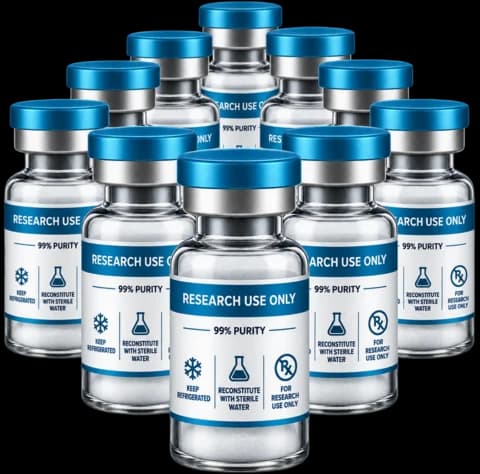
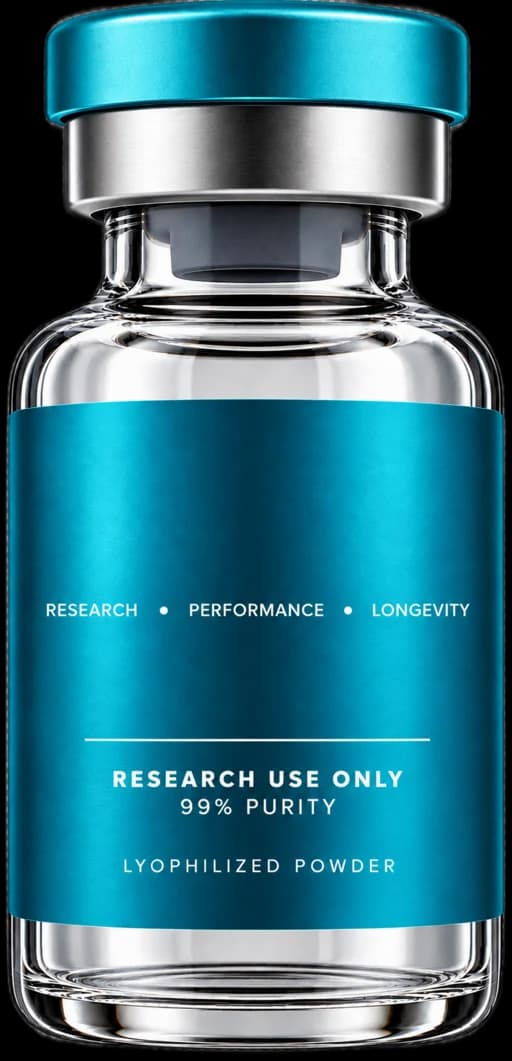
What the ratio does not capture is everything that is not price. The research channel ships lyophilised powder labeled for research use only, with no clinician in the loop, no dispensing pharmacist, no lot release against a compendial monograph, and no recourse if a vial is off-spec. Buyers evaluating that channel generally lean on third-party certificates of analysis instead — our guide to verifying a COA covers what a usable one contains and what a decorative one omits. The legal picture for both tracks is separated out in are peptides legal in the US.