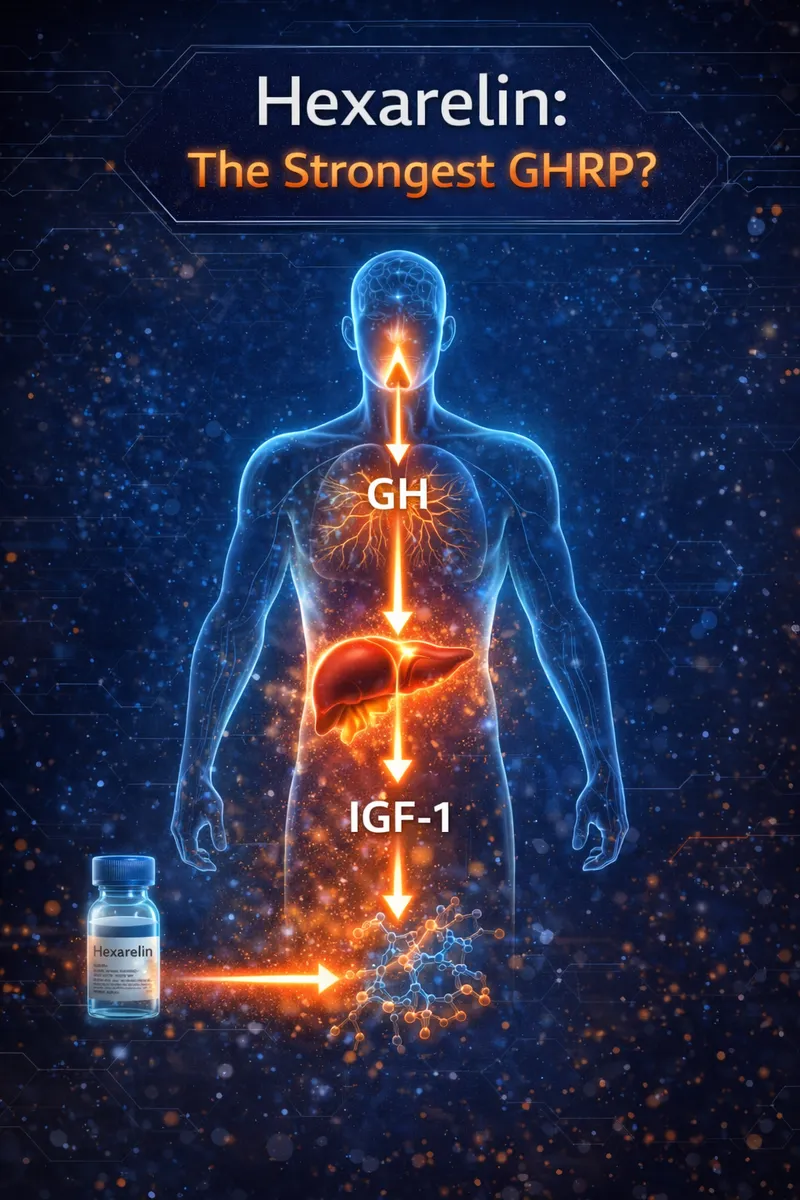
Hexarelin is widely considered the most potent Growth Hormone Releasing Peptide (GHRP) ever studied — stronger than GHRP-2, GHRP-6, and Ipamorelin. Originally developed in the 1990s as a synthetic ghrelin agonist, it has resurfaced in metabolic and GH-axis research circles due to its exceptionally high GH pulse amplitude, unique cardioprotective data, and distinct signaling profile.
This guide breaks down the mechanism, benefits, risks, and comparisons to every other GHRP in its class — with PubMed citations throughout. For practical dosing protocols, see our Hexarelin Dosing Guide.
Research-context information only. Hexarelin is a research peptide. Protocols, doses, and reactions reported below come from published research and self-reported community sources. This article reports what has been documented, not what should be done. Consult a licensed physician for personal medical decisions.
1. What Is Hexarelin?
Hexarelin (also known as Examorelin, and in literature as hexarelin acetate) is a synthetic hexapeptide (His-D-2-methyl-Trp-Ala-Trp-D-Phe-Lys-NH₂) belonging to the GHRP class of growth hormone secretagogues. It binds the GHSR-1a ghrelin receptor on pituitary somatotrophs, triggering a rapid, pulsatile release of growth hormone.
If you're unfamiliar with how GHRPs differ from GHRH peptides and oral secretagogues, read our full breakdown: GHRH vs GHRP vs Secretagogues: The Mechanistic Difference.
Hexarelin also triggers dose-dependent increases in:
- ACTH and cortisol (via hypothalamic cross-activation)
- Prolactin (highest among all GHRPs)
- Ghrelin-like downstream signaling
What makes Hexarelin unique is its GH pulse amplitude — it produces the strongest single-dose GH release recorded among all synthetic GHRPs in clinical studies (Arvat et al., 2001).
How Hexarelin Compares at a Glance
| Peptide |
GH Potency |
Appetite |
Prolactin/Cortisol |
Desensitization Risk |
| Hexarelin |
Highest |
Mild |
Highest |
Highest |
| GHRP-2 |
Moderate–High |
Mild |
Moderate |
Moderate |
| GHRP-6 |
Moderate |
Strong |
Lower |
Moderate |
| Ipamorelin |
Low–Moderate |
None |
Negligible |
Lowest |
2. Mechanism of Action: Why Hexarelin Is So Potent
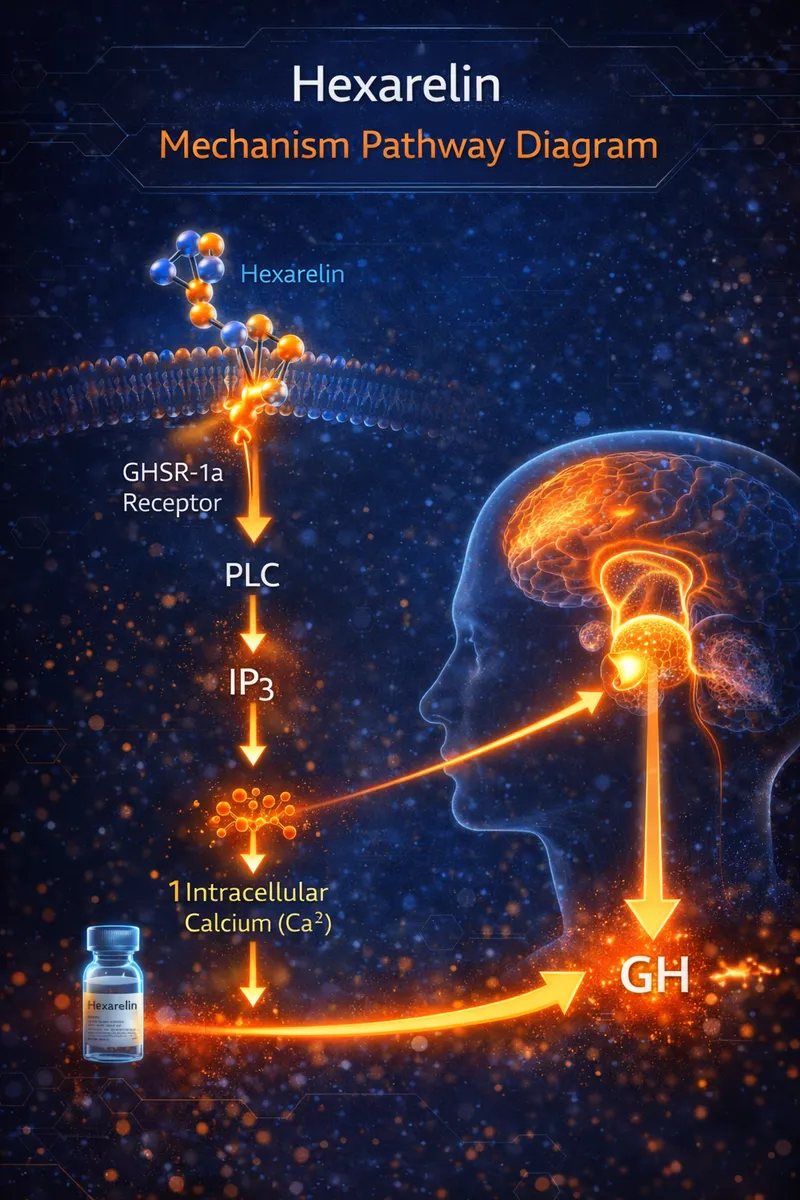
Hexarelin activates the GHSR-1a (growth hormone secretagogue receptor type 1a), the same receptor targeted by endogenous ghrelin. This triggers the PLC/IP3/Ca²⁺ pathway — fundamentally different from the cAMP/PKA pathway used by GHRH-based peptides like CJC-1295 and Sermorelin.
Hexarelin → GHSR-1a → Gαq/11 → PLC-β → IP3 → ↑ Intracellular Ca²⁺ → Rapid GH vesicle exocytosis
This calcium-mediated pathway produces a sharper, more intense GH spike compared to the cAMP-mediated signaling of GHRH analogs. The key mechanistic features:
- Gαq/11 coupling → activates phospholipase C-β (PLC-β)
- PLC-β cleaves PIP2 → generates IP3 and diacylglycerol (DAG)
- IP3 triggers Ca²⁺ release from endoplasmic reticulum stores
- The calcium spike drives immediate GH vesicle exocytosis
- DAG activates PKC → additional downstream signaling including ERK/MAPK
Hexarelin's unusually strong GH response appears to involve additional mechanisms beyond standard GHSR-1a agonism. Research suggests it may also activate CD36 receptors (a scavenger receptor involved in fatty acid uptake), which may explain its unique cardiovascular effects not seen with other GHRPs (Bodart et al., 2002).
Synergy With GHRH Peptides
Because Hexarelin (PLC/Ca²⁺) and GHRH analogs (cAMP/PKA) use completely different intracellular cascades, combining them produces a multiplicative GH response — not merely additive.
Studies in human subjects demonstrate GH release 2–3× higher when a GHRP is administered alongside a GHRH analog compared to either alone (Arvat et al., 2001). This synergy is the basis for popular research stacks pairing CJC-1295 or Sermorelin with a GHRP.
This dual-pathway synergy also partially overcomes somatostatin suppression — somatostatin primarily inhibits the cAMP pathway, so the Ca²⁺-mediated GHRP pathway retains activity even when somatostatin tone is high (Bowers et al., 1991). For practical GHRH + hexarelin stacking protocols, see our hexarelin dosing guide.
Ready to buy? Compare verified vendors on our best hexarelin sources page, or browse all coupon codes for up to 50% off.
3. Research Benefits Observed in Models
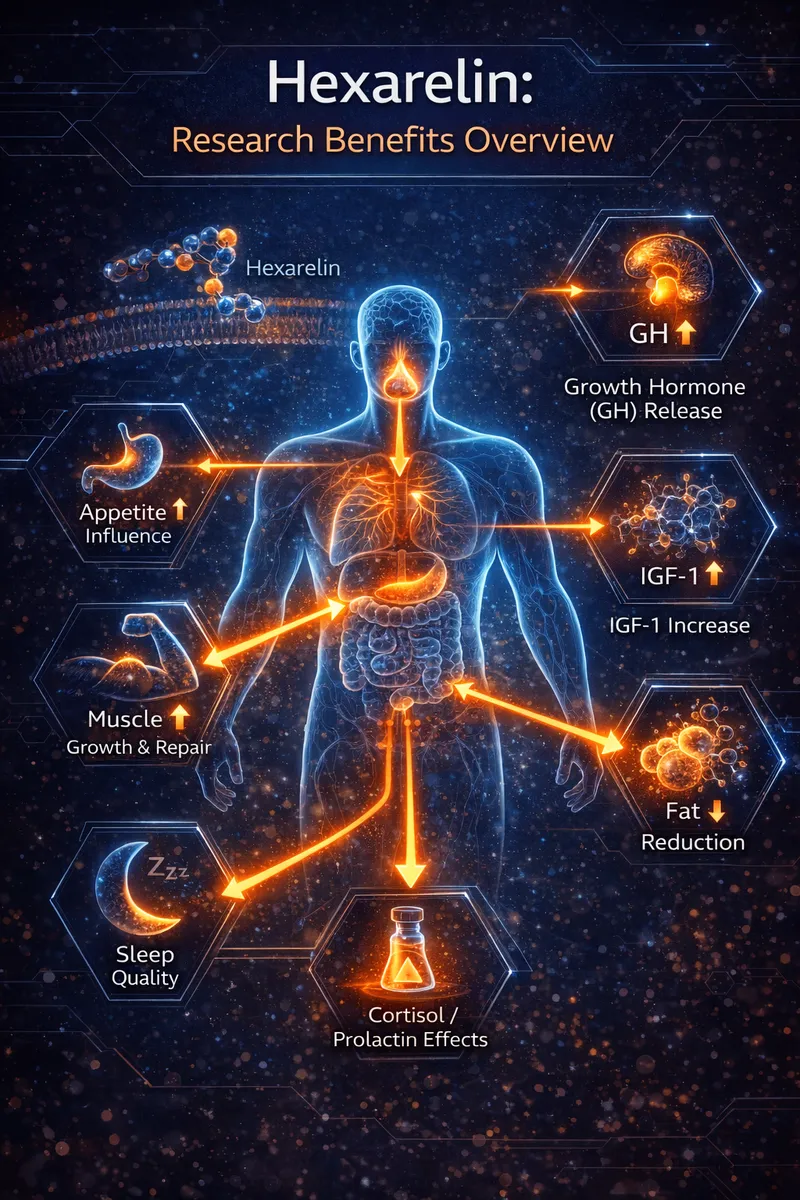
3.1 GH & IGF-1 Elevation
Hexarelin produces the strongest acute GH pulse among all GHRPs studied in human subjects. In a head-to-head comparison, Hexarelin elicited significantly higher peak GH levels than GHRP-6 and GHRP-2 at equivalent doses (Ghigo et al., 1994).
Downstream effects include:
- Sustained IGF-1 elevation via liver stimulation
- Increased GH pulse amplitude without substantially altering pulse frequency
- Enhanced endogenous GH secretion patterns
3.2 Muscle Growth & Repair
Through the GH/IGF-1 axis, Hexarelin has shown in research models:
- Increased lean body mass
- Enhanced satellite cell proliferation and protein synthesis
- Improved recovery from tissue damage
- Anabolic effects on skeletal muscle comparable to or exceeding other GHRPs
These effects parallel those seen with other GH-elevating peptides but are more pronounced due to the higher GH amplitude.
While Hexarelin is not a metabolic peptide in the same class as Semaglutide or Tirzepatide, elevated GH/IGF-1 signaling drives:
- Increased lipolysis (fat breakdown)
- Enhanced fatty acid oxidation
- Reduction in visceral adipose tissue
Tesamorelin, an FDA-approved GHRH analog, received approval specifically for visceral fat reduction — demonstrating that GH-axis stimulation has meaningful metabolic effects.
3.4 Cardioprotective Effects (Unique to Hexarelin)
This is where Hexarelin diverges from every other GHRP. Multiple studies have demonstrated cardiac-specific benefits:
- Improved left ventricular function in GH-deficient models (Bisi et al., 1999)
- Anti-fibrotic effects on cardiac tissue
- Protection against ischemia-reperfusion injury in isolated heart models (Locatelli et al., 1999)
- Reduced cardiomyocyte apoptosis following ischemic damage
These cardiac effects appear to be mediated through CD36 receptor activation — independent of GH release — making Hexarelin unique among GHRPs. Bodart et al. identified CD36 as hexarelin's cardiac binding protein, and hexarelin's coronary perfusion-pressure response was absent in hearts from CD36-null mice (Bodart et al., 2002).
A clinical study in patients with cardiac dysfunction showed that Hexarelin improved ejection fraction and cardiac output independently of its GH-releasing effects (Broglio et al., 2002).
4. Risks & Safety Considerations
Hexarelin is the most potent GHRP — and its side-effect profile reflects that. Understanding these risks is essential for any research context.
4.1 Desensitization (GHSR-1a Downregulation)
This is Hexarelin's most significant limitation. Repeated high-frequency dosing leads to progressive GHSR-1a receptor downregulation, reducing GH pulse amplitude over time.
Key findings:
- GH response to Hexarelin decreased significantly after 16 weeks of continuous administration (Rahim et al., 2000)
- Desensitization is dose-dependent — higher doses accelerate receptor downregulation
- The effect is reversible with washout periods
- Hexarelin shows more desensitization than GHRP-2, which in turn shows more than Ipamorelin
4.2 Prolactin Elevation
Hexarelin produces the highest prolactin increase of any GHRP. This is a consistent finding across multiple studies and is dose-dependent (Arvat et al., 2001).
The prolactin hierarchy among GHRPs:
Ipamorelin (negligible) < GHRP-6 (mild) < GHRP-2 (moderate) < Hexarelin (highest)
4.3 Cortisol & ACTH Elevation
Hexarelin triggers mild-to-moderate increases in ACTH and cortisol through hypothalamic cross-activation. While generally transient, this is another factor that distinguishes it from cleaner options like Ipamorelin, which has essentially no effect on cortisol (Raun et al., 1998).
4.4 Appetite Effects
Unlike GHRP-6, which strongly stimulates appetite via vagal afferent GHSR activation, Hexarelin produces only mild appetite stimulation despite being more potent for GH release. This makes it more suitable for research models where appetite confounding is undesirable.
4.5 Regulatory Status
Hexarelin has:
- No FDA-approved medical indications
- No human-use approvals in any jurisdiction
- Availability only as a research compound
- It is on the WADA prohibited substances list
Dosing Protocols
For complete community dosing protocols, reconstitution instructions, cycling strategies, and desensitization management, see our dedicated guide:
Hexarelin Dosing Guide: Community Protocols, Reconstitution & Cycling
6. Hexarelin vs GHRP-2 vs GHRP-6 vs Ipamorelin
This is the comparison most researchers want. Each GHRP activates GHSR-1a but with meaningfully different profiles.
| Feature |
Hexarelin |
GHRP-2 |
GHRP-6 |
Ipamorelin |
| GH Pulse |
Strongest |
Moderate–High |
Moderate |
Low–Moderate |
| Appetite |
Mild |
Mild |
Strong |
None |
| Prolactin |
High |
Moderate |
Mild |
Negligible |
| Cortisol |
Moderate |
Mild–Moderate |
Mild |
None |
| Desensitization |
Most prone |
Moderate |
Moderate |
Least prone |
| Cardioprotection |
Strong evidence |
Weak |
Weak |
None studied |
| Selectivity |
Low (hits multiple targets) |
Moderate |
Low–Moderate |
Highest |
Choosing the Right GHRP
- Maximum GH amplitude: Hexarelin — but accept higher side effects and desensitization risk
- Balanced potency/tolerability: GHRP-2 — moderate GH with manageable side effects
- Appetite stimulation priority: GHRP-6 — strong hunger drive, useful in wasting models
- Cleanest side-effect profile: Ipamorelin — no appetite, cortisol, or prolactin effects
- Cardiac research: Hexarelin — the only GHRP with robust cardiovascular data
An oral secretagogue alternative is MK-677, which also targets GHSR-1a but with a much longer half-life (~24 hours) and oral bioavailability. MK-677 lacks Hexarelin's sharp GH pulse character but provides sustained GH/IGF-1 elevation. For more on MK-677, see our MK-677 overview.
7. Where Hexarelin Fits in the GH Ecosystem
Hexarelin occupies a specific niche in the growth hormone research landscape:
- Strongest acute GH secretagogue in the GHRP class
- Only GHRP with robust cardiac research (CD36-mediated, GH-independent)
- Highest side-effect burden among GHRPs (prolactin, cortisol, desensitization)
- Best suited for combination protocols where its dose can be lowered via GHRH synergy
- Poor choice for long-term continuous use due to receptor downregulation
For most GH research, Ipamorelin paired with CJC-1295 is the more practical combination — cleaner side-effect profile, less desensitization, and still meaningful GH elevation. Read more about that stack in our Peptide Stacking Guide.
Hexarelin's unique value is in short-term, high-amplitude GH research and cardiac-focused models where its CD36 activity provides benefits no other GHRP can match.