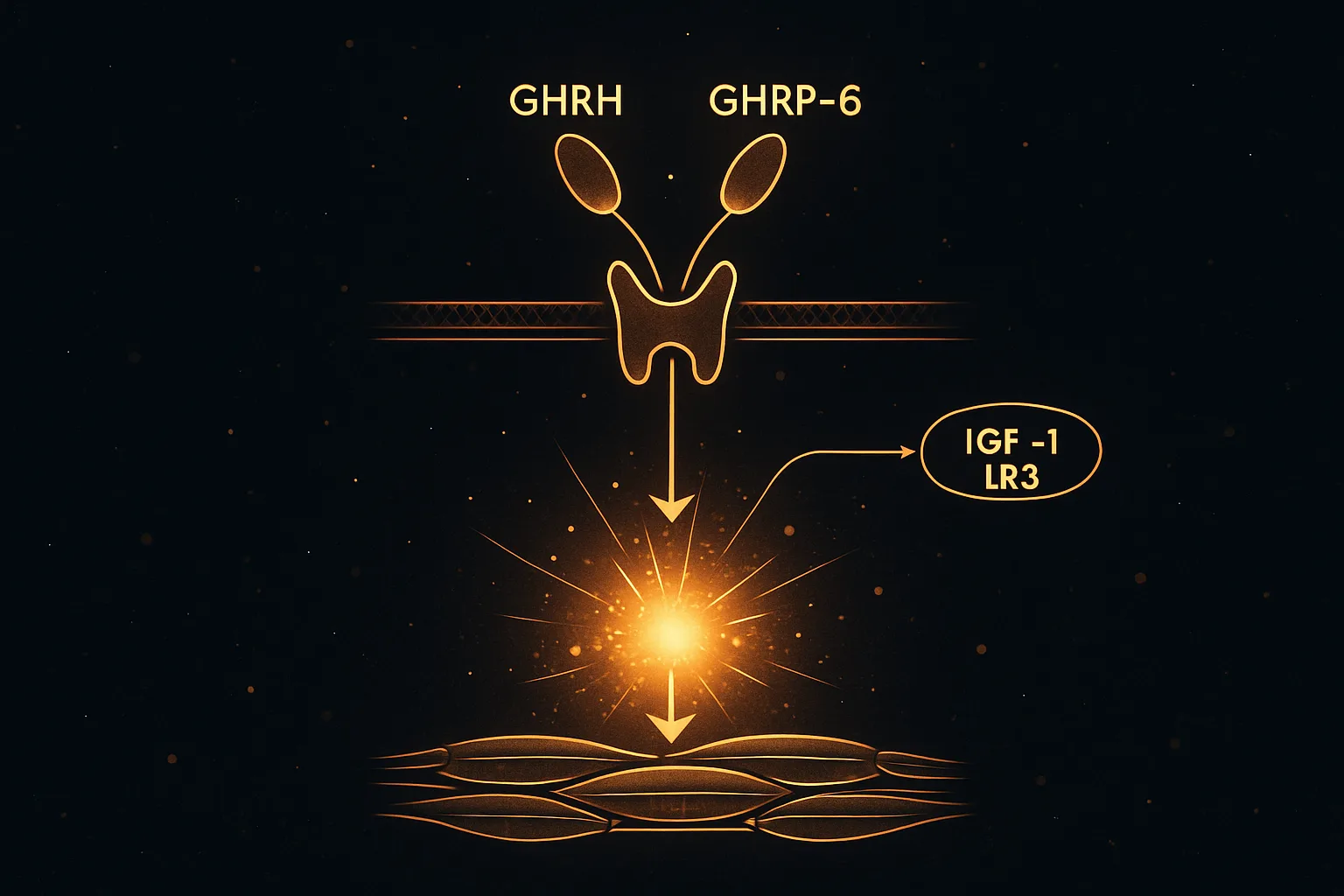
For readers searching "best peptides for bulking," the short answer most experienced users describe in community sources is this: bulking-focused peptides are typically run as a pair, with the GHRP half chosen specifically for its appetite profile. Published clinical research describes the combination of a GHRH analog plus a GHRP as producing a GH pulse 2-3x larger than either peptide alone — and within the GHRP class, GHRP-6 and the oral compound MK-677 carry documented appetite-stimulating effects that community sources describe as a feature for hard gainers.
Research-context information only. Compounds discussed below are research peptides and supplements; some are investigational drugs not approved by the FDA. Protocols, doses, and reactions reported come from published research and self-reported community sources. Possession or use of investigational drugs outside an authorized clinical trial may be illegal in your jurisdiction. This article reports what has been documented, not what should be done. Consult a licensed physician for personal medical decisions.
Evidence at a glance
Peptides covered below, sorted by clinical evidence strength. Each peptide also carries a parallel community-evidence grade reflecting real-world adoption. How we grade evidence.
Animal hypertrophy data; no human RCTs in healthy trained populations.
This guide ranks the 8 peptides community sources most commonly describe for bulking, in the order experienced users typically reach for them. Each entry explains how the peptide is positioned in a bulk, who tends to choose it, and what self-reported community outcomes look like. Cycle structure, injection mechanics, and bloodwork detail live in the linked deep-dive guides.
What Trial Data and Community Sources Describe as a Bulking Peptide
Three patterns appear consistently in published research and community usage:
Systemic anabolism. Published research describes GH/IGF-1 axis elevation or direct IGF-1 receptor activity as the underlying signal community sources call "anabolic."
Appetite support. Some users self-report difficulty hitting a caloric surplus. Trial data and community sources commonly describe GHRP-6 and MK-677 as providing a measurable appetite signal.
Tolerable on a surplus. Community reports cluster around the GHRH+GHRP fluid-retention profile being manageable in a clean surplus. Heavier-handed compounds combined with a surplus are commonly described as harder to recover from.
The Rankings
Bac Water Made for Peptides
Don't risk a $300 peptide on generic bac water.
Most cloudy reconstitutions trace back to one thing — and it isn't the peptide. Sterile, non-pyrogenic, 0.9% benzyl alcohol — formulated for peptide reconstitution, not repackaged from generic stock.
✓ 0.9% benzyl alcohol✓ Made for peptides✓ 30 mL multi-dose
1. CJC-1295 + Ipamorelin (Blend) — the canonical bulking base
Best for: lifters with normal appetite who want the most commonly described first bulking stack.
This is the stack community sources most often describe as the default opening base for a bulking cycle. CJC-1295 (no DAC) is a synthetic GHRH analog with a roughly 30-minute effective half-life in published pharmacokinetic data — long enough to amplify a GHRP pulse, short enough to preserve the body's natural pulsatile GH rhythm. Ipamorelin is the selective GHRP, and trial data describe it as releasing GH without meaningfully raising cortisol, ACTH, or prolactin.
Combined, the two produce a clean synergistic pulse — published clinical research describes the GH response as 2-3x larger than either peptide alone. For bulking, the value of the clean profile is that the GH elevation supports lean partitioning of surplus calories without adding the cortisol or appetite confound that other GHRPs introduce.
Community reports on CJC + ipa for bulking cluster around three themes: deeper sleep within the first week, fuller-looking muscles around weeks 3-4, and a 3-5 lb lean-mass gain on a 300-500 kcal surplus across a full 16-week cycle. The most common caveat in those same community sources is that the effects build slowly compared to a more aggressive stack — users who have run both commonly describe tesa + ipa as producing larger body-composition shifts.
Best for: lifters who consistently struggle to hit a caloric surplus.
GHRP-6 is the GHRP community sources most commonly describe for the appetite signal. Published research describes hunger onset within 30-60 minutes of injection in a substantial fraction of trial subjects, and community reports cluster tightly around the same timeline. Per-mg GH release in published research is comparable to ipamorelin, and the Pandya et al. 1998 study describes GHRP-6 as requiring endogenous GHRH or a GHRH analog for the full response — which is why community usage almost always pairs it with CJC-1295 or sermorelin rather than running it alone.
For a hard gainer, community sources commonly describe pre-meal timing as a feature — the hunger window aligns with planned eating. Users in community sources commonly describe pairing pre-meal GHRP-6 doses with structured meals 2-3 times per day.
Community reports cluster around two themes: a noticeable hunger push within the first week, and a measurable easier path to hitting calories across a 16-week bulk. The most common caveat in community sources is that the hunger signal can be too aggressive for users who already have appetite dialed in — at which point they typically swap back to ipamorelin.
Best for: experienced users layering a downstream tool on top of an established GHRH+GHRP base.
IGF-1 LR3 doesn't act through the GH pathway at all — it's IGF-1 itself, modified to last longer in circulation, injected directly. Published research describes it as activating muscle IGF-1 receptors directly, which is the strongest direct anabolic signal in the peptide toolkit on paper. Documented risks include hypoglycemia, because IGF-1 cross-activates the insulin receptor at higher doses; trial protocols and community guidance describe keeping fast-acting carbs accessible during use, and warn against combining IGF-1 with exogenous insulin without medical supervision.
For most users researching peptides for bulking, IGF-1 LR3 sits past the first-cycle decision. Community usage typically describes a 4-6 week IGF-1 LR3 phase layered onto weeks 9-14 of a 16-week GHRH+GHRP base — not as a replacement for the base, but as an intensification window before deload.
Community reports cluster around three themes: vivid forearm and target-muscle pumps within hours of injection, durable strength gains over 4-6 weeks, and the consistent caution that hypoglycemia onset is faster than first-time users expect. Community usage as a first-cycle entry point is rare.
Best for: users who avoid injection and accept the side-effect profile that comes with daily oral dosing.
MK-677 is the only oral compound on this list. Published research describes it activating the same ghrelin receptor as the GHRPs, taken once daily in trial protocols. The Nass et al. 2008 trial reported daily MK-677 producing 1.6 kg fat-free mass gain over 12 months in older adults, with strength not moving significantly over that window. The clinical translation: trial subjects gained mass, but the gains were largely compositional (water retention, fuller-looking muscles, higher scale weight) rather than functional raw-strength.
For a bulk, the appetite boost and the 24-hour GH/IGF-1 elevation profile are both relevant. The trade-offs trials and community sources flag most consistently are noticeable water retention by week 2, sharp appetite increase, and measurable elevation in fasting blood glucose — community sources commonly treat the 8-week and 12-week HbA1c checks as non-negotiable on an extended MK-677 cycle.
Community reports cluster around the trial-documented effects: hunger onset within days, fluid retention in weeks 1-4, and the same glucose drift trial subjects developed.
5. Tesamorelin + Ipamorelin (Blend) — the lean-bulk option
Best for: lifters bulking with the leanest possible fat gain and budget flexibility.
Tesamorelin is the most clinically-tested compound on this list — the only GHRH analog with phase III randomized trial data behind it. The Falutz et al. 26-week trial reported daily tesamorelin reducing visceral fat by roughly 15-18% and raising IGF-1 about 80% versus placebo. A follow-up analysis reported tesamorelin also increasing truncal lean muscle area while decreasing intramuscular fat. Paired with ipamorelin's clean GH-release profile, the stack produces the strongest documented body-composition shift on this list.
For a bulk specifically, community sources commonly describe tesa + ipa as the pick when the priority is shifting more of the surplus calories toward lean tissue rather than fat. The trade-off described most often is cost — tesa + ipa is the most expensive stack on this list.
Community reports cluster around three themes: visible waist-tightening within 4-6 weeks even in a surplus, deeper sleep within the first week, and improved between-session recovery. The most common complaint in community sources is occasional injection-site sensitivity attributed to tesamorelin specifically.
6. Sermorelin + GHRP-6 — the conservative beginner bulk
Best for: users new to GH peptides looking for the gentlest bulking entry point.
Sermorelin was the original synthetic GHRH analog and has the longest clinical track record of any peptide on this list. Published pharmacokinetic data describe a shorter half-life than CJC-1295 — each pulse is smaller per dose. That smaller pulse is also why community sources commonly describe sermorelin as the conservative on-ramp for users new to GH peptides.
Paired with GHRP-6 for appetite support, the stack covers both the pulse rationale and the caloric-intake problem at a lower intensity than CJC-1295 + GHRP-6. Community usage commonly describes this pairing as the older-user, first-time-bulker entry point.
Community reports cluster around subtle sleep improvements, gradual recovery improvements, and a slower body-composition shift over a 12-16 week cycle. Users who later switch from sermorelin to CJC + ipa typically describe a noticeable step up in pulse strength and outcome.
Best for: users on an existing bulk who need a temporary appetite push during a stall.
Running GHRP-6 without a GHRH analog produces a smaller GH pulse than the paired protocol — the Pandya et al. 1998 study describes GHRP-6 as requiring endogenous GHRH for the full response. Solo GHRP-6 is rarely described as a primary bulk driver in community usage; the more common pattern is a 4-8 week appetite-bridge phase during a bulk where intake has stalled.
Community reports cluster around the appetite signal showing up immediately and the GH-related effects (sleep, fuller-looking muscles) being smaller than the paired version. Community usage as a first-line bulking peptide is rare.
8. Follistatin-344 — the experimental myostatin adjunct
Best for: users who've explored a GHRH+GHRP base and want to test a separate muscle pathway.
Follistatin works through different biology than everything else on this list. Published research describes it binding and neutralizing myostatin — a protein the body produces specifically to limit muscle growth. The Kota et al. 2009 nonhuman primate study reported follistatin gene delivery producing durable muscle size and strength increases. The human peptide-injection dataset is limited and shorter-term.
This is genuinely experimental territory. Community usage typically describes follistatin as a 4-week adjunct layered on top of a GHRH+GHRP stack during the middle of a 16-week bulk — a separate lever rather than a replacement for the base. Long-term human safety data remains thin.
Community reports vary widely, which is itself a signal that responses are individual. Users in community sources commonly describe noticeable strength jumps within 2-3 weeks; others run a full vial and self-report no perceived change.
Community usage and trial-evidence patterns map cleanly onto reader profiles. Here's how the picks above tend to break down across common audiences:
First-time bulkers with normal appetite typically choose CJC-1295 + ipamorelin. Community sources describe it as the most commonly chosen entry point.
Hard gainers who struggle to hit calories commonly pair CJC-1295 with GHRP-6 specifically for the appetite-stimulating effect documented in published research.
Users over 40 looking for the gentlest bulking entry point commonly settle on sermorelin + GHRP-6. Sermorelin has the longest clinical track record on this list and produces the smallest per-dose pulse.
Users who avoid injection are limited to MK-677 (oral) — the only non-injectable on this list with meaningful GH/IGF-1 elevation in published research. The trade-off is the side-effect profile (water retention, appetite, glucose drift) documented in trials.
Lean-bulk-focused users with budget flexibility typically choose tesamorelin + ipamorelin. It has the strongest clinical evidence for combined fat-loss and lean-mass effects of any peptide on this list.
Users on a second or third bulking cycle sometimes layer IGF-1 LR3 over weeks 9-14 of a 16-week GHRH+GHRP base. Community usage describes this as an addition, not a replacement.
Users testing a separate muscle pathway sometimes layer follistatin-344 for 4 weeks mid-cycle. Community usage describes follistatin as experimental and rarely a first-cycle choice.
What Trial and Community Data Describe as Signals of Effect
Three signals appear consistently in published research and community sources, in this order:
Weeks 1-2: Sleep and recovery first. Community reports cluster around deeper sleep within 2-3 days of starting a GHRH+GHRP bulk base, and faster recovery between training sessions by the end of week 2. Trial subjects describe the same pattern. Absence of any sleep shift by day 14 is what community sources typically flag as a signal of under-dosing or product degradation.
Weeks 4-8: Bloodwork and visible fullness. IGF-1 is the most-tracked biomarker in both trials and community protocols — published research describes a working GHRH+GHRP stack raising IGF-1 30-60% from baseline. Community sources describe under-30% increases as a signal of under-dosing or product issues, and over-60% increases as the dose-reduction threshold most clinical protocols use. Trials also commonly tracked fasting glucose and HbA1c at 8-12 weeks because GH opposes insulin, and a subset of trial subjects developed measurable glucose elevation over time.
Weeks 8-16: Body composition. Trial-reported lean-tissue gains in trained subjects on a full secretagogue cycle have typically clustered around 2-4 lb. Community reports across full 16-week bulking cycles commonly describe 4-7 lb of lean tissue plus 3-5 lb of fat in trained users on a 300-500 kcal surplus, and 6-9 lb of lean mass when IGF-1 LR3 is layered for the final 4-6 weeks. Trial data does not support claims of steroid-scale transformations from secretagogue stacks alone.
Running GH peptides without bloodwork is functionally running them blind. The trial-and-community standard is baseline IGF-1 plus a 4-week recheck and 8-12 week metabolic panel — that's how published research designs measured efficacy, and it's what community sources commonly treat as the minimum monitoring set.