For readers searching "best peptides for cutting," the short answer most experienced users describe in community sources is this: cutting peptides are evaluated by fat-to-lean loss ratio, not scale weight. Trial subjects on pure appetite-suppression compounds commonly lost 20-25% of total weight as lean tissue in published research — community sources describe this as acceptable for large-volume weight loss but unfavorable for lifters cutting from moderate to low body fat.
Research-context information only. Compounds discussed below are research peptides and supplements; some are investigational drugs not approved by the FDA. Protocols, doses, and reactions reported come from published research and self-reported community sources. Possession or use of investigational drugs outside an authorized clinical trial may be illegal in your jurisdiction. This article reports what has been documented, not what should be done. Consult a licensed physician for personal medical decisions.
Evidence at a glance
Peptides covered below, sorted by clinical evidence strength. Each peptide also carries a parallel community-evidence grade reflecting real-world adoption. How we grade evidence.
No statistically significant weight loss vs. placebo in Phase 2b (n=534).
This guide ranks the 7 peptides community sources most commonly describe for cutting in the order experienced users typically reach for them. Each entry explains what trial data and community usage describe for that peptide in a cutting context, who tends to choose it, and what self-reported outcomes look like. Cycle structure, injection mechanics, and bloodwork detail live in the linked deep-dive guides.
What Trial Data and Community Sources Describe as a Cutting Peptide
Three patterns appear consistently in published research and community usage:
Mechanism that preserves lean mass. Published research describes GH/IGF-1 elevation, amylin signaling, or direct lipolytic effects as more lean-protective than pure appetite suppression.
Body-composition trial endpoints. Community sources commonly describe DXA-measured fat and lean mass separation as the trial endpoint that distinguishes cutting peptides from generic weight-loss compounds.
Practical 12-16 week cycles. Community usage commonly describes side-effect profiles and bloodwork cadence as manageable inside this window.
The Rankings
Bac Water Made for Peptides50% off
Don't risk a $300 peptide on generic bac water.
Most cloudy reconstitutions trace back to one thing — and it isn't the peptide. Sterile, non-pyrogenic, 0.9% benzyl alcohol — formulated for peptide reconstitution, not repackaged from generic stock.
✓ 0.9% benzyl alcohol✓ Made for peptides✓ 30 mL multi-dose
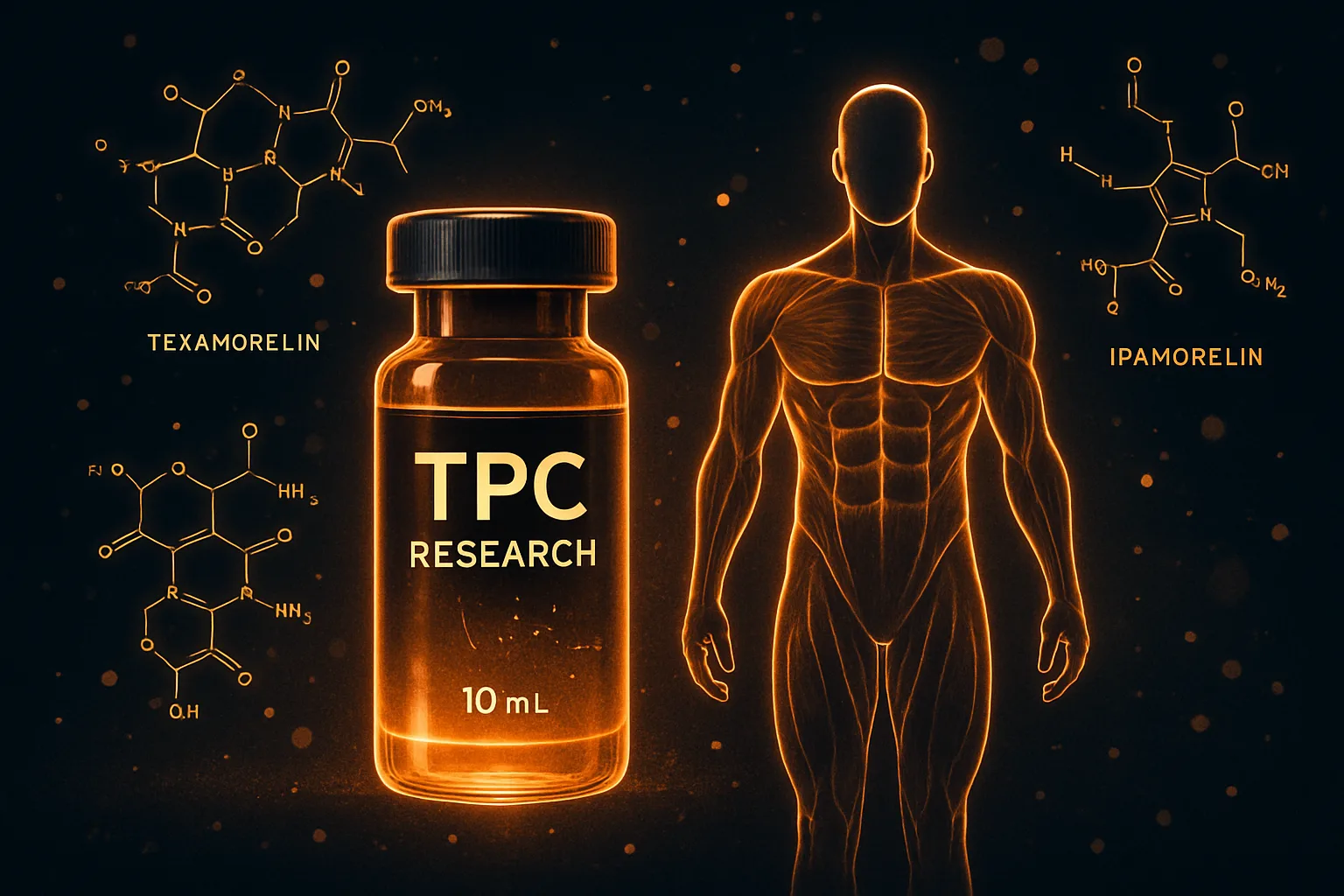
1. Tesamorelin + Ipamorelin (Blend) — the strongest cutting evidence
Best for: lifters who want the deepest documented body-composition shift and have budget flexibility.
This is the stack community sources most often describe as the strongest cutting tool by published evidence. Tesamorelin is the most clinically-tested compound on this entire list — the only GHRH analog with phase III randomized trial data behind it. The Falutz et al. 26-week trial reported daily tesamorelin reducing visceral fat by 15-18% and raising IGF-1 about 80% versus placebo. A follow-up analysis reported tesamorelin also decreasing intramuscular fat and increasing muscle cross-sectional area — the exact body-composition profile community sources describe a cut as chasing.
Ipamorelin pairs with it. Trial data describe ipamorelin as the most selective GHRP — releasing GH without meaningfully raising cortisol, ACTH, or prolactin. The clean profile matters on a cut: GHRP-2 and GHRP-6 raise cortisol and appetite in published research, which community sources describe as counterproductive in a caloric deficit.
Combined, the Bowers et al. 1990 study describes the GH pulse as 2-3x larger than either peptide alone.
Community reports on tesa + ipa during a cut cluster around three themes: visible waist-tightening within 4-6 weeks, deeper sleep within the first week, and strength holding or modestly improving across a 12-16 week cycle when protein and lifting are locked in. The most common caveat in community sources is cost — it's the most expensive stack on this list.
2. CJC-1295 + Ipamorelin (Blend) — the budget cutting stack
Best for: users running their first cutting cycle or working within a tighter budget.
Community sources commonly describe CJC + ipa (specifically the no-DAC version of CJC-1295) as the default budget cutting stack. CJC-1295 (no DAC) is a synthetic GHRH analog modified to extend its half-life — the Teichman et al. 2006 study describes that window as long enough to amplify a GHRP pulse, short enough to preserve the body's natural pulsatile GH rhythm.
Combined with ipamorelin, the stack produces a clean synergistic pulse — same mechanism described for tesa + ipa, at a lower price point with somewhat less direct outcome data. For a first cutting cycle or where cost is the limiting factor, community sources commonly describe this as the entry point.
Community reports on CJC + ipa during a cut cluster around consistent themes: better sleep within days, fuller-looking muscles around weeks 3-4, and gradual fat loss alongside slow recomposition by week 8. The most common caveat in community sources is that the body-composition shift feels smaller in magnitude than tesa + ipa.
3. Cagrilintide (+ Semaglutide) — the stalled-cut layered tool
Best for: users coming off a stall on a GHRH+GHRP base, or users with a weight-loss anchor.
Cagrilintide is a long-acting amylin analog. Published research describes amylin signaling satiety through a pathway distinct from GLP-1 — and the REDEFINE 1 trial of cagrilintide combined with semaglutide reported 20.4% body weight loss at 68 weeks with a more favorable fat-to-lean ratio than published GLP-1 monotherapy data. For a lifter, the cagrilintide half of the stack is the muscle-preservation advantage community sources describe over running semaglutide alone.
Community usage typically describes cagrilintide as a stalled-cut layered tool — added on top of an existing GHRH+GHRP base when fat loss has plateaued — or as the weight-loss anchor for users coming from a GLP-1 background and folding in tesa + ipa or CJC + ipa for the anabolic support layer.
Community reports cluster around steady appetite reduction, durable fat loss, and a more favorable lean-mass retention profile than self-reported semaglutide-monotherapy timelines. The most consistent community caveat is GI side effects during titration.
4. Tesamorelin (Solo) — for users who already have a GHRP
Best for: people who already run ipamorelin (or another GHRP) and want to add the strongest GHRH.
Tesamorelin alone still produces meaningful GH elevation — trial data describe it as the strongest GHRH analog on a per-mg basis, and it's the only one with phase III evidence for both fat-loss and lean-mass effects. Users already running ipamorelin or another GHRP commonly add tesamorelin separately rather than buying the blend.
Where solo tesa falls short of the blend: two separate vials, two separate draws, and the two peptides need to be timed tightly enough to overlap for the GH-pulse synergy described in published research. Community usage of solo tesa skews toward users who either already had ipamorelin on hand or wanted finer dose control on each component than a fixed blend allows.
Community reports cluster around the same waist-tightening and visceral-fat reduction trial subjects describe, with users commonly noting the protocol is easier to dial when both peptides are sourced separately.
5. MK-677 (Ibutamoren) — the no-needle cutting option
Best for: users who avoid injection and accept the side-effect profile that comes with daily oral dosing.
MK-677 is the only oral compound on this list. Published research describes it activating the same ghrelin receptor as the GHRPs orally, raising GH and IGF-1 over a 24-hour window. The Nass et al. 2008 trial reported 1.6 kg fat-free mass gain over 12 months in older adults — a meaningful lean-mass preservation signal in a population the control arm was losing in.
The complication on a cut: MK-677 also raises appetite in trial subjects and community reports, which most cutters do not want. Community sources commonly describe MK-677 cuts as practical only in small deficits (250-500 kcal/day), where the extra hunger can be redirected toward hitting protein. For aggressive cuts, community usage typically describes a GHRH+GHRP instead.
Trial-documented trade-offs include water retention in weeks 1-4, sharp appetite increase, and measurable elevation in fasting glucose. Community sources commonly treat the 8-week and 12-week HbA1c checks as non-negotiable on an MK-677 cycle.
Best for: users layering a low-cost fat-mobilization adjunct on top of a GHRH+GHRP base.
Published research describes AOD-9604 as the C-terminal fragment of GH (residues 177-191), proposed to preserve the lipolytic activity of GH without the insulin-like effects of full GH. The human evidence base is thinner than vendor marketing typically suggests — phase II obesity trials reported modest weight loss that did not consistently hit statistical significance across endpoints.
Where AOD-9604 fits in community usage: as a low-cost adjunct stacked on top of a GHRH+GHRP cut. Community sources commonly describe it as well-tolerated and inexpensive, possibly accelerating subcutaneous abdominal fat loss when layered. Community usage as a standalone cutting peptide is rare.
Community reports cluster widely, which is itself a signal that responses are individual. Some users describe noticeable acceleration of localized fat loss; others self-report no perceived change versus the GHRH+GHRP base alone.
Best for: users already running an injectable GH stack who want to test a separate mechanism via a pill.
Published research describes 5-amino-1MQ as an NNMT (nicotinamide N-methyltransferase) inhibitor. The proposed mechanism in animal models is that NNMT inhibition frees up intracellular NAD+ and SAM, which preclinical research describes as raising metabolic rate and reducing adipose storage. Human data is limited.
Community usage typically describes 5-amino-1MQ as an experimental adjunct for the metabolism angle, not a primary cutting tool. The oral delivery is the practical appeal — community sources commonly describe it as a second-mechanism layer for users already on an injectable GH stack who want to add a non-injectable lever.
Community reports vary widely across short cycles and overlap heavily with the underlying GH-stack effects, which makes 5-amino-1MQ's standalone signal hard to isolate in self-reported timelines.
Community usage and trial-evidence patterns map cleanly onto reader profiles. Here's how the picks above tend to break down across common audiences:
Bodybuilding contest-prep users with budget flexibility typically choose tesamorelin + ipamorelin. Phase III trial data describe it as the strongest body-composition signal on this list.
First-time cutters or budget-constrained users typically choose CJC-1295 + ipamorelin. Community sources commonly describe it as the most accessible cutting entry point.
Users on an existing GH stack with a fat-loss stall commonly layer cagrilintide on top — community usage describes it as a stalled-cut tool, not a base stack.
Users on a medical GLP-1 protocol who lift commonly add tesa + ipa or CJC + ipa for lean-mass support. Community usage describes the GLP-1 as the fat-loss anchor and the GHRH+GHRP as the lean-mass anchor.
Users who avoid injection are limited to MK-677 (oral). Community sources commonly describe it as practical only in small deficits given the appetite signal.
Users running an existing GHRH+GHRP base who want a low-cost adjunct sometimes add AOD-9604 for the lipolytic angle, or 5-amino-1MQ for the oral metabolism angle. Community usage describes both as adjuncts, not primary cutting tools.
What Trial and Community Data Describe as Signals of Effect
Three signals appear consistently in published research and community sources, in this order:
Weeks 1-2: Sleep depth and appetite signal. Trial subjects and community sources commonly describe deeper sleep within the first 1-2 weeks of a GHRH+GHRP base. On layered cagrilintide or MK-677 protocols, community reports cluster around an appetite shift (suppression on cagrilintide, increase on MK-677) within the same window.
Weeks 4-8: Bloodwork. IGF-1 is the most-tracked biomarker in both trials and community protocols — published research describes a working GHRH+GHRP stack raising IGF-1 30-60% from baseline. Trial protocols also commonly tracked fasting glucose and HbA1c at 8-12 weeks because GH opposes insulin, and a subset of trial subjects developed measurable glucose elevation. Community sources commonly flag HbA1c rises of 0.3% or more as a dose-reduction or compound-switch threshold.
Weeks 6-16: Body composition. Trial subjects on tesamorelin commonly described visible waist-tightening at 4-6 weeks and confirmed visceral fat reduction at trial endpoints. Community reports across full 12-16 week cuts commonly describe strength holding or improving when protein and resistance training are maintained. Trial data does not support claims of steroid-scale transformations from cutting peptide stacks.
Running GH peptides without bloodwork is functionally running them blind. The trial-and-community standard is baseline IGF-1 plus a 4-week recheck and 8-12 week metabolic panel — that's how published research designs measured efficacy, and it's what community sources commonly treat as the minimum monitoring set.