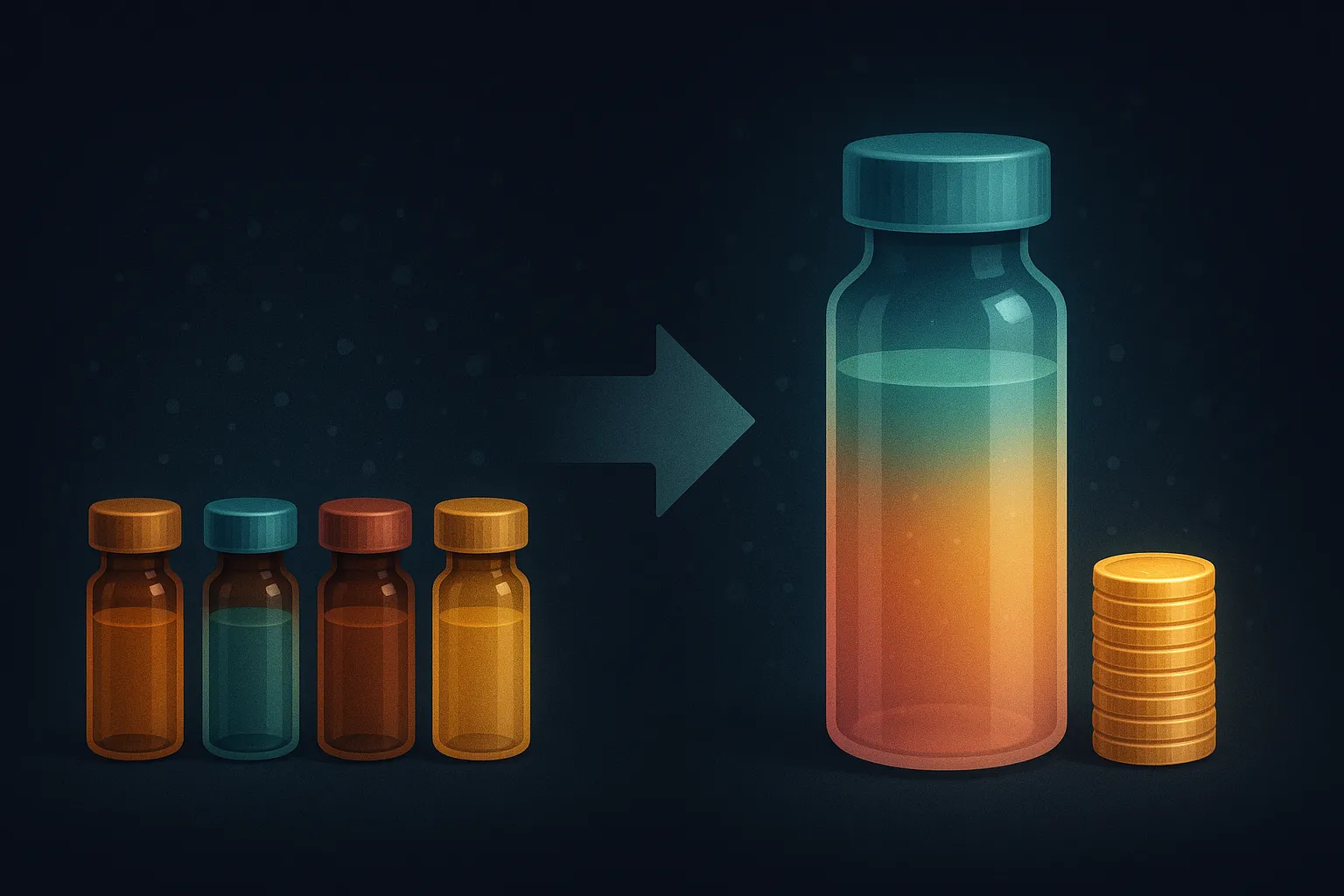
KLOW is the most comprehensive healing-and-anti-inflammatory blend on the market — BPC-157 (10mg), TB-500 (10mg), GHK-Cu (50mg), and KPV (10mg) pre-mixed in a single 80mg vial. One reconstitution, one injection, four mechanisms. The question most buyers ask isn't "is it legit" — it's "am I actually saving money over buying the singles."
Research-context information only. The KLOW blend is a research-peptide blend (containing Kisspeptin, BPC-157, GHK-Cu, and TB-500). Protocols, doses, and reactions reported below come from published research and self-reported community sources. This article reports what has been documented, not what should be done. Consult a licensed physician for personal medical decisions.
Short answer: yes, and it's not close. An 80mg KLOW vial from a top vendor runs $88-135, while the same peptide quantities bought separately run $215+. This guide walks you through how to verify a KLOW vendor, what you should actually pay per milligram, how the blend pricing math compares to singles, and the red flags to avoid.
This is not a ranked vendor list — for that, see our Best KLOW Blend Vendors comparison. This guide teaches you how to evaluate any blend vendor yourself.
Understanding KLOW Blend Pricing
KLOW is sold almost exclusively as a single 80mg lyophilized vial. The actual ratio inside the vial: GHK-Cu 50mg (62.5%), BPC-157 10mg (12.5%), TB-500 10mg (12.5%), KPV 10mg (12.5%). Blend pricing is driven by the same three factors as single peptides — vial size, vendor markup, testing investment — plus one extra: whether the vendor actually uses the stated ratios (verifiable on the COA).
Current Market Pricing (2026)
| Vendor Tier | Typical Price (80mg) | Price Per Total mg | Notes |
|---|---|---|---|
| Budget | $88-110 | $0.55-0.69/mg | EZ Peptides, Ion Peptide |
| Mid-tier | $114-135 | $0.72-0.84/mg | Glacier Aminos, Ascension, Penguin |
| Premium | $150-275 | $0.94-1.72/mg | Certified Pep, specialty boutique vendors |
The pattern is clear: KLOW's total-mg pricing hides the per-component economics. What looks like $0.55-1.70/mg for the blend is actually ~$1.10-3.40 per mg of effective dose at the stated ratios (because 62.5% of the mass is GHK-Cu, which is the cheapest component individually). Compare that to the cost of buying the four components separately below.
Blend vs Buying Singles (Cost Per Cycle)
Using typical community vendor pricing, here's what the same peptide mass costs each way:
| Peptide | Amount | Singles Price (mid-tier) |
|---|---|---|
| BPC-157 | 10mg | ~$45 |
| TB-500 | 10mg | ~$45 |
| GHK-Cu | 50mg | ~$80 |
| KPV | 10mg | ~$45 |
| Singles total | 80mg | ~$215 |
| KLOW 80mg vial | 80mg | $88-135 |
| Savings | — | 40-60% |
The pattern is clear: you save at least $80 per vial — typically closer to $100-130 — by buying the blend. Over a 12-week cycle (~2 vials), that's roughly $160-260 in savings.
Cheapest single-vial option: Ascension Peptides's 50% off drops the 160mg vial to $67.50 ($0.42/mg effective) — the lowest effective price we track for buying one vial. Get the code →
Cost Per Week at Standard Doses
| Protocol | Vials per Cycle (12wk) | Monthly Cost (EZ $88) | Monthly Cost (mid-tier $125) |
|---|---|---|---|
| Loading only (4 wks @ 5x/wk) | 1 | $88 | $125 |
| Standard cycle (12 wks) | 2-3 | $59-88/month | $83-125/month |
| Aggressive injury (daily, 10 wks) | 3-4 | $88-117/month | $125-167/month |
For current vendor-specific pricing with exact $/mg breakdowns, see our Best KLOW Blend Vendors comparison.
How to Verify KLOW Blend Quality

Blend COAs are trickier than single-peptide COAs. A vendor can technically pass a "blend purity" test while still having the ratios wrong, or while having one component at 70% purity dragging the aggregate down. For a 4-peptide blend, you need per-component testing — that is the single most important thing to verify.
What a KLOW COA Should Include
Identity Confirmation (Per Component)
- Mass spectrometry confirming correct molecular weight for each peptide:
- BPC-157: 1,419.55 Da
- TB-500: 4,963.44 Da
- GHK-Cu: 340.85 Da (tripeptide-copper complex)
- KPV: 372.46 Da
- Amino acid sequence verification for each
Purity Testing
- HPLC purity per component — look for 98%+ for each peptide individually
- A single aggregate blend purity number is insufficient
Contamination Testing
- Endotoxin (LPS) levels — critical for an injected product
- Residual solvent analysis (acetonitrile, TFA)
- Heavy metals screening — especially important because GHK-Cu contains copper, making heavy-metal testing non-optional
How to Verify a COA Is Legitimate
Not all COAs are real. Some vendors photoshop results, reuse old certificates, or show a single-peptide COA and hope nobody notices. Here's how to verify:
-
Check the testing lab — Reputable labs include Janoshik Analytical, MZ Biolabs, and Colmaric Analyticals. Avoid vendors who only show "in-house" testing.
-
Verify on the lab's website — Janoshik COAs have a task number you can look up directly at janoshik.com. If the vendor won't provide a verifiable task number, that's a red flag.
-
Check the date — COAs should be recent (within 6 months). Old COAs may not represent the current batch.
-
Match the batch — The batch/lot number on the COA should match what's printed on your vial.
-
Demand per-component data — For a 4-peptide blend, any vendor not showing separate HPLC for BPC-157, TB-500, GHK-Cu, and KPV is cutting corners.
Red Flags to Avoid
- Single "blend purity" number with no per-component breakdown — the biggest blend-specific red flag
- No COA available — walk away immediately for a research blend this complex
- Only in-house testing — self-reported purity is meaningless without independent verification
- Prices significantly below market — KLOW below $80/vial across the board is a quality concern
- Heavy metals not tested — non-negotiable given GHK-Cu's copper content
- No endotoxin testing — injection safety issue, period