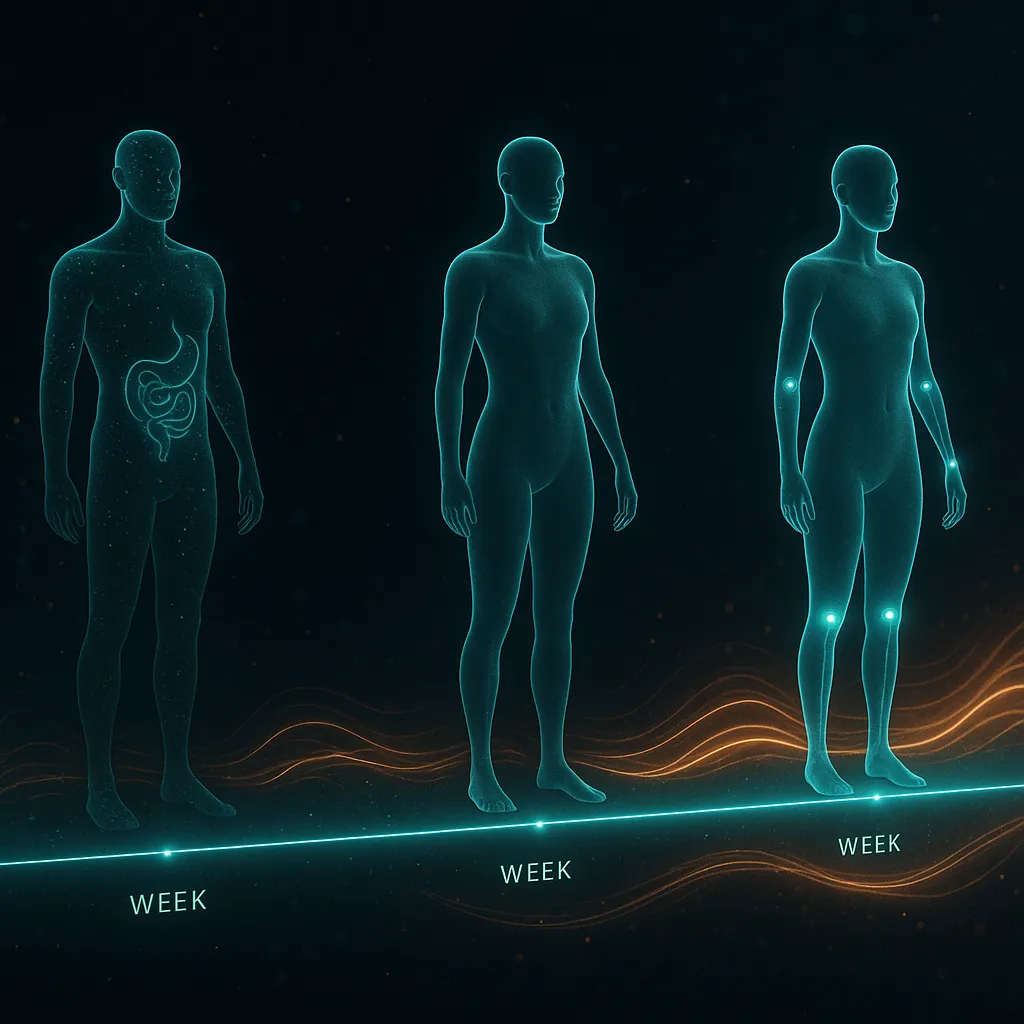
"When does Klow actually start working?" is the question everyone asks after the first injection. The realistic answer depends on which of the four peptides is being tracked — BPC-157 delivers noticeable pain relief within days, KPV calms gut inflammation within 1-2 weeks, while GHK-Cu and TB-500 collagen remodeling effects build gradually over weeks to months.
No controlled human trials have established timelines for the Klow blend specifically. What follows is compiled from preclinical data on each component individually, published mechanistic studies, and commonly reported experiences in research communities. Individual results vary based on the condition being addressed, severity, dose consistency, and baseline health.
This guide breaks down the Klow blend timeline week by week, then by use case, with the factors that determine whether someone is a fast or slow responder.
Research-context information only. The Klow blend (KPV, LL-37, Oxytocin, Wolverine peptides) is a research peptide. Protocols, doses, and reactions reported below come from published research and self-reported community sources. This article reports what has been documented, not what should be done. Consult a licensed physician for personal medical decisions.
Before the week-by-week breakdown, understand what moves the needle most:
1. Which outcome is being tracked. Pain relief (BPC-157) shows up in days. Gut symptom improvement (KPV) takes 1-2 weeks. Skin texture and collagen changes (GHK-Cu) need 4-8 weeks. Watching only for skin changes can read as Klow not working when it has been healing tissue internally for weeks.
2. Severity of the condition. A mild gut flare responds to KPV faster than chronic IBD-type inflammation. A recent injury responds to BPC-157 faster than a 6-month tendinopathy. Acute issues respond faster than chronic ones — this is basic biology, not a limitation of the blend.
3. Dose and consistency. The standard protocol is 10 units (4mg total blend) at 5x/week during loading. Underdosing or skipping injections delays results. These peptides work cumulatively — consistency matters more than any single dose. See the Klow Dosing Guide for full protocol details.
4. Baseline inflammation. KPV's NF-kB suppression is most impactful in people with elevated inflammatory markers. With an already-low CRP, KPV's contribution is less distinct — it's still working, but from a lower baseline.
Week 1: Days 1-7
Week 1 is about initiating repair cascades and reducing acute inflammation. Structural healing has not begun yet.
What's happening biologically:
BPC-157 begins upregulating VEGF (vascular endothelial growth factor), initiating angiogenesis at damaged tissue sites. Its nitric oxide system modulation starts improving local blood flow to injured areas (Sikiric et al., 2018).
KPV enters intestinal epithelial cells via PepT1 transport and begins suppressing NF-kB activation — the master inflammatory switch. Pro-inflammatory cytokine production starts decreasing at the cellular level (Dalmasso et al., 2008).
TB-500 circulates systemically, activating actin-mediated cell migration. Immune and repair cells begin mobilizing toward damaged tissue more efficiently (Malinda et al., 1999).
GHK-Cu starts its gene-activation cascade — over 4,000 genes are affected — but these changes take weeks to translate into visible tissue remodeling (Pickart & Margolina, 2018).
What most users report:
Reduced pain at injury sites within 3-5 days (BPC-157 effect)
Mild improvement in gut comfort if GI issues are present (KPV beginning to work)
Some report improved sleep quality — likely from reduced systemic inflammation
Injection site may show minor redness (normal, resolves within an hour)
What not to expect yet:
No visible skin changes yet. GHK-Cu's collagen remodeling hasn't had time to manifest.
Pain reduction reflects inflammation control, not structural repair. Testing an injury aggressively will still hurt.
Some people feel nothing in week 1, especially if their primary goal is skin/collagen improvement. This is normal.
This is where the first clear "it's working" signals appear — particularly for pain and gut symptoms.
What's happening biologically:
BPC-157 has established early angiogenesis. New capillaries are forming, improving oxygen and nutrient delivery to damaged tissue. Fibroblast recruitment accelerates via the FAK-paxillin pathway (Chang et al., 2011).
KPV has achieved meaningful NF-kB suppression. Intestinal inflammation markers are decreasing. Users with gut issues often report this as the inflection point where symptoms shift noticeably (Brzoska et al., 2007).
TB-500 reaches tissue saturation. Collagen deposition begins, with better fiber organization than typical scar tissue. Its anti-fibrotic properties reduce disorganized scarring (Ehrlich & Hazard, 2010).
GHK-Cu gene activation is building momentum. Early collagen synthesis is underway but not yet visible. Copper-dependent enzyme systems are upregulating tissue repair pathways.
What most users report:
Pain reduction of 30-50% at injury sites compared to baseline
Gut symptoms (bloating, discomfort, irregular motility) noticeably improved
Improved range of motion in affected joints
Reduced morning stiffness
Better workout recovery — less DOMS, faster bounce-back
Some users report subtle skin "glow" — likely hydration from improved microcirculation rather than collagen changes yet
The KPV difference becomes clear here. Users running Klow often report a broader sense of reduced inflammation compared to those on the Glow blend (which lacks KPV). This shows up as less general achiness, reduced background fatigue, and improved gut function — effects that go beyond localized tissue repair.
Weeks 4-6
This is the visible improvement window. GHK-Cu's collagen effects start showing up, and the cumulative impact of all four peptides hits its stride.
What's happening biologically:
GHK-Cu collagen remodeling becomes measurable. Type I collagen synthesis is increasing, elastin production is upregulated, and glycosaminoglycan levels in the skin rise. The 4,000+ gene activation cascade is now producing visible downstream effects (Pickart & Margolina, 2018).
BPC-157 tissue repair is well-established. Growth hormone receptor expression in fibroblasts is upregulated, amplifying the structural repair response. Tendon and ligament injuries show measurable tensile strength gains.
TB-500 continues organizing collagen fiber architecture, shifting the ratio from immature type III collagen (scar tissue) to mature type I collagen (functional tissue).
KPV maintains NF-kB suppression. Systemic inflammation markers (CRP, ESR) should show measurable improvement on bloodwork if they were elevated at baseline.
What most users report:
Visible skin texture improvement — smoother, more even tone, reduced fine lines
Joint comfort significantly improved — both at rest and during activity
Injury healing at 50-70% improvement for acute conditions
Hair and nail quality changes beginning to appear (GHK-Cu effect)
Sleep quality improvements stabilizing
Gut symptoms largely resolved for mild-to-moderate issues
Reduced systemic inflammation — less joint stiffness, less general soreness
This is typically when maintenance phase begins. Most protocols shift from 5x/week to 3x/week at week 5, transitioning from loading to maintenance. The tissue has been primed with adequate peptide exposure, and lower frequency sustains the effects.
Weeks 7-12
The maturation and consolidation phase. This is where chronic conditions show the most meaningful progress and GHK-Cu's deeper anti-aging effects manifest.
What most users report:
Skin: Continued collagen density improvement. Fine lines softened, skin elasticity measurably better. Users often say friends or family comment on their skin unprompted during this window.
Gut: Chronic gut issues (if present) approaching resolution for most mild-to-moderate cases. Severe inflammatory gut conditions continue improving but may need a second cycle.
Injuries: Acute injuries largely resolved (80-95%). Chronic injuries at 50-70% improvement, with active remodeling continuing.
Recovery: Training recovery at its best. Reduced DOMS, faster tissue repair between sessions, improved joint resilience.
Systemic: Overall inflammation burden noticeably lower. Users report feeling "younger" — a combination of reduced inflammation, improved tissue quality, and better sleep.
When to stop vs continue:
Stop at 8 weeks when acute issues are resolved and skin/recovery improvements are satisfactory. Community protocols take 4-8 weeks off before repeating.
Continue to 12 weeks if chronic conditions are still actively improving. The extended timeline is warranted when progress hasn't plateaued.
Stop and reassess if no measurable improvement by week 6. Verify peptide quality (COA), dose adequacy, and injection consistency.
Post-cycle expectations:
Tissue remodeling continues for 4-8 weeks after stopping. The collagen produced during the cycle persists — GHK-Cu stimulated the body's own repair mechanisms, and that repaired tissue remains. KPV's anti-inflammatory effects gradually diminish over 1-2 weeks after cessation, so underlying inflammatory conditions may slowly return without the active NF-kB suppression.
Results by Use Case
Skin Repair and Anti-Aging
The most common reason people choose Klow over simpler blends. GHK-Cu does the heavy lifting here, with BPC-157 and TB-500 providing vascular and cellular support.
Timeframe
Expected Progress
Week 1-2
Improved skin hydration, subtle "glow" from microcirculation
KPV's NF-kB pathway suppression combined with BPC-157's nitric oxide modulation creates a broad anti-inflammatory effect.
Timeframe
Expected Progress
Week 1
Initial NF-kB suppression begins
Week 2-3
Measurable reduction in general achiness, stiffness
Week 4-6
CRP/ESR improvement on bloodwork if monitored
Week 7-12
Sustained inflammatory load reduction
Bac Water Made for Peptides50% off
Don't risk a $300 peptide on generic bac water.
Most cloudy reconstitutions trace back to one thing — and it isn't the peptide. Sterile, non-pyrogenic, 0.9% benzyl alcohol — formulated for peptide reconstitution, not repackaged from generic stock.
✓ 0.9% benzyl alcohol✓ Made for peptides✓ 30 mL multi-dose
Missing doses matters more than doubling up. These four peptides work cumulatively — each injection builds on the previous one's effect. A consistent 5x/week loading schedule outperforms sporadic 7x/week dosing with missed days scattered throughout.
Injection Site for Injury Targets
When tissue repair is a primary goal, community protocols describe subcutaneous injection near the injury site. BPC-157 achieves higher local concentrations with proximal injection. TB-500 works systemically regardless, and GHK-Cu/KPV circulate systemically — so near-site injection provides the best of both localized and systemic coverage.
Sleep, Protein, and Vitamin C
GHK-Cu stimulates collagen synthesis, but the body needs raw materials:
Protein: 0.8-1g per pound bodyweight supports collagen production
Vitamin C: Cofactor for collagen synthesis — 500-1000mg/day
Sleep: 7-9 hours — growth hormone release during deep sleep drives tissue repair
Hydration: Dehydrated tissue heals slower and produces lower-quality collagen
Baseline Inflammation Level
High-inflammation individuals see the most dramatic early improvements because KPV has more to work with. With an already-low CRP, KPV's contribution is more subtle — maintaining low inflammation rather than dramatically reducing it.
When to Adjust the Protocol
Signs It's Working
Progressive pain reduction week over week
Gut symptoms improving (if applicable)
Skin texture changes visible by weeks 4-6
Better sleep and recovery
Improved range of motion
Signs the Protocol Needs Adjusting
No improvement by week 3: Verify peptide quality via COA, check dose (10 units at 2mL reconstitution), ensure consistent injection schedule
Gut symptoms unchanged after 2 weeks: KPV should produce noticeable gut improvement by this point. If not, the issue may require clinical evaluation beyond peptide support
Skin showing no change by week 6: Ensure adequate protein, vitamin C, and sleep. Consider extending the loading phase (5x/week) beyond 4 weeks
Improvement plateaued early: A 1-week break followed by resumption can sometimes restart progress
When Klow May Not Be Enough
Severe structural injuries — complete tears need surgical repair first
Severe IBD — KPV supports but does not replace clinical treatment for serious inflammatory bowel disease
Unrealistic timelines — deep wrinkles and chronic conditions need 12+ weeks, not 2
Frequently Asked Questions
How long does the Klow blend take to work?
BPC-157 delivers pain relief within 3-7 days for most users. KPV gut relief typically appears within 1-2 weeks. GHK-Cu skin and collagen effects build over 4-8 weeks. Full protocol results require 8-12 weeks.
When will I see skin improvements from Klow?
GHK-Cu drives the skin effects, and collagen remodeling is a slow process. Most users report visible skin texture changes by weeks 4-6, with continued improvement through week 12. Deeper wrinkle reduction and elasticity gains take 8-12 weeks.
Does Klow help with gut issues?
Yes — KPV is the gut-specific component. It suppresses NF-kB-mediated intestinal inflammation via PepT1 transport. Most users with gut symptoms report noticeable improvement within 1-2 weeks, with substantial relief by weeks 3-4.
What if I see no results after 4 weeks?
First check the basics: dose adequate (10 units/injection)? Injection frequency consistent (5x/week loading)? Peptide quality verified via COA? If all boxes check, continue to 8 weeks — GHK-Cu's collagen and gene-activation effects need time to manifest.
How does Klow compare to Glow for results speed?
Both share BPC-157, TB-500, and GHK-Cu — so tissue repair timelines are similar. The difference is KPV: Klow users with inflammatory or gut issues typically see faster overall improvement because KPV addresses the inflammation that slows healing.
Research Supplies for Klow Blend
Hand-picked storage, injection, and recovery supplies paired with Klow Blend protocols.
Pickart L, Margolina A. "Regenerative and Protective Actions of the GHK-Cu Peptide in the Light of the New Gene Data." Int J Mol Sci. 2018;19(7):1987. PubMed
Malinda KM, et al. "Thymosin beta4 accelerates wound healing." J Invest Dermatol. 1999;113(3):364-8. PubMed
Chang CH, et al. "The promoting effect of pentadecapeptide BPC 157 on tendon healing involves tendon outgrowth, cell survival, and cell migration." J Appl Physiol. 2011;110(3):774-80. PubMed
Ehrlich HP, Hazard SW 3rd. "Thymosin beta4 enhances repair by organizing connective tissue and preventing the appearance of myofibroblasts." Ann N Y Acad Sci. 2010;1194:10-6. PubMed
Brzoska T, Luger TA. "Alpha-MSH related peptides: a new class of anti-inflammatory and immunomodulating drugs." Ann Rheum Dis. 2007;66 Suppl 3:iii52-5. PubMed
This article is for educational and research purposes only. It is not medical advice. The Klow blend contains research peptides with no FDA approval. All timelines described are extrapolated from animal research, mechanistic studies, and community reports — no controlled human clinical trials have established therapeutic timelines for the Klow blend.