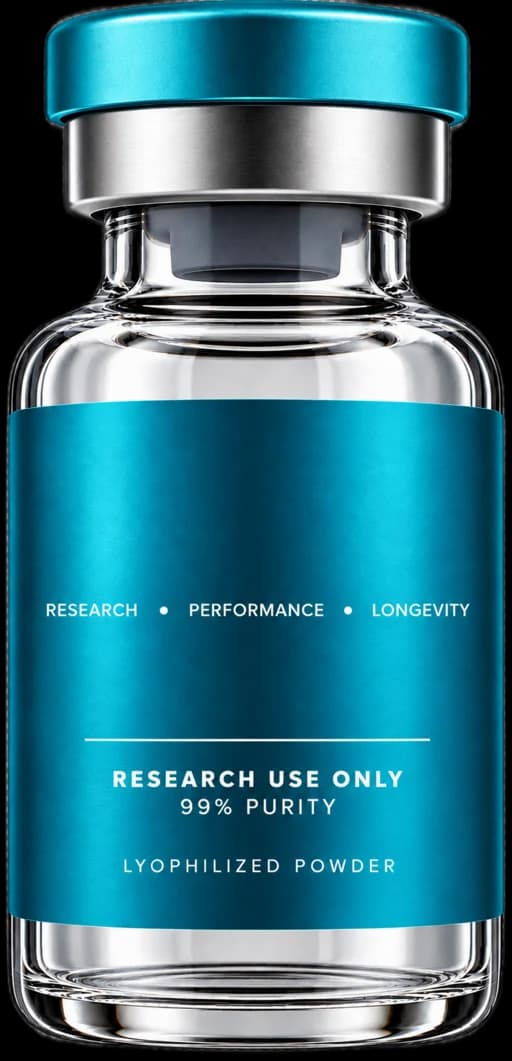
The Wolverine Stack is the classic healing blend — BPC-157 (10mg) and TB-500 (10mg) pre-mixed in a single 20mg vial. One reconstitution, one injection, two complementary mechanisms: preclinical (mostly rodent) research describes BPC-157 as promoting local angiogenesis and protecting against gastric and duodenal lesions in rats (Sikiric 1994), and thymosin beta-4 as promoting cell migration and wound repair (Malinda 1999). Community sources describe it as a commonly chosen blend for injury recovery; the pairing is widely used rather than clinically validated.
Research-context information only. The Wolverine stack is a research-peptide blend (containing BPC-157 and TB-500). Protocols, doses, and reactions reported below come from published research and self-reported community sources. This article reports what has been documented, not what should be done. Consult a licensed physician for personal medical decisions.
Short answer on the math: whether the blend is cheaper than buying 10mg of each peptide separately depends on the vendor. The lowest-priced blend vials undercut the two singles, while others cost about the same or more. Every blend vial means one injection instead of two. This guide covers how to verify a Wolverine vendor, what you should pay per milligram, how the blend compares to singles, and the red flags to avoid.
This is not a ranked vendor list — for that, see our Best Wolverine Stack Vendors comparison. This guide teaches you how to evaluate any blend vendor yourself.
Understanding Wolverine Stack Pricing
Wolverine is sold in two common sizes: 5mg/5mg (10mg total) and 10mg/10mg (20mg total). A few vendors stock a 5mg-only TB-500 variant, but 1:1 ratios are the standard. Pricing is driven by vial size, vendor markup, and testing investment — plus whether the vendor publishes per-component COAs.
Current Market Pricing (2026)
| Vial Size | Best For |
|---|---|
| 5mg / 5mg (10mg total) | Tolerance testing, short 4-week cycles |
| 10mg / 10mg (20mg total) | Standard 8-week protocol — best value |
| 5mg TB-500 only variants | Less common; not the true Wolverine blend |
The pattern is clear: the 20mg vial is the sweet spot. In live offers it is cheaper per milligram than the 10mg version, and it lasts the standard 8-week healing protocol with just 2 vials. The 10mg vial only makes sense for tolerance-testing or ultra-short cycles.
Blend vs Buying Singles (Cost Per Cycle)
Here is what the same peptide mass looks like each way:
| Peptide | Amount | Format |
|---|---|---|
| BPC-157 | 10mg | Single vial |
| TB-500 | 10mg | Single vial |
| Singles total | 20mg | Two vials, two reconstitutions |
| Wolverine 20mg vial | 20mg | One vial, one reconstitution |
| Savings | — | Varies by vendor (live offers below) |
The pattern: at the lowest-priced blend vendors, a Wolverine vial costs less than the two singles combined; at others, the blend costs about the same or more. The consistent gain is half the reconstitutions and half the injections over a standard 8-week cycle (2 vials).
Cost Per Week at Standard Doses
| Weekly Dose | Monthly Mass (30 days) | 10mg-total Vials per Month | 20mg-total Vials per Month |
|---|---|---|---|
| 3.5 mg/week (500 mcg/day) | 15 mg | 1.5 | 0.75 |
| 5.25 mg/week (750 mcg/day loading) | 22.5 mg | 2.25 | 1.1 |
| 7 mg/week (500 mcg 2x/day acute) | 30 mg | 3 | 1.5 |
For current vendor-specific pricing with exact $/mg breakdowns, see our Best Wolverine Stack Vendors comparison.
How to Verify Wolverine Stack Quality
Blend COAs are trickier than single-peptide COAs. A vendor can pass a "blend purity" test while having the ratios off, or while having one component at 80% purity dragging the other down. For Wolverine specifically, you need per-component testing — separate HPLC for BPC-157 and separate HPLC for TB-500.
What a Wolverine COA Should Include
Identity Confirmation (Per Component)
- Mass spectrometry confirming correct molecular weight for each:
- BPC-157: 1,419.55 Da
- TB-500: 4,963.44 Da
- Amino acid sequence verification for each
Purity Testing
- HPLC purity per component — look for 98%+ for each peptide individually
- Aggregate "blend purity" alone is not enough
Contamination Testing
- Endotoxin (LPS) levels — critical for any injectable
- Residual solvent analysis (acetonitrile, TFA)
- Heavy metals screening
How to Verify a COA Is Legitimate
Not all COAs are real. Here's how to verify:
-
Check the testing lab — Reputable labs include Janoshik Analytical, MZ Biolabs, and Colmaric Analyticals. Avoid vendors who only show "in-house" testing.
-
Verify on the lab's website — Janoshik COAs have a task number you can look up directly at janoshik.com. If the vendor won't provide a verifiable task number, that's a red flag.
-
Check the date — COAs should be recent (within 6 months). Old COAs may not represent the current batch.
-
Match the batch — The batch/lot number on the COA should match what's printed on your vial.
-
Demand per-component data — For a 2-peptide blend, any vendor unable to show separate HPLC for BPC-157 and TB-500 is cutting corners.
Red Flags to Avoid
- Single "blend purity" number with no per-component breakdown — the biggest blend-specific red flag
- No COA available — walk away immediately for any injectable research peptide
- Only in-house testing — self-reported purity is meaningless without independent verification
- Prices suspiciously low — a price far under what established, COA-testing vendors charge is a quality concern
- No endotoxin testing — injection safety issue, period
- Missing TB-500 mass spec — TB-500 is commonly mis-synthesized or substituted with thymosin beta-4 variants; verify the 4,963.44 Da molecular weight