Side-by-side evidence
Outcomes where both peptides have published data. Each cell carries two grades: clinical evidence (human-RCT depth for this specific outcome) and community evidence (real-world adoption). How we grade evidence.
| Outcome | BPC-157 | TB-500 |
|---|
| Tendon and ligament healing | Clinical:Weak Community:Strong Accelerated tendon-to-bone healing in rodent Achilles models; localized injection preferred. | Clinical:Preliminary Community:Moderate Limited tendon-specific rodent data; primarily systemic healing focus. |
| Gut and GI healing | Clinical:Weak Community:Strong Strong rodent evidence for ulcer healing, IBD models, and intestinal anastomosis recovery. | Clinical:Preliminary Community:Moderate Limited gut-specific data; primarily studied for systemic and cardiac repair. |
| Systemic / cardiac repair | Clinical:Preliminary Community:Strong Some cardioprotective signals in rodents but localized-injury data dominates. | Clinical:Weak Community:Moderate Post-MI cardiac repair and angiogenesis in rodent infarct models. |
| Human clinical evidence | Clinical:Preliminary Community:Strong Pliva ran a Phase 2 ulcerative colitis program (PL 14736) but never published the results in a peer-reviewed journal. | Clinical:Weak Community:Moderate RegeneRx ran multiple completed Phase 2 trials (RGN-259 dry eye, RGN-137 epidermolysis bullosa) — published in peer-reviewed journals; results were modest. |
The Two Most Popular Healing Peptides
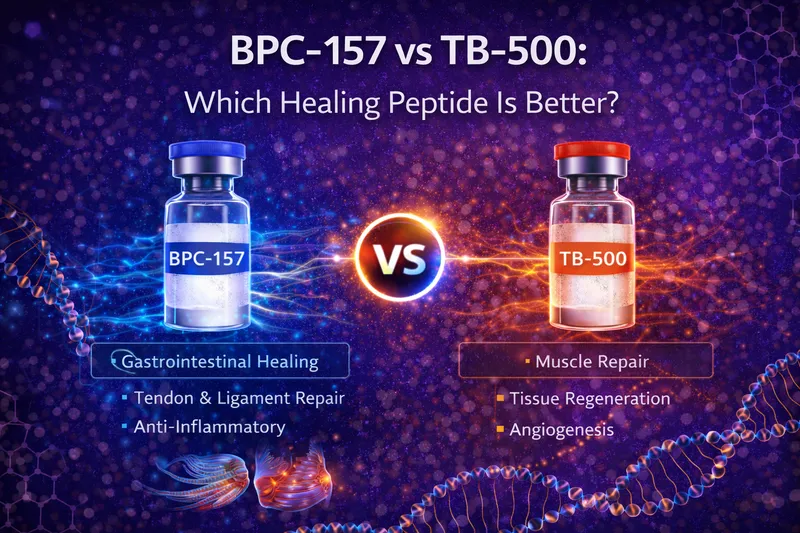
BPC-157 and TB-500 are the two most widely discussed healing peptides in research. Both promote tissue repair, but they work through completely different mechanisms — which is why many researchers study them together.
This comparison breaks down exactly how they differ and where each one has the strongest research support.
Mechanism of Action
BPC-157 (Body Protection Compound)
BPC-157 is a synthetic pentadecapeptide (15 amino acids) derived from a protective protein found in human gastric juice. Its mechanisms include:
- Nitric oxide modulation — regulates blood flow and inflammation at injury sites
- Growth factor upregulation — increases EGF, FGF, and VEGF expression
- Gut-brain axis signaling — systemic effects mediated through the GI tract
- Dopaminergic system interaction — neuroprotective properties
BPC-157 is unique among healing peptides because it works systemically through the gut, even when administered locally.
TB-500 (Thymosin Beta-4 Fragment)
TB-500 is a synthetic fragment (amino acids 17–23) of Thymosin Beta-4, the body's primary actin-sequestering peptide. Its mechanisms include:
- Actin polymerization — mobilizes cellular building blocks for tissue repair
- Cell migration — accelerates fibroblast and keratinocyte movement to injury sites
- Angiogenesis — promotes new blood vessel formation via VEGF upregulation
- Anti-inflammatory — reduces IL-1β and TNF-α at injury sites
TB-500's smaller molecular size gives it excellent tissue distribution throughout the body.
Quick Comparison Table
| Feature |
BPC-157 |
TB-500 |
| Size |
15 amino acids |
7 amino acids (active fragment) |
| Origin |
Derived from gastric juice protein |
Synthetic fragment of Thymosin Beta-4 |
| Core mechanism |
Nitric oxide + growth factors |
Actin mobilization + angiogenesis |
| Best studied for |
Gut healing, tendon, neuroprotection |
Muscle repair, cardiac, systemic healing |
| Administration |
Subcutaneous or oral (stable in GI tract) |
Subcutaneous |
| Oral bioavailability |
Yes — unique among peptides |
No |
| Systemic reach |
Via gut-brain axis |
Via small molecule diffusion |
| Typical dose |
250–500 mcg/day |
2–5 mg, 2x/week |
| Loading phase |
Not typically needed |
Often recommended |
Ready to buy? Compare verified vendors on our best BPC-157 sources page, or browse all coupon codes for up to 50% off.
Research Benefits Compared
Where BPC-157 Has Stronger Evidence
- Gut healing — BPC-157 was literally derived from gastric juice; it has the strongest evidence for GI repair including ulcers, IBD models, and gut barrier integrity
- Tendon-to-bone healing — multiple studies show accelerated tendon repair and reattachment
- Neuroprotection — interaction with dopaminergic and serotonergic systems
- Oral administration — BPC-157 survives stomach acid, making it the only healing peptide with oral bioavailability
Where TB-500 Has Stronger Evidence
- Cardiac tissue repair — parent molecule (TB-4) shown to activate epicardial progenitor cells in Nature publications
- Muscle regeneration — superior satellite cell activation and muscle fiber repair
- Wound healing — extensive dermal wound closure data
- Anti-fibrotic effects — reduces excessive scar tissue formation across multiple tissue types
- Corneal healing — significant clinical research in eye injury repair
Where Both Are Strong
- Tendon & ligament repair — both show significant benefit through different pathways
- Anti-inflammatory effects — both reduce pro-inflammatory cytokines
- Angiogenesis — both promote new blood vessel formation (different pathways)
Dosing Comparison
For research and educational discussion only.
BPC-157
| Protocol |
Dose |
Frequency |
Duration |
| Standard |
250–500 mcg |
Daily (subcutaneous) |
4–8 weeks |
| Oral |
500 mcg |
Daily |
4–8 weeks |
| Localized |
250 mcg |
Near injury site, daily |
4–6 weeks |
TB-500
| Protocol |
Dose |
Frequency |
Duration |
| Loading |
4–8 mg/week |
Divided 2x/week |
2–4 weeks |
| Maintenance |
2–4 mg/week |
1–2x/week |
4–8 weeks |
Side Effects & Safety
BPC-157
- Generally very well tolerated in research models
- Minimal reported side effects at standard doses
- No significant hormonal impact
- Theoretical concern: may promote angiogenesis in existing tumors (same as any pro-angiogenic compound)
TB-500
- Well tolerated; Phase I human trial of parent molecule (TB-4) showed no serious adverse events
- Mild injection site reactions possible
- Same theoretical angiogenesis/tumor concern as BPC-157
- Head rush or lightheadedness reported anecdotally at higher doses
Can You Stack BPC-157 and TB-500?
This is the most common question — and the answer from a mechanistic standpoint is yes, they are complementary rather than redundant:
- BPC-157 works through nitric oxide and growth factors (gut-mediated)
- TB-500 works through actin mobilization and cell migration (structural)
These are non-overlapping pathways, which is the theoretical basis for combining them. Many research protocols explore both peptides simultaneously for injury recovery.
A common research protocol:
- BPC-157: 250–500 mcg daily (subcutaneous near injury)
- TB-500: 2.5 mg twice weekly (subcutaneous)
- Duration: 4–8 weeks
The Bottom Line
| If your research focus is... |
Consider |
| Gut healing / GI repair |
BPC-157 (clear advantage) |
| Tendon injury |
Both — complementary mechanisms |
| Muscle recovery |
TB-500 (stronger satellite cell data) |
| Cardiac repair |
TB-500 / TB-4 (unique progenitor cell activation) |
| General systemic healing |
Both stacked |
| Neuroprotection |
BPC-157 (dopaminergic interaction) |
| Oral administration needed |
BPC-157 (only option) |
| Wound healing / anti-scarring |
TB-500 (stronger anti-fibrotic data) |
Neither peptide is universally "better" — they excel in different contexts and work through different mechanisms. The strongest approach for broad healing research may be combining both.
- TB-4 vs TB-500 — Full peptide vs synthetic fragment: which is better for healing?
- Thymosin Beta-4 Benefits — Complete deep dive into TB-4 mechanisms, dosing, and cardiac research
- Ipamorelin vs GHRP-2 vs GHRP-6 — If you're also exploring growth hormone peptides
- GHK-Cu — Another healing peptide often stacked with BPC-157 for skin and collagen repair
- LL-37 — Antimicrobial peptide with wound healing properties
This article is for educational and research purposes only. It is not medical advice.