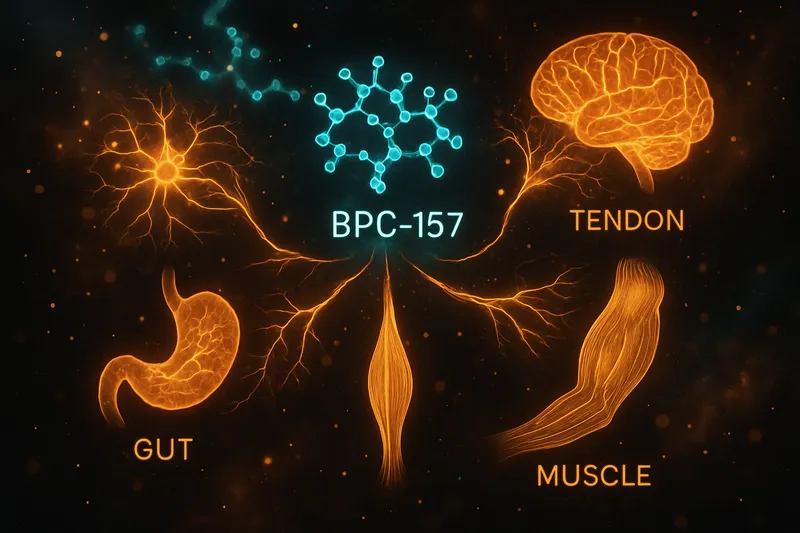
BPC-157 (Body Protection Compound-157) is a 15-amino-acid peptide derived from a protective protein found in human gastric juice. It's one of the most studied healing peptides in preclinical research — with over 100 published studies across gut, tendon, muscle, nerve, bone, and vascular injury models.
Research-context information only. BPC-157 is a research peptide. Protocols, doses, and reactions reported below come from published research and self-reported community sources. This article reports what has been documented, not what should be done. Consult a licensed physician for personal medical decisions.
This guide covers what the research actually shows. Every benefit is linked to published data. No hype, no miracle claims — just the science.
Table of Contents
- What Is BPC-157?
- Research Benefits Overview
- GI Healing
- Tendon & Ligament Repair
- Muscle Healing
- Neuroprotection
- Bone Healing
- Vascular & Cardiovascular Effects
- Anti-Inflammatory Mechanisms
- What BPC-157 Does NOT Do
- References
What Is BPC-157?
BPC-157 is a synthetic peptide based on a sequence found in human gastric juice — specifically a fragment of the protein known as Body Protection Compound. Unlike most peptides used in research, BPC-157 is stable in gastric acid, which is unusual for a peptide and relevant to its oral bioavailability in animal models (Sikiric et al., 2018).
Its mechanisms are broad. BPC-157 modulates the nitric oxide (NO) system, upregulates growth factor receptors (including VEGF, EGF, and their receptors), interacts with the dopaminergic system, and influences the FAK-paxillin pathway involved in cell migration and tissue remodeling (Seiwerth et al., 2018).
BPC-157 is distinct from structural repair peptides like TB-500 (which works primarily through actin remodeling) or immune-modulating peptides like Thymosin Alpha-1. Its strength is systemic cytoprotection — it protects and repairs tissue across multiple organ systems simultaneously.
For dosing protocols and reconstitution details, see our BPC-157 Dosing Guide.
Research Benefits Overview
| Research Area | Key Finding | Primary Source |
|---|---|---|
| Gastric ulcers | Accelerated healing, protection against NSAID damage | Sikiric et al., 1993 |
| Inflammatory bowel disease | Reduced inflammation and tissue damage in colitis models | Sikiric et al., 2003 |
| Achilles tendon | Accelerated tendon-to-bone healing | Chang et al., 2011 |
| MCL injury | Improved ligament repair and biomechanical strength | Chang et al., 2014 |
| Muscle crush injury | Faster functional recovery and reduced fibrosis | Novinscak et al., 2008 |
| Traumatic brain injury | Reduced brain edema and improved outcomes | Tudor et al., 2010 |
| Peripheral nerve | Accelerated nerve regeneration after transection | Gjurasin et al., 2010 |
| Bone fracture | Enhanced bone healing and callus formation | Krivic et al., 2006 |
| Vascular injury | Promoted angiogenesis and vessel repair | Hsieh et al., 2017 |
| Dopamine system | Counteracted dopaminergic agent effects | Sikiric et al., 2016 |
GI Healing
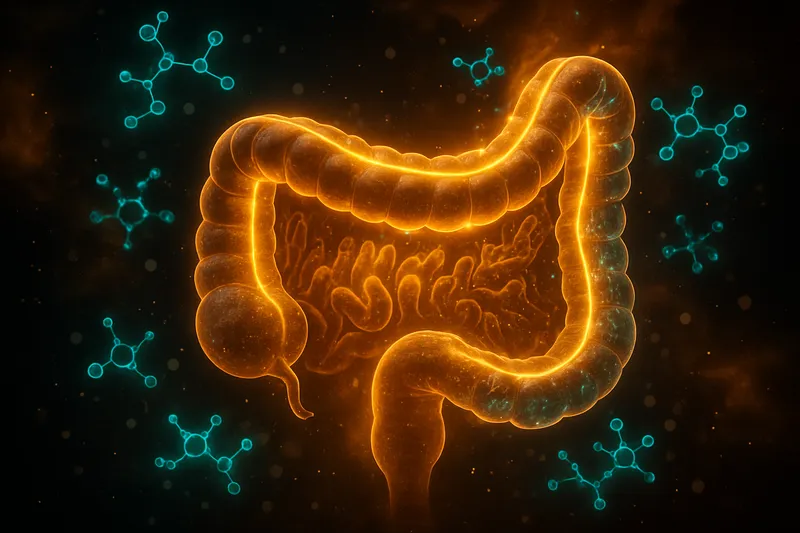
The gastrointestinal tract is where BPC-157 research began — and where the evidence is strongest. This makes sense: the peptide is derived from a gastric protein and remains stable in stomach acid.
Ulcer Healing
BPC-157 accelerates healing of gastric ulcers in multiple animal models. A foundational study by Sikiric et al. demonstrated that BPC-157 healed ethanol-induced, stress-induced, and cysteamine-induced ulcers in rats — even at very low doses. The peptide promoted mucosal repair through angiogenesis and granulation tissue formation (Sikiric et al., 1993).
Subsequent work showed BPC-157 also heals esophageal lesions and duodenal ulcers, extending its protective effect beyond the stomach lining (Sikiric et al., 2018).
Inflammatory Bowel Disease (IBD)
In experimental colitis models (the closest animal analog to Crohn's and ulcerative colitis), BPC-157 significantly reduced inflammatory infiltration, mucosal damage, and adhesion formation. A 2003 study showed BPC-157 prevented and reversed colitis-associated lesions in trinitrobenzene-induced IBD models (Sikiric et al., 2003).
A separate study demonstrated that BPC-157 also counteracted the inflammatory effects of colitis on the liver and other distant organs — suggesting a systemic cytoprotective effect rather than just local gut repair (Sikiric et al., 2011).
NSAID Gastroprotection
NSAIDs (ibuprofen, naproxen, diclofenac) are a leading cause of gastric damage. BPC-157 has been shown to both prevent and reverse NSAID-induced gastrointestinal lesions. In rats given chronic diclofenac, BPC-157 administration prevented ulcer formation and protected intestinal mucosa from damage (Sikiric et al., 2006).
This NSAID-protective effect is one of BPC-157's most replicated findings and is relevant to anyone using NSAIDs long-term.
Intestinal Permeability (Leaky Gut)
BPC-157 tightens intestinal barrier function in injury models. Research shows it restores epithelial integrity after damage from alcohol, NSAIDs, and surgical anastomosis. The mechanism involves upregulation of tight junction proteins and mucosal blood flow via nitric oxide modulation (Seiwerth et al., 2018).
In intestinal anastomosis models (surgical reconnection of bowel), BPC-157 improved healing strength and reduced anastomotic leakage — a critical surgical complication (Sikiric et al., 2018).
Tendon & Ligament Repair
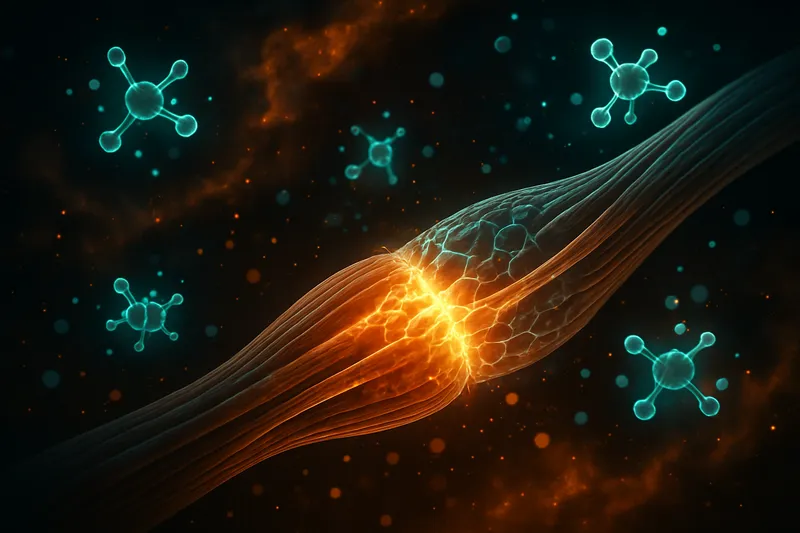
After GI healing, tendon and ligament repair is BPC-157's most-studied application. Tendons heal slowly due to poor blood supply — BPC-157 addresses this through VEGF-mediated angiogenesis and direct fibroblast activation.
Achilles Tendon
Chang et al. (2011) studied BPC-157 in a rat Achilles tendon-to-bone injury model. BPC-157 significantly accelerated healing, with treated animals showing improved tendon-bone junction integrity, better collagen fiber organization, and earlier return of biomechanical strength (Chang et al., 2011).
Medial Collateral Ligament (MCL)
In a 2014 follow-up, the same group demonstrated BPC-157's effect on MCL repair. Rats with surgically transected MCLs receiving BPC-157 showed significantly greater ligament strength, improved collagen alignment, and superior functional recovery compared to controls (Chang et al., 2014).
Rotator Cuff
Research on supraspinatus tendon detachment (the rotator cuff model) showed that BPC-157 applied locally at the repair site improved tendon-bone healing, increased load-to-failure strength, and promoted organized collagen deposition (Staresinic et al., 2006).
Mechanism in Tendon Repair
BPC-157 promotes tendon healing through:
- VEGF upregulation — new blood vessel formation in avascular tendon tissue
- Growth hormone receptor activation — enhanced expression of GH receptor in tendon fibroblasts (Chang et al., 2014)
- FAK-paxillin pathway — promotes fibroblast migration and adhesion to injury sites
- Collagen organization — drives ordered collagen deposition over disordered scar tissue
For complementary tendon healing through actin remodeling and angiogenesis, many researchers examine TB-500. See our BPC-157 vs TB-500 comparison for a detailed head-to-head analysis.
Muscle Healing
BPC-157 accelerates muscle recovery in crush injury, transection, and denervation models.
A study by Novinscak et al. (2008) demonstrated that BPC-157 significantly improved functional recovery in rats with quadriceps muscle crush injuries. Treated animals showed faster muscle fiber regeneration, reduced fibrosis, and earlier return to normal gait patterns (Novinscak et al., 2008).
In a muscle transection model, BPC-157 promoted reattachment and healing of completely severed muscle — an injury where healing typically fails without surgical intervention. The peptide enhanced myoblast proliferation and reduced the fibrotic scar that normally replaces functional muscle tissue (Staresinic et al., 2006).
BPC-157 also counteracts muscle wasting from corticosteroid use. In rats given systemic corticosteroids, BPC-157 administration prevented the typical muscle atrophy and weakness that accompanies chronic steroid exposure (Sikiric et al., 2018).
Ready to buy? Compare verified vendors on our best BPC-157 sources page, or browse all coupon codes for up to 50% off.